Beauty itself is very subjective, but the pursuit of it is not– either you think things should be beautiful whenever possible, or you don’t really care either way (or maybe believe spending money/time on beautifying things is just a waste). One of the many revolutions of the late 19th century was the notion that everyday objects could and should be beautiful, and that art should infuse even modest homes in ways large and small, from the wallpaper to chairs to teapots.
That way of thinking was a natural response to the mass-produced mayhem of the industrial revolution, and it still influences us today. It’s why we like Apple products–functional AND elegantly beautiful–and why stores as ubiquitous as Ikea feature furnishings that appeal to our sense of style.
That’s just one message lurking beneath the surface at the gorgeous exhibit on view at San Francisco’s Legion of Honor museum right now: The Cult of Beauty: The Victorian Avant-Garde 1860 – 1900. I highly recommend it. Not just for the delectable teapots by Christopher Dresser and wallpaper by William Morris, but also for the many waves of aesthetic movements that it covers, and the many approaches to beauty it encompasses. There are several must-see paintings by James McNeill Whistler, a proponent of “art for art’s sake” who really does show how “modern” artists in this period could be, and a number of over-the-top works by Dante Gabriel Rossetti and company–not my favorite artists but a force to be reckoned with for (at least) a whole generation.
 |
| Symphony in White, No. 1: The White Girl by James McNeill Whistler- This piece is featured in the exhibit. (from Wikipedia Commons) |
Another undercurrent of the show is the rise of sensual approaches to art that scandalized the establishment. Cited in many of the art descriptions is poet Algernon Charles Swinburne. The name brought back a flood of memories for me: I’d written one of my college research papers on some of his poems, comparing his work with that of Gerard Manley Hopkins. These two three-barreled men at first glance had very little in common, one being a “decadent” and sensualist (Swinburne) and the other a devout Jesuit (Hopkins)–but I tried to show how much they did share in a counter-intuitive way. I don’t normally quote myself, but here’s a little taste: “Both poets wrote about the divine and the body, and both believed that there were intimate links between the spiritual and the physical…” And in conclusion: “Both men took uniquely physical approaches to the spiritual, and both attempted to mingle the body and the soul in unique, redemptive philosophies.” Of course the core ideas of those philosophies were at either ends of the spectrum of their age–a Dorian Gray-like release through sensual materialism, vs. a martyr-imbued Catholicism.
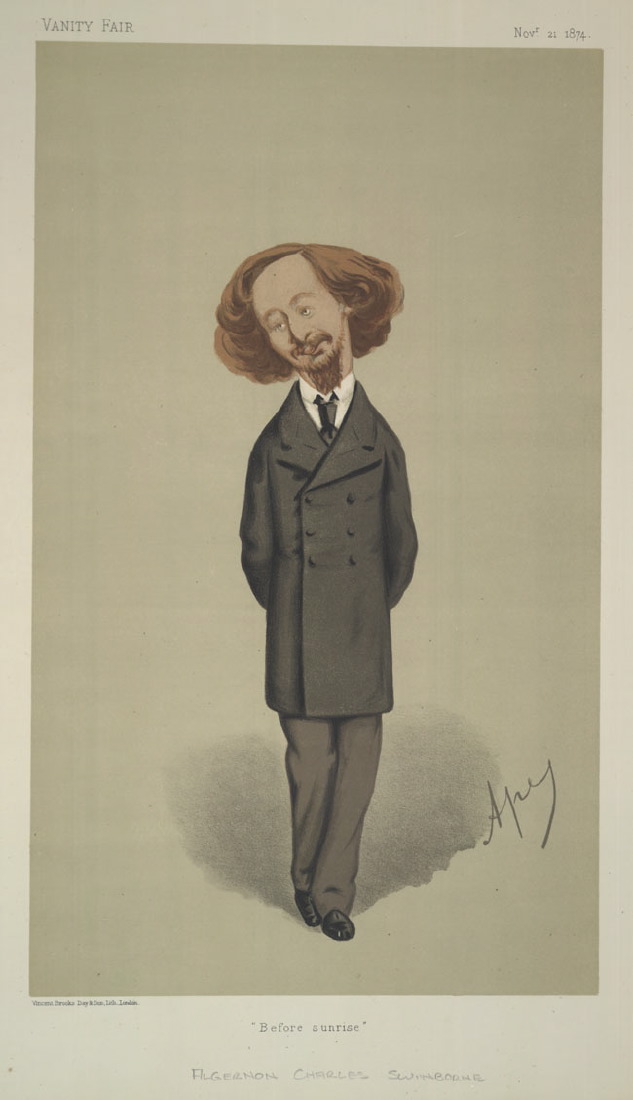 |
| Swinburne, in a contemporary caricature from Vanity Fair (from Wikipedia Commons) |
 |
| Aubrey Beardsley’s The Peacock Skirt (from Wikipedia Commons) |
 MeredithInk
Here's something to consider: the flip side of the focus on beauty. It's not always about art… what about people in everyday life? I think that it's what's inside of you that counts. But I really still think that art is important and adds something meaningful to our lives.
LikeLike