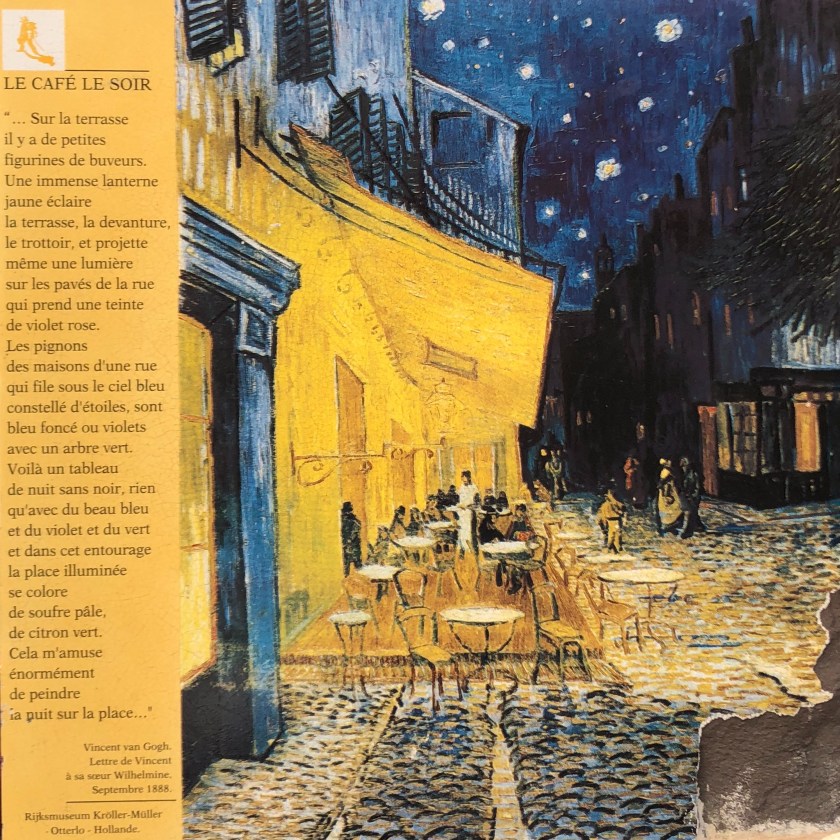
The Dutch painter Vincent Van Gogh’s dream of making the Southern French city of Arles an arts destination is finally becoming a reality. Now, a brand-new, Frank Gehry-designed, 184-foot tower dedicated to the arts is being constructed on the site of an old rail yard, where it seems to rise up out of nowhere when seen from afar.
We saw it at a distance this June from the vantage point of the Arles Roman amphitheater when we climbed to the top of the ancient stones, its shiny, twisty newness looking out across the horizon past old church steeples.

According to the Wall Street Journal, the silver structure is already covered in nearly 12,000 “microstressed” steel blocks. It’s set to open soon and is already hosting events. The driving force behind this structure is a contemporary Francophile with far more influence than Van Gogh ever achieved in his lifetime: A 62-year-old Swiss art patron, Maja Hoffmann, key funder for “Luma Arles.” A scion of the Hoffmann-La Roche pharmaceutical company, she has worked in the arts and film production for decades.
Nearby is the well-known Actes Sud, an independent publisher with a big reputation; its director, Françoise Nyssen, recently was tapped as the French cultural minister under President Emmanuel Macron.
And it is this old vs. new that defines the rest of Arles. Visiting the city, we sought out numerous Roman ruins as well as the still-in-use amphitheater. You really can’t help but see them even if you’re not looking—they are central and prominent in this small city.

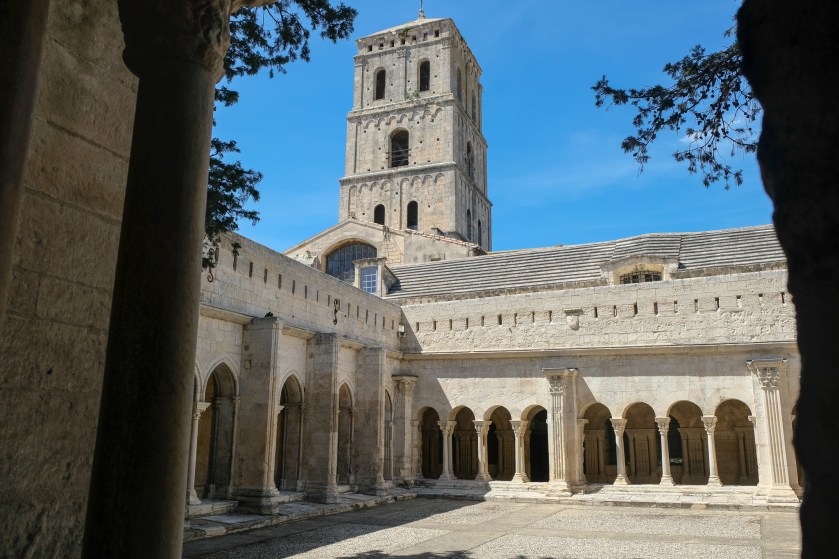
We stood on a Roman stage and looked out at Roman stadium seating (invented by the Greeks, but a staple of Roman bread and circuses). We saw old Roman marble columns being repurposed in medieval cloisters. A Turkish marble obelisk, also ancient, sits at the center of a main square.
A huge modern museum covers Arles’ ancient history extremely well, showcasing an ancient boat and many marble busts, as well as small-scale reproductions of what it was like in the really old days.
But there is a great deal of newness evident in Arles, too, and not just in the arts buildings. There’s also the contemporary photography emphasis, including an educational institution and a huge multi-site exhibit event that was happening just after our departure. (Our rental apartment featured some interestingly photographed female nudes in black-and-white, and a restaurant we ate at was displaying and selling artfully captured male semi-nudes.)
You’ll find numerous hip boutiques and trendy restaurants that dot side streets and places. A fun one: a store named after the mosquito, La Moustique, carrying all kinds of creative things with images of the hated insect (this one gave my older daughter PTSD from the 40+ mosquito bites she sustained at summer camp the year before… and her propensity to attract the critters wherever she goes).
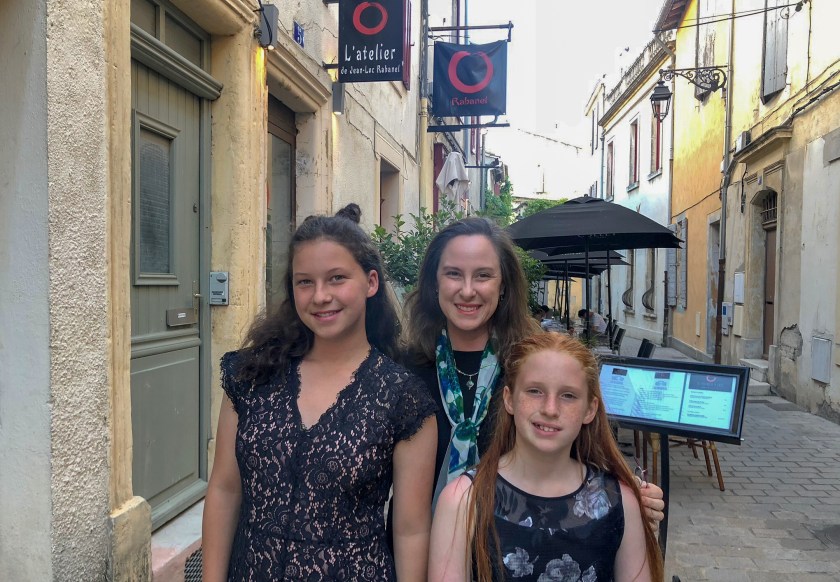
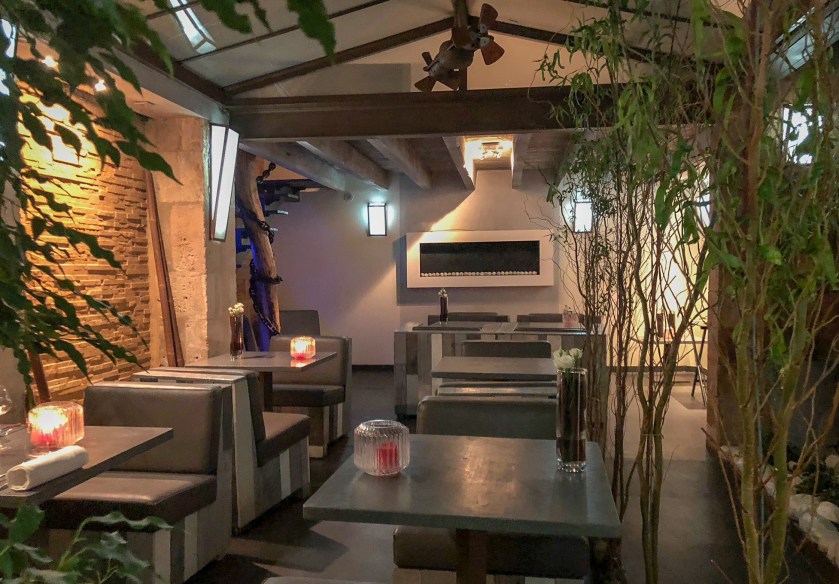
And one more innovative establishment to add to the list: a Michelin-starred restaurant, recommended by a colleague, that we were lucky enough to enjoy. The Atelier de Jean-Luc Rabanel is a retreat from the dusty streets into quite another world of upscale dining. We began in a bamboo-laced room with large comfy seats, consuming a cherry gazpacho with garlic sorbet and fish with anisette broth and tiny vegetables. The chef, Jean-Luc, stopped by to say hello. Even the number of breads on offer, around 6 kinds, amazed us (hint: skip the squid ink, try the chocolate).
As we enjoyed our first courses, we noticed other diners being whisked away—odd, we thought. Are they finished with their multicourse meal so soon?
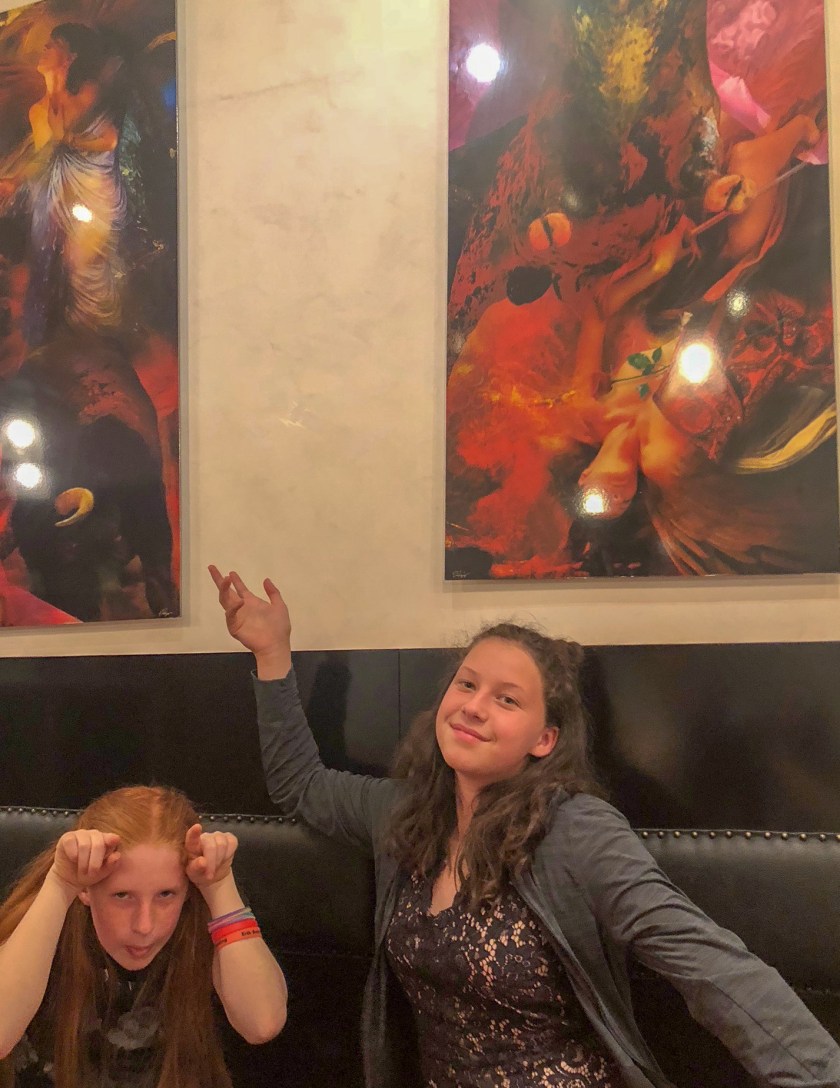
No. They (and we) were being moved to a separate dining room, one with fanciful photos of beautiful women in toreador outfits and the mysterious bulls they loved (OK, I might not have that exactly right, but it was something along those lines!).
We were indeed given a plate of “taureau,” a popular dish of “bull meat.” The Camargue marsh area around Arles is known for wild bulls. I don’t know much about their lives, but I picture them enjoying the southern sun until they enter the amphitheater for a bullfight (nonlethal in France these days) or they end up on our dinner plates (definitely lethal).
But despite its solid ancient roots and its artistic sparkle, Arles often feels like an out-of-the-way place. It’s a city that hasn’t been discovered yet by Uber drivers, for example. We did meet up with one, just by luck: he was from Marseilles, and normally worked there, but a passenger at the Marseilles airport had asked for a ride to Arles. Hence he was available to take us across town.
When I asked him why Arles is not serviced by ride sharing companies, the young, smooth-headed driver answered, “C’est une ville qui ne marche pas.” (It’s a city that doesn’t work… or pay.) I wondered what Arles’ famously Communist mayor would say to that?
In one odd way the city does “marche” (work) with enviable civility. It may seem obvious in this ancient city, but it’s important to note that the medieval streets in the old town are narrow—VERY narrow. These one-way passages can barely accommodate one medium-size car and often wind around blind corners. We found ourselves navigating through these streets in our rented Opel Zafira hatchback numerous times, with my husband (a fearless and experienced stick driver) at the wheel.
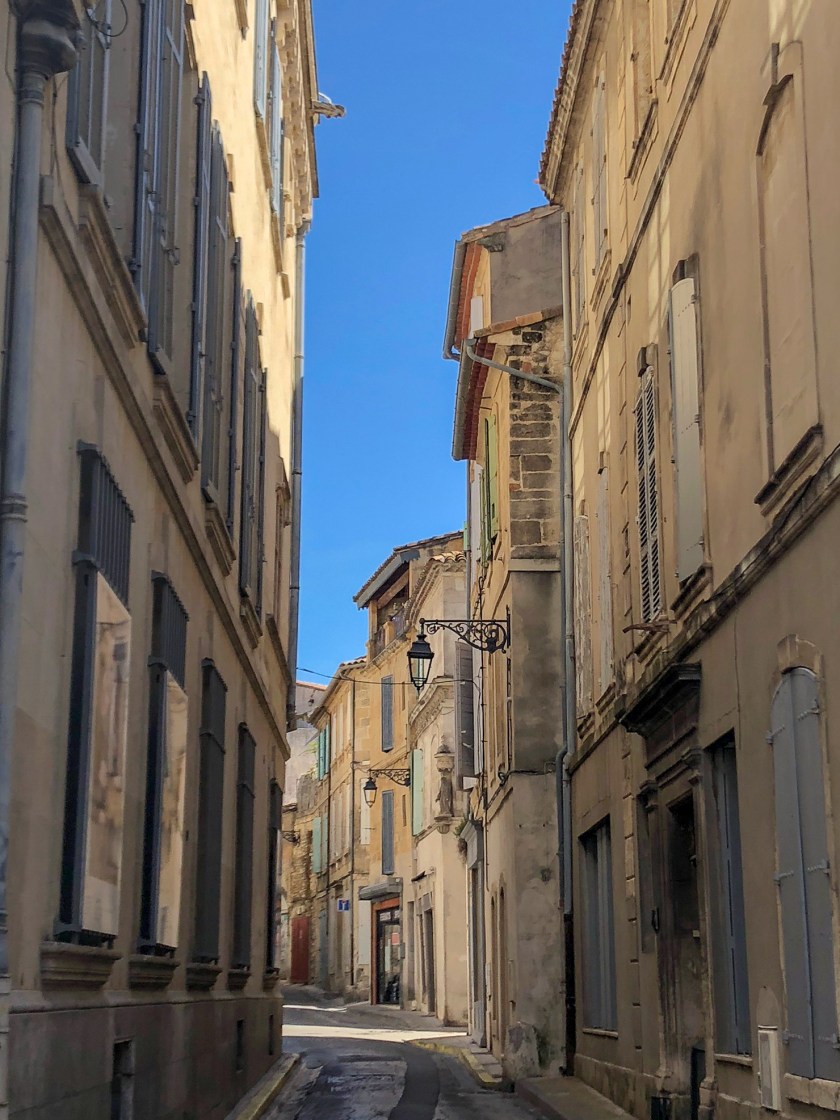
When we first arrived in the city after departing from an airy boulevard-like street near the train station in Aix-en-Provence (albeit torn up by construction), we were somewhat shocked. We approached the address our GPS gave us for our lodging. Was this tiny street really the road housing the furnished apartment building where we’d rented a place? There was just a sliver of sidewalk in front of the door with its old brass knocker, and no place to pull over without blocking all traffic behind us. I jumped out with my kids while my husband planned to circle the side streets and figure out a parking spot.
When we found the caretaker, a hip young woman, we asked where should we park to unload our luggage? Oh, just stop your car right in front of the door, she said, and unpack it there. Really? Won’t the drivers behind us be incensed while we block the street to remove 4 suitcases and various backpacks, tote bags, and briefcases?
No, they’ll be fine. That’s how we do it here. (Cue the raised eyebrows of four dubious Americans.)
Without any other option, we stopped and blocked the street while two adults and two kids unspooled all our stuff and deposited it behind the bright blue double doors of the apartment building.
Amazingly, cars stopped behind us, but no one got angry, no one yelled, and no one honked. Because they, too, have to frequently block streets themselves for similar purposes—and the Arlesians are willing to pay it forward.
That small gesture left a lasting impression of this vibrant, historic city.

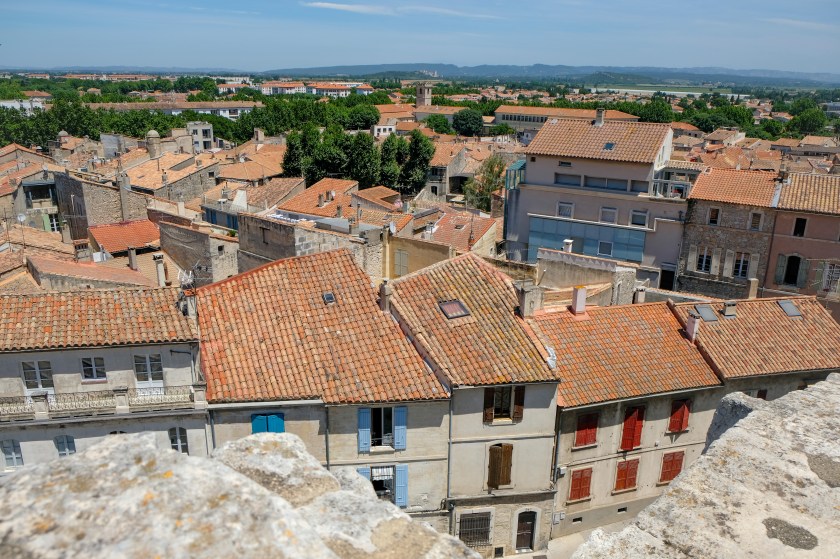 The French city of Arles is filled with contrasts—you could even say ironies.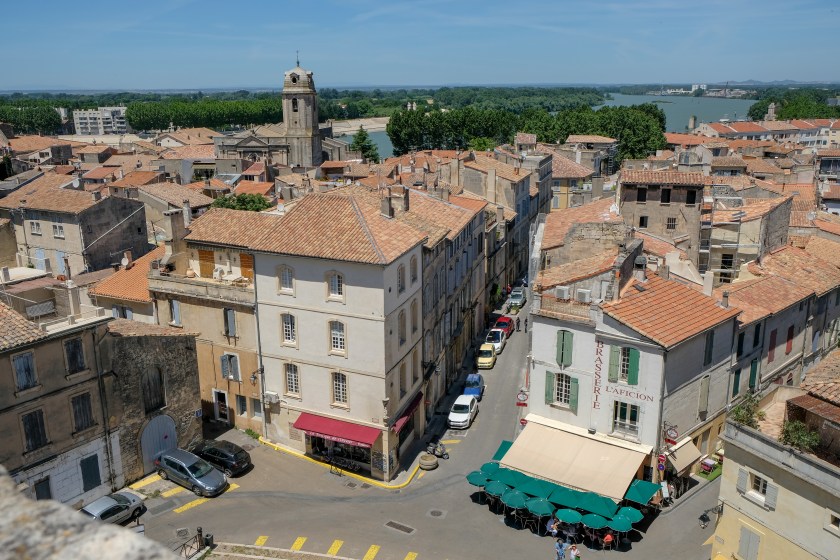




 MeredithInk