In the Room Where It Happened

IMG_1912

My younger daughter is obsessed with Hamiltonthe modern musical by Lin-Manuel Miranda about the “founding father without a father” Alexander Hamilton. Nonstop I hear it in my house, both in recordings and on her lips.

It started with my older daughter a couple years ago when she began middle school. She still loves the musical, but now my younger child is the most vocal super-fan, reciting the words rapid-fire on the playground with a few other Hamilton-adoring kids. She said she learned to sing better from this effort. She spent her special spending money ordering (with my help) two Hamilton t-shirts online. So yeah, it’s big around here.

There are some fringe benefits. I, too, love the mashup of hip-hop, R&B, pop, jazz, soul, big band, and show tunes-style music. Inspired by the show, I’ve learned more about foundation of the national bank. Both of my kids have aced a few history projects thanks to the energy generated by this musical track.

Now that my daughters have exposed me to enough of the musical that I’ve memorized my fair share of songs. I was lucky enough to see the show live recently. In “the room where it happened”—that is, in the theater —I was even more taken by its dramatic tangle of emotions, ideas, and historical characters, all set to pitch-perfect musical narration.

(Spoiler alert: if you haven’t listened to, seen, or read about Hamilton, and want to be surprised by the show, you may wish to stop here!)

Aaron Burr, the lawyer and politician who was Hamilton’s greatest rival, serves as the show’s narrator, in a sense. In a musical about Hamilton, we expect to hate Burr, but it’s far more nuanced.

We, the audience, come to understand Burr’s point of view. In “Wait for It,” Burr sings “I am the one thing in life I can control.” The whole song is about self-control in the face of whatever life throws at you. Burr, unlike the frenetic, constantly moving Hamilton, is willing to wait for success, to wait for his destiny. (Unfortunately that destiny left him known primarily as Hamilton’s killer and as the loser in a presidential race.)

Burr, like Hamilton, is also keenly aware that death is always lurking, unpredictably, for all of us, no matter our achievements or goodness:

“Death doesn’t discriminate
Between the sinners
And the saints
It takes and it takes and it takes
And we keep living anyway
We rise and we fall
And we break
And we make our mistakes…”

The vulnerability expressed in this song creates sympathy for a man that you might, otherwise, despise. Burr is thoughtful, emotionally vivid, and very human.

Hamilton, too, is a complex and highly sympathetic character whose biography drives the show forward. His tremendous productivity is motivated by his impending sense of death. “Why do you write like you’re running out of time?” asks Eliza Hamilton, Alexander’s wife. He’s fixated on the potential for failure before he’s done with his life’s work, before he can make the best use of “his shot.”

Hamilton puts it this way in “The Room Where It Happened”:

“God help and forgive me
I wanna build
Something that’s gonna
Outlive me…”

Hamilton’s character is summed up by the song “Not Throwing Away My Shot.” (Yes, there is a lot of irony there, given his final duel.) His key idea: “Just act.” We cannot wait for someone else to make things right. Instead, we need to take action, and stand up for what we care about. If we do, we might just achieve something lasting.

The script depicts Hamilton’s main critique of Burr as centered around Burr’s lack of core principles. From Hamilton’s perspective, Burr doesn’t “stand for” anything. Political games (and jealousy over lack of access to Washington and power more generally) seem to consume Burr.

Hamilton views Burr as an opportunist and supports another rival, Jefferson, for the presidency because “Jefferson has beliefs, Burr has none.” In the show’s version of events, this friction ultimately leads to the duo’s deadly last dispute.

Hamilton is also the story of a man who destroys himself because he lacks a specific virtue: Self-control.

He’s got courage and a keen sense of justice, but his wisdom fails him in a few important moments and he flairs out of control. The show demonstrates how his infamous extra-marital affair and angry sense of self-justification bring about his undoing in politics and in his personal life. Jefferson and Madison ask: “You ever seen somebody ruin his own life?”

Sucked in by bad passions and insults, guilty over his son’s demise after receiving his unfortunate advice, Hamilton is not able to recover the sense of honor that he has lost. He seems obsessed with proving his own righteousness to others, especially his fiercest rivals. With an almost suicidal intent, he enters the duel with Burr that he doesn’t survive.

Despite Hamilton’s ill-fated end, we can take away a few key ideas to live our own lives better.


  • “I’m not throwing away my shot” to pursue a meaningful life. 🔥
  • Act on your good intentions now—not in some distant future. 🏃🏻‍♀️ After all, we don’t know how much time is left, as Hamilton points out. “I imagine death so much it feels like a memory. When’s it going to get me?” he says. “We have to make this moment last.” We must fully engage in the present, and live out our principles as best we can.
  • And for a little more inspiration: Figure out what matters to you and why. Then stand up for what you think is right, and give your work your best effort—no matter what others say. To quote Hamilton once more: “You got skin in the game, you stay in the game. But you don’t get a win unless you play in the game. You get love for it, you get hate for it. You get nothing if you wait for it.” 💪


Paris Observations (Part 1)

DSCF0182-2

Paris is a very old place, and yet it has remained dynamic over the centuries. Every time I return to the City of Light, I see something new—some detail or quirk that I’d never noticed in numerous visits, or something that’s actually changed as generations of Parisians shift and evolve.

In this post, I’ll share the first part of my Paris observations from June 2018, when I visited with my husband and two daughters.

……….

As soon as I arrived in the heart of the city, I spotted a trend. Just about everyone—both men and women—sported fancy sneakers.

These are specific kinds of sneakers: Adidas, Nike, and New Balance, primarily. Only certain colors and styles that qualified as somewhat upscale. Gentrified sneakers, not so much running shoes as urban fashion sneakers. And compared with two years ago, it was a vast uptick.

My older daughter, wearing slightly beat-up Adidas Superstars (the kind popular at her school), fit right in, whereas in ages past, any sneakers-wearing tourist would have been immediately branded an American and pointed/laughed at. (When I was a student in Paris, I selected my footwear just as carefully as my clothing, to try to fit in. Leather oxfords, flats, or sandals seemed acceptable then.)

Screen Shot 2018-08-02 at 6.18.54 PM

Our first night in the city, my husband and daughter spent a couple hours watching feet go by the Place St. Michel as we sat at the Café St-Severin. Nearby, Saint Michael himself watched us from his mighty statue, wings spread and sword in hand, judging us all.

Screen Shot 2018-08-11 at 9.59.22 PM

Sneakers with wide culottes. Sneakers with dresses. Dodging puffs of smoke from  neighboring diners, my family members spied dozens of Adidas and Nikes coming in and out of the Metro stop.

Interesting that the French seem to have now embraced healthier approaches in some areas—wearing supportive footwear, drinking detox teas, enjoying spa treatments, and taking up running—while still continuing to smoke like chimneys.

……….

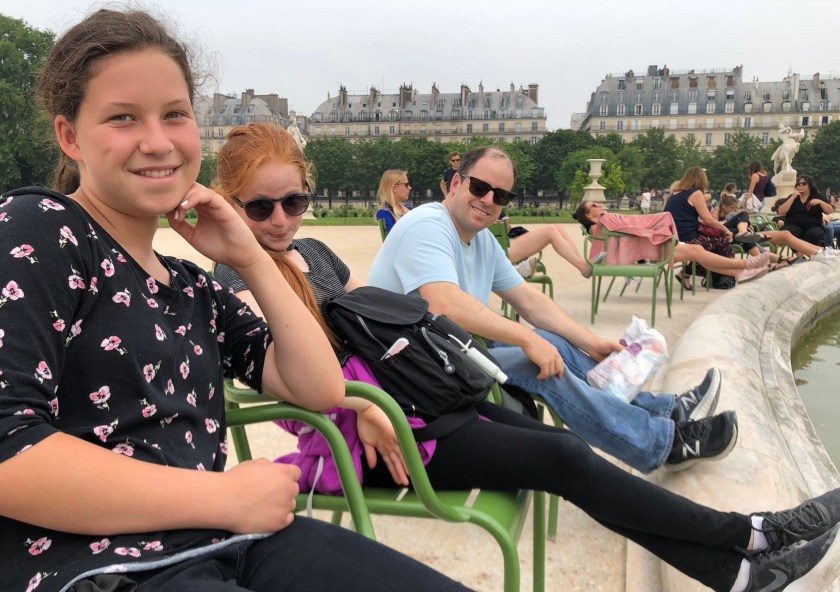
In Paris, we walked. And walked. And walked (in our well-designed footwear). And then we did what the French do, alongside tourists, in public parks—we propped our weary feet up on the edges of large fountains.

We did this at the Palais-Royal, the famous royal courtyard now populated with black-and-white columns, leafy trees, and a traditional round fountain basin encircled by metal chairs (this site was featured in Mission Impossible: Fallout, along with many other Paris locales).

Screen Shot 2018-08-11 at 10.23.39 PM.png

Later, in the Tuileries garden, by an even larger round pool, where many tourists sat to take in the view of the Louvre, statuary, and patches of (off-limit to feet) very green grass.

The weather was humid and damp, not exactly hot, but sticky. (It got cooler and much wetter as our Paris stay went on.) Given our jetlag and the longer-than-usual walks often fighting against the traffic waves of cars or of other tourists, it felt good to relax à la française.

img_5786-e1533017095808.jpg

……….

Have you ever been shamed into silence by a museum guard? My family has.

“Un peu de silence, s’il vous plaît,” alternated with “quiet, please” (same thing, in English, and less poetic-sounding). This happened in two places: the Orangerie museum was the first. It’s a gem located in the Tuileries garden, not far from the Place de la Concorde. The museum houses remarkable wrap-around waterlily paintings by Monet, who wanted the space to be a sanctuary for “working men” (and women, one hopes) far from the hustle and bustle, a place of rest and peace. I sort of got the point of honoring his wishes in the Monet rooms.

DSCF0292-2

But in other rooms, featuring riotous post-Impressionists, the same rule seems to hold—guards asked us to keep our voices down. And they did that too, with other patrons who had not yet learned to communicate with each other silently, in a special exhibit featuring the influence of Monet on contemporary New York artists.

Really? “New York modern art scene” and “silence” are a very unlikely combo, in my opinion.

The second spot of voice-shaming was the mausoleum in the basement of the Pantheon, where Voltaire, Rousseau, Victor Hugo, Alexandre Dumas, and many others are entombed and memorialized. I understand that it’s a solemn place.

But the female guard yelled “silence” and “quiet” through the labyrinth of echoing halls so vociferously that it was unsettling. Her voice created its own disturbance. (My younger daughter continued to invoke the hypocrisy of this approach long after.)

……….

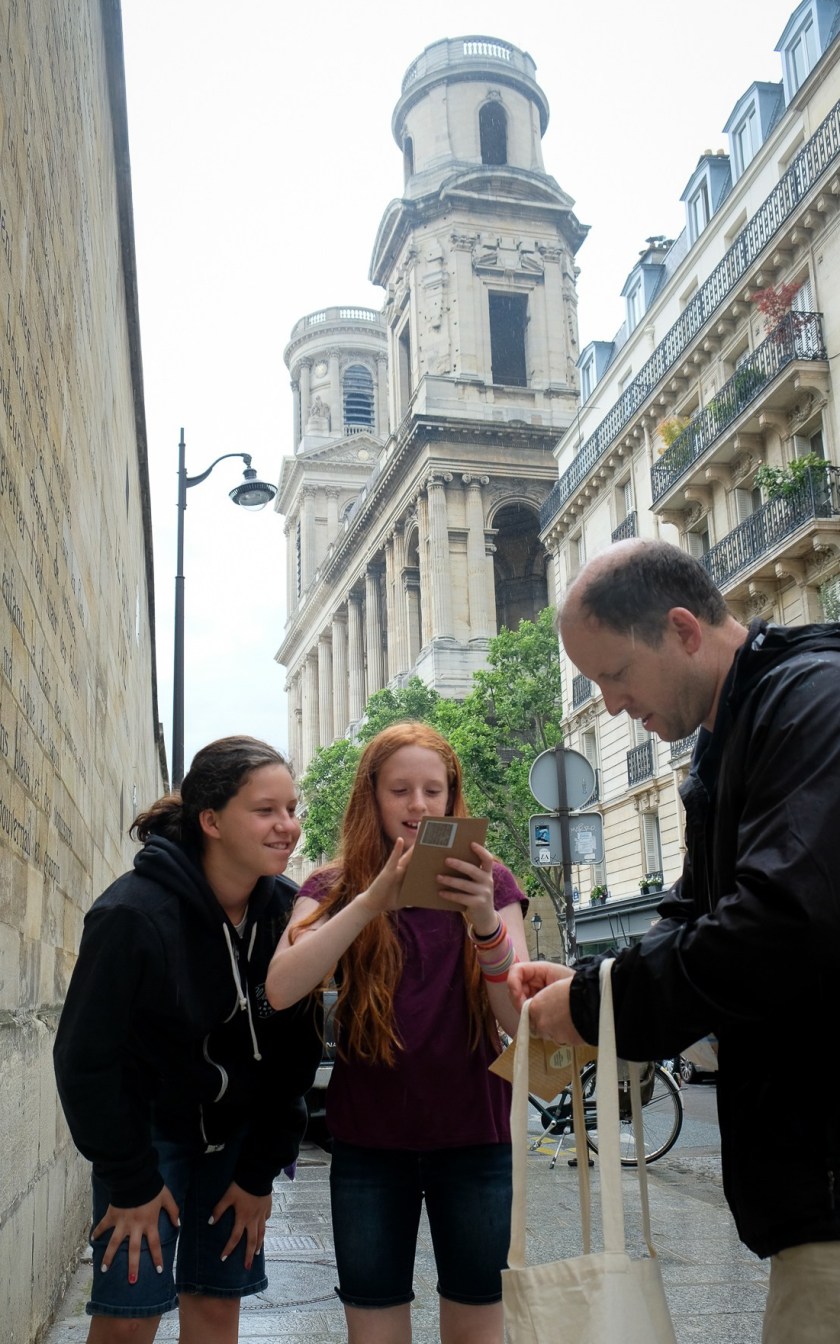
Also in Paris, we learned that if you design a treasure hunt, it’s best not to offer as clues “water” and “a ledge.”

The otherwise-clever City in My Bag Paris treasure hunt overlooked this notion.

DSCF0349-2

The experience as a whole was quite fun and we enjoyed the little gifts and treasures we could “unlock” along the way by solving location puzzles. However, one visual clue was a photo of water from above. In a city that 1) has a large river running right through it 2) has numerous (aforementioned) fountains everywhere and 3) is constantly being rained on and fairly frequently flooded, a picture of water does not really distinguish things much.

The ledge image, a different clue, was also kind of funny. It turns out that specific sizes of these items were used by the French as they converted to the metric system more than 200 years ago. Physical ledges, built into walls, told the citizens how long a meter was.

(Are we meant to picture people walking up to these ledges, taking their measurement, and then being forever informed of its size? Or did they have to go back over and over again to check their work?)

There’s one such ledge still in existence, and we think it’s somewhere near the Luxembourg gardens. The only problem was, what was happening near the gardens when we visited that day was an aggressive protest. A passerby told us it was striking railway workers, but with all the smoke bombs and torches and loud megaphones booming, as well as the armored swat teams ready to pounce, it was a bit hard to tell.

DSCF0401-2

The rest of the week, my younger daughter kept pointing to random ledges and asking, “Is this the ledge? Is it this one?”

dscf0407-2.jpg

……….

We may have made it onto the B roll of a French film.

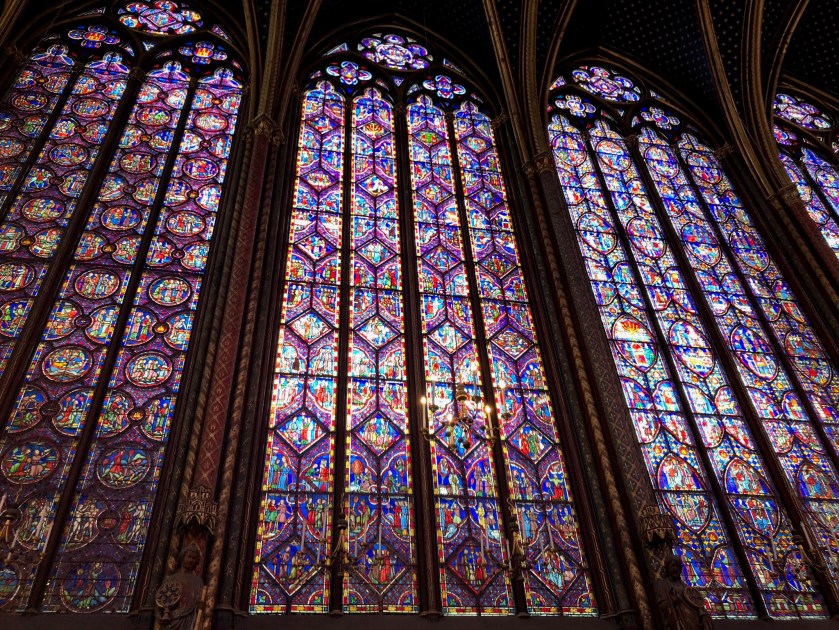
I can’t be sure. I really have no idea what they were recording with a professional-grade video camera when my kids and I visited Sainte Chapelle. We were admiring the gem-like windows, coated in brilliant red and blue stained glass. They surround you on all sides in the former royal chapel, an outstanding example of medieval artistry and modern cleaning/repair work.

IMG_6169

And then the woman in red appeared, and with her, an encourage. A large camera, a mic on a small boom, and some people hovering about trying to ensure a good shot.

At one point she ascended to the top of the pulpit area. And her camera person seemed to be seeking something else to shoot. Another person–the assistant director perhaps–pointed in our direction as we were carefully observing windows from the sidelines. The camera pointed our way for sometime. I could swear it moved with us.

I wanted to ask what they were filming, but they were intensely focused, and I didn’t find a good opportunity to interrupt their work.

So who knows? “Coming soon, on a screen far from you: Meredith and daughters touring Paris, hot on the heels of a mysterious woman in red…”

……….

Next time: Paris musings, part two. Please return for the sequel!

Less than perfect girls

Girls grow up wanting to be perfect. More than that: they think that they have to be perfect to be liked, admired, and successful.

The perfectly behaved young girl is an “angel.” The perfect daughter is a dream–she does what her parents ask and conforms to their wishes. The perfect student always follows her teachers instructions and is at the top of her class. She selects her activities and courses based on those she can perform perfectly, without flaws, deliberately choosing what she’s already best at doing. The perfect friend does what her friends want to do, agrees with their likes and dislikes, and does nice things for them. And underneath it all are very specific expectations about physical appearance, too. After all, the perfect girl (and later on the perfect woman) is pretty, fit, and makes an effort to look attractive.

This outward perfection–and the conformity to others’ wishes, instructions, needs, and desires about their behavior and their appearance–becomes a deep-seated obsession for girls, even at the subconscious level. Somehow girls–and women–feel they will only be loved, respected, and valued if they maintain this facade of being the perfect daughter, student, friend, and later girlfriend, wife, mother, employee, boss. (Note: The mechanism behind this “somehow” needs much more exploration in future posts.)

But while this perfectionism appears to win girls friends and fans, it is incredibly destructive in the long run. Our culture’s expectation that girls and women will behave, and look, a certain way, and that anything outside that is flawed, unwelcome, disruptive, even dangerous, creates an iron-clad box that traps them.

This is not the way to grow women with fresh ideas and plans. This is not the way to raise women leaders.

Leadership is about taking risks and putting your own ideas out there, thinking up original strategies, and–yes, dare I say it?–making mistakes. Errors. Even failing. If you try something outside the boundaries of “perfect” and compliant, rule-following behavior, you might just try something that doesn’t work. You might land face first on the pavement. You might even make enemies and people won’t like you.

What’s more, girls aren’t being encouraged to be true to their own minds and their own potential. Authenticity is rooted being unafraid to voice what you really think–not what your teachers, parents, friends, boyfriend, husband, boss, or social media followers think. It’s about creating your own style–including in your appearance.

So the “teacher’s pet” perfect girl won’t end up at the top of the class in life. Her training in the school of perfection has hampered her, enchained her. This is true behavior-wise and also in the realm of academics and career. And this is something I’ve experienced myself as I try to break away from “good girl” behaviors into taking on new, riskier challenges in my life.

How can we change this situation for girls today? It’s an urgent question to me as the mother of two daughters.

I know I’m not the only person worried about this problem. Numerous Ted talks, research studies, and books are tackling it from various points of view. I’m researching them now and hope to come up with a range of strategies, and then investigate how they are used now and how they could be expanded in the future.

I have come across an approach recently that’s worth exploring: design thinking.

The premise of design thinking is that you should just try things out. Don’t be afraid to fail the first time, because you can always try again. Most endeavors are an iterative process. You can give it a whirl, and if it doesn’t work out, tweak it, and give it another spin. This can apply to marketing products, to creating new inventions, to building an educational program, and even to how you move forward in your life and career, as the incredibly successful book and Stanford course Designing Your Life make clear.

Design thinking has started to make a difference in small ways is the ideas spread. I am eager to see how it could change education, especially for young girls. In my daughter’s third-grade class, her teacher encouraged kids to try out new ways of approaching projects and of doing group classwork. She told them, “It’s OK to try something and to make mistakes. You don’t have to do it right the first time.” The teacher informed students that she did not care if they spelled some words wrong in an essay… or if their handwriting wasn’t perfect. Keep going, keep trying, and keep working on it.

Being the imperfect human beings that we are, making a mistake doesn’t mean you are a bad person–it doesn’t mean you are a “failure.” And it certainly doesn’t mean you are anything less because you are less than perfect.


Fake It Until You Make It

What is “fake”–and does it matter? When it comes to the spaces in which we live, work, and play, it’s not a simple question. I pondered this idea as I strolled up the Ramblas-style avenue bisecting Santana Row, San Jose’s self-created shopping mecca.

The Row doubles as a “downtown” in a section of the city that’s a bit of a no-man’s land, in between Santa Clara and San Jose. In an area where before, there had only been a huge indoor mall with (obviously) no sense of street life, now there’s an island of capitalist and epicurean pleasure. Gucci, Burberry and Tesla Motors (typical car starting at $109,000) storefronts rub shoulders with sushi, steak, and other high-end fare. At one end, a movie theatre shows art films; on the other, just off the main drag, Crate and Barrel sells stuff you want because it’s pretty and the Container Store (next door) sells you big plastic bins to stash it in.

By all accounts, I should hate this place. It’s so fake. But I don’t react that way. In fact, it’s a ton of fun to walk around here, and I’m not the only fan—hundreds of local residents flock here on the weekends, especially at night, to experience our best shot at “street life” on this side of suburbia. People strut around in heels and designer jeans, looking ultra-cool even if a fair few are pushing baby strollers. It’s a scene, and you hear every language under the sun from passers-by.

I think Santana Row proves a theory that’s gotten a little higher in my book lately: the idea that “faking it” can change attitudes enough to create a new reality. This street was wholly conjured out of nothing, built to look like a Barcelona boulevard replete with fountains and lounge chairs. Just looking around, you start to imagine what life might be like if you actually could have a mid-day siesta away from work and other obligations just to hang out here. A lot of people object to how “fake” it is to fabricate street life this way. But they did build it, and people did come, and now it’s a real pleasure to walk in your brand-new shoes from bubble tea right to tapas to grab a Japanese birthday card while you wrap up a little gift of costume jewelry.

That is, if your wallet can stand it—this is a very expensive date.

But there are a few semi-bargains. Did I mention the Pinkberry? Yes, in the center aisle of the street, surrounded by comfy outdoor chairs, is my favorite frozen yogurt place, with huge chunks of mango and pineapple just waiting to be scooped into your cup…

Yes, I enjoy the fantasy. And maybe that’s because it’s all fantasy on some level. I’ll give you an example. Americans think of the Eiffel Tower as an unchanging symbol of the outrageous stylishness of the French, and a trip to Paris wouldn’t be complete without going up this steel shaft. But in fact, many of the French originally hated this “monstrosity” and couldn’t understand why it was built. It was new and ugly and, I’m sure, pretty silly looking. But now it’s an icon.

That’s just one small case in point. Even more importantly, I’ve learned over the years that you can actually change your feelings about things by faking it. Hang on—I’m not referring to what Elaine (of Seinfeld fame) called out as “fake, fake, fake, fake!” I’m talking about recent studies that show that just by smiling—no matter how you feel inside—you eventually start to feel happier.

So join me in our fake world and take a stroll on the Ramblas of San Jose. Now, if only they’d finish that pedestrian mall in Sunnyvale, surrounded by the huge Target and Macy’s….. then I could actually walk to a “downtown shopping experience” of my very own.