Growing up, I saw myself as a future expert. Someone who knew her stuff, who could exude wisdom and knowledge to others. It was a goal I worked on throughout junior high, high school, college, and graduate school.
It took a long, long time to figure out that I didn’t want to be defined as an expert. I’ll tell you a bit about how it happened, and where it took me.
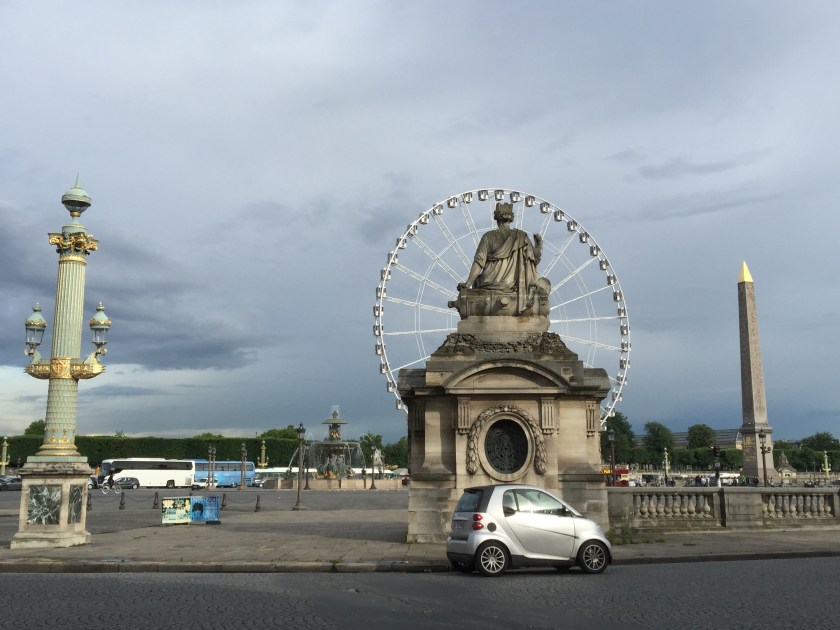
My steps along the expert path began early. As a young kid, I was lucky enough to travel from the Chicago area to Paris when I was turning seven. My parents got me excused from my first-grade class to accompany them and my younger sister on a once-in-a-lifetime journey, a chance for my dad to work with French colleagues and for the rest of us to experience life as Parisians. My mom and dad were both confirmed Francophiles and relished the idea of several weeks in the heart of the Latin Quarter, and they were brave enough to bring their two young daughters.
I was amazed by what I saw on that trip. Even as a child, I was blown away by the sheer force of so much art, history, architecture, culture, and a fascinating language—with echoes of English, but more melodic and rich to my ear.
When I got home, I started studying French. Combining my recent exposure with a natural affinity for language, I was able to copy a Parisian accent better than my classmates. My teachers heaped praise on me. I spent years striving to learn to speak authentic French so that I could truly experience a country steeped in art and history, could live like the students I saw roaming confidently through major French cities, sipping their tiny cups of coffee and flipping their long hair.
My parents took me back to France a few years later after receiving another invitation, and we explored Toulouse and the Southwest. The visit reenforced my love of the place.
As a student, I’d heard that there were opportunities to get back to France if I aced academic competitions—which I did. I made it through a competitive high school (a big public institution in suburbia) and into the college of my dreams. I focused on European history and literature, specifically that of France, and won grants to study in Paris during summers. I then went on to a year-long exchange scholarship stay to study in Paris again, and from there, attained my goal of being accepted into an excellent program for graduate studies. I was, I thought, living the intelligentsia dream.
But things had begun to fall apart. During my time studying in Paris, I struggled to find a research topic that I thought was worth pursuing. I knew it was an extraordinary opportunity to learn something, yet I flitted from class to class, hoping to uncover some hidden meaning there. The most memorable course I was in focused on the history of European government and law, and the only part I really recall was my effort to understand and translate the group discussion about a new European Union human rights law against dwarf tossing. Yes, you read that right—they were talking about whether it would be legally permissible to throw human beings for sport. I seemed to find myself in an alternate universe, and not just because I couldn’t always speak (or comprehend) the language.
I felt lost.
What exactly was I trying to become an expert in? As I trolled the libraries, I asked myself, how much could I really learn about European history as a modern American, hundreds of years after the period I studied? What could I actually glean from old documents molding in the archives… and who would care what I had to say about these distant events and people? An even larger question hovered: What was the point of this exercise?
It was beginning to dawn on me that inhabiting a purely academic sphere did not suit me. In the midst of my master’s program, I made a decision: I would leave academia to become a journalist and a writer. I would start over, putting aside my expertise in French and European history, and take on the goal of telling stories about the people around me, their passions, and their discoveries. I would learn from their lives and work, and maybe find ways to apply that learning to my own experience. Expert no more—except in the craft of writing itself.
My first paid writing job was at a legal newspaper. My second was at a weekly business and technology magazine (sadly, now defunct). My next roles were writing and editing for a foundation and then for Stanford University.
All the while, I wrote about people and topics far outside my own knowledge and experience, including: lawyers suing Microsoft; conserving wilderness through smart land deals; the legal rights of pets and their “guardians”; motorcycle personal injury work; margin lending; stock wealth on paper and its rapid disappearance in the economic downturn; ancient practices of making music from conch shells and worshipping jaguars; the Stanford prison experiment; how to secretly meet intelligence officers in Moscow and live to tell about it; bioengineering molecules to fight cancer; using light to activate the brain; crab migration and survival in changing climates; improving testing for tuberculosis; women’s volleyball star turns; a college quarterback returning from his Mormon mission; prehistoric horsemen who invaded Western Europe; the genius of Buckminster Fuller; and the ethics of self-driving cars. I talked to experts often, to tell stories about discoveries and ideas and human lives.
It was not just liberating—it felt true.
All around us are stories that are worth telling, innovations worth understanding, people worth knowing more deeply. I still carry a deep interest in European history, culture, and French language, and I treasure my French experiences and friends, but I’ve opened my world far beyond the limits of that expertise.
I am reminded of Shakespeare’s famous lines, voiced by Hamlet: “There are more things in heaven and earth, Horatio, than are dreamed of in your philosophy.” As a non-expert, I was free to explore all those things. And I still feel that way now.
Each day, learn a little. Each month, interview new people, write about something I’m not knowledgeable about. Each year, rediscover that there is more out there than I will ever know—feeling a sense of satisfaction not from expertise itself, but from the ability to ask good questions and find new answers.
 MeredithInk