Living the dream

Apple_IIe,_Google_NY_office_computer_museum.jpg
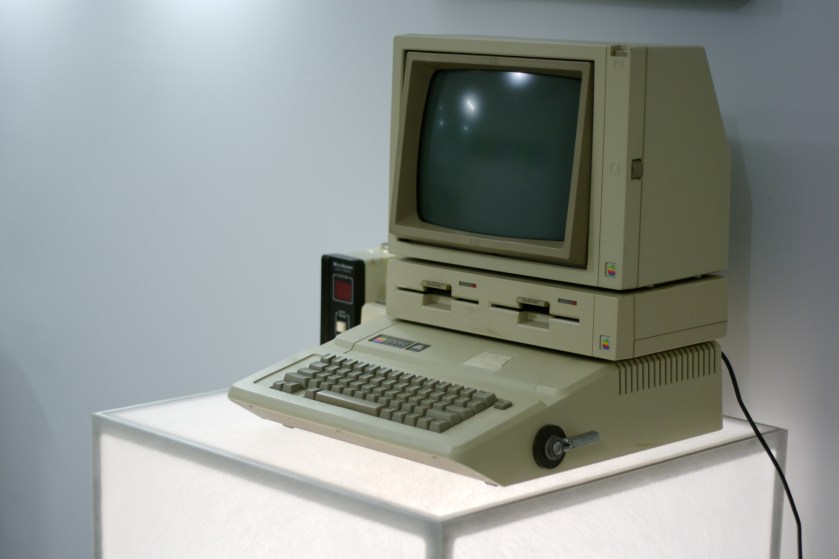
Apple IIe: The computer my dad brought home in 1983. (Photo by Marcin Wichary)

I always dreamed of becoming a writer and artist. And I did—just not exactly in the way I dreamed it. I am a writer professionally, focused in my job on science and technology. In my personal time, I write about modern life as a woman and mother, about what holds us back and what helps us thrive, and about philosophies of life going back to ancient times. My art projects are a combination of creative crafts and, when time permits, a range of other classic forms.

I’ve realized some of my dreams, and I have also worked hard to change my focus as my interests have evolved. I’ve tried to keep learning and growing, to build new strengths and keep the old.

Now, in some ways, it feels as if I’m returning home.

I find myself surrounded by science and technology researchers at my new job. Almost all have PhDs in engineering or computer science fields. They share many of the traits of focused intellectuals everywhere: a sense of purpose, a belief that theirs is the most important work, and a brainy concentration able to tune out all else.

This all feels very familiar to me. My dad was a mathematician. He was also a self-trained computer scientist, the first one who taught courses in that field at his university. He was a pioneer.

His interest in computers permeated some of my early memories. Like when he brought home our first computer, an Apple IIe, in 1983.

On a tiny desk in the corner of our dining room, the boxy black screen lit up with green characters when you typed on the keyboard. Magic! At the time, none of my friends had computers. It was cutting-edge.

At first, it seemed more like a science experiment than a useful tool. That was 1983, remember! What did you do with a computer back in those days if you weren’t a computer science researcher?

There were no GUI interfaces or desktop-computer video games or digital photos or social media or instant messaging. No icons, just typed-in text. My teachers did not require we word-process homework and there was no Internet (at least that I could access) to help us research assignments. None of my friends had email (although I believe Dad did, very early on).

In a search to make the computer fun, Dad soon found a “cool” piece of software (on a floppy disk that made horrible crunching sounds when you inserted it) for me and my sister.

It was an early text-based role-playing game that asked a series of yes or no questions. The player would type in answers in an effort to find hidden treasure deep within a castle. I never won. I got stuck at the well. And later I found myself standing in front of an armed knight. Was I armed too? I can’t remember. And I cannot ask my dad, because he died much too young in 1999.

At my new office, a woman I encountered at a social event said to me: “You’re living the dream! You’ll get to write about a lot of very cool things in that job.” She works for a different team and seemed quite taken with the innovative efforts of the researchers I’m surrounded with.

When I heard that, I felt that Fortuna was smiling down on me. Fate willing, as the ancient Stoic philosophers say, I will enjoy this work. Fate willing, I will teach my daughters that you can change and grow what you do professionally and land in a good place.

And no matter what may come, I will continue to feel a connection to my father and his groundbreaking work whenever I turn on a computer.

Future Dads: Start Worrying Now

When I was expecting both my children, I spent a lot of time worrying. The fears began long before I even became pregnant. Like many mothers-to-be, I was tortured with concerns, and my doctor asked me a lot of the same questions—making me fret even more. Did I have genetic failings that I could pass down? Would my age affect my baby?  Was my weight OK? Did I take the right vitamins? Did I get enough exercise? How about my stress level—would my cortisones harm a baby? Was it bad that I ate fish and soft cheeses? Did my daily commute expose me to harmful fumes, which could affect a fetus?

After I was lucky enough to make it through with healthy babies, I tried to put away these fears. But recently I’ve been following scientific studies showing that the power of epigenetics on human life. This brand of genetic research focuses on the idea that circumstances around us (including stress, diet, toxin exposure) can turn genes on and off, potentially affecting an individual for an entire lifetime. In fact, once genes are turned on, researchers believe, they can actually stay that way not only for one person’s life but for future generations as well. One of the outcomes of that work is the idea that a mother’s exposures to toxins could have damaging effects far, far into the future, harming not only her own child but her grandchildren or great-grandchildren. A mother’s worries could carry on for centuries!

So imagine my interest—and, frankly, my sense of welcome surprise—when I read about new studies showing that the father’s genetic material actually has a large effect on the child’s mental and cognitive health. Indeed, disorders including autism, schizophrenia, and bipolar disorder can be passed down by mutations in fathers’ genes.

A recent study followed Icelandic men as they aged. The results were that the age of the father has a direct bearing on the number of genetic flaws passed down to his children. So the dad who fathered a child at 36 passed on twice as many genetic mutations than the one who fathered a child at age 20, and it just went up from there. The Nature article summarizing the work quotes a researcher saying, “The older we are as fathers, the more likely we will pass on our mutations.”

Fathers bequeathed almost four times as many new mutations as mothers. So while we like to talk about women’s “biological clocks,” it is clear now that aging reproductive systems are not just a women’s problem. And just as importantly, epigenetic studies distribute the responsibility for future disease to men, too. They have highlighted the dad’s genetic influence: for example, a Swedish study showed that a man’s diet during pre-puberty could affect heart disease and diabetes levels in both his sons and his grandsons.

I wonder if this new information could change the dynamic for men. Will they question themselves before trying to start late-in-life families, or second families, just as women do? Will they take the measure of their own genetic content more closely before trying for a baby? Will doctors start questioning future fathers about their age and health during prenatal visits? Dads, now it’s your turn to worry, too.

Are We Missing Something? Online Research’s Role in Writing and Editing

Is the Internet “making us stupid?” That question, asked of Google and the entirety of the web, was the focus of a recent Atlantic Monthly article that has stirred a lot of buzz.

I don’t think “stupid” is the right word, but I do think the Net is having a huge impact on the way writers and editors work today. And we should take a step back to look at how that change affects our written product.

I began my writing and editing career when the Net was really taking off as a source of information, not just a means of marketing or a techie meeting ground. More and more publications were going online. Amateur websites about obscure topics were being created on a daily basis, then overhauled by experts who added accuracy and legitimacy to their information.

Today’s writers can glean much of what they need from the web without ever setting foot in a library.

It’s fun detective work, trolling the web for that oddball quote in a trade publication, or uncovering a debate you didn’t know existed, or finding out your profile subject is a champion Frisbee-thrower.

But my academic experience doing research in the field of European history—reading primary sources in the bowels of an old library, visiting foreign book collections and archives, scrolling through reams of microfilm and fiche, straining to read handwritten notations, wearing special gloves to handle 200-year-old cartoons—taught me how to dig beneath the surface of things.

Scrolling through the Net doesn’t always yield a full picture. Not everything is there, especially if it’s more than a few years old, or requires more than a few paragraphs of explanation. You have to ask yourself what you’re not seeing online, and you have to go to the source—whether that’s a research paper, a book that references older books, and those books too, or the people at the heart of an idea or project.

Net-only researchers are missing out. There are decades’ worth—dare I say centuries’ worth—of relevant information crammed away in libraries’ troves of books, magazines, microfilms, special collections, and more. Some of this is starting to crop up online through sources like Google News Archive, but many, many gaps remain.

Writing that exclusively relies on the Internet without any other sources of information reminds me of those book reviews some students wrote in high school after watching the movie version of the book—or just reading the Cliff’s notes.

So if a research topic piques your interest, go to the page, not just the screen. And then go to the person, too—that’s still the most important source. (One reason I did not become an academic historian was that my interest in learning from other people, rather than just paper sources, was so strong.)

One more thought: Another side effect of the Net is that it may someday impede research into our own era. The Internet may have replaced much of our culture’s paper ephemera—the broadsides and fliers of old, and increasingly, the muckraking and the opinion-shaping, will now live on computers. And that will certain be a barrier if our servers and hard drives crash without leaving backups behind. And what’s more, that will be a problem for future historians unable to track down hard copies of just about anything.