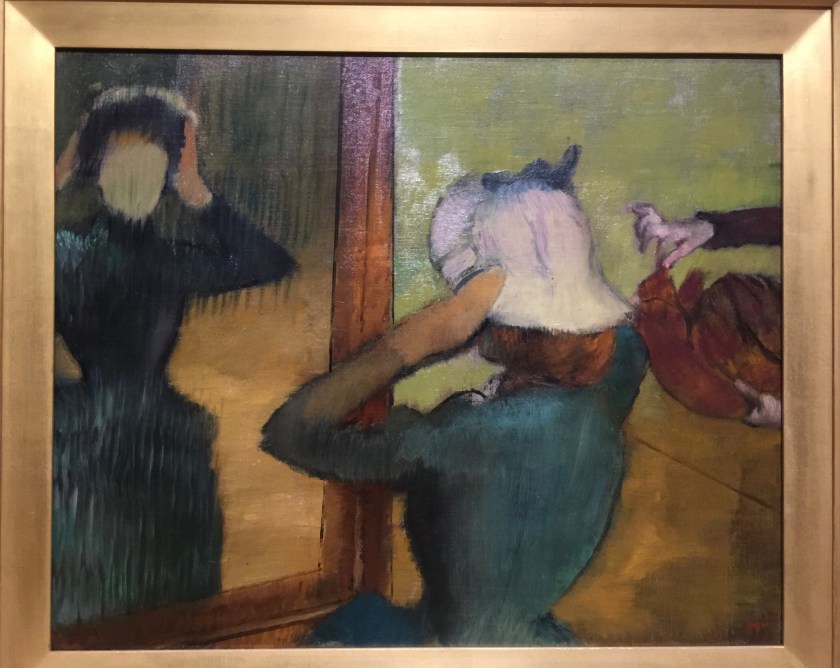
The magic of new clothes

IMG_4115
The magic of a new hat as depicted by Edgar Degas. Here, the hat seems to remake its wearer, whose face is a blank slate.

Every year, as the school year gets underway and fall approaches, something happens me: I begin to want new clothes.

This year the feeling is bolstered by my own new endeavors. More on that in a moment. But first, back to school. I have two school-age daughters (one elementary, the other middle school). By the end of summer, their bedraggled t-shirts, shorts, and capris need a refresh. Returning to class, they will encounter new teachers and meet new friends and see old ones they’ve missed all summer, so it’s natural for them to want to look decent. My husband and I often take them shopping for a few new things.

We just had the first day of school last week, and my older daughter selected a white sleeveless button down blouse with a loose black bow tie. My younger daughter found a creative combination, a blue lacy shirt with a mint green gauzy skirt. Snazzy in both cases, and their own ideas of what looked good. A bit out of the ordinary, and a little magic.

For me, when a new beginning rolls around, it feels like the right time for the magic of new clothes. The magic, at its core, is about the way we imagine our near-future selves. We picture ourselves in a new place, with new people, new environment—”a new you,” as they say in TV commercials. Somehow having a set of fresh clothes seems to solidify this image and ensure success.

During these imaginings, the mental picture I create in my head shows me looking far more glamorous that I do in reality, and that’s a good thing. It boosts my confidence and makes me feel capable of trying something new—in my case, a job as a science writer and editor working with an innovative research lab.

Of course, when you embark on adding to your wardrobe, you don’t need to go overboard; nothing I wear is designer or custom or even sold at full retail price. I seek out sales. But a few fresh things can make a subtle psychological difference, whether from the dollar store or a high-end department store.

So as much as I adore the wisdom of Henry David Thoreau, I disagree with his famous passage about clothes in Walden:

“I say, beware of all enterprises that require new clothes, and not rather a new wearer of clothes. If there is not a new man, how can the new clothes be made to fit? If you have any enterprise before you, try it in your old clothes. All men want, not something to do with, but something to do, or rather something to be. Perhaps we should never procure a new suit, however ragged or dirty the old, until we have so conducted, so enterprised or sailed in some way, that we feel like new men in the old…”

Notice the operative use of “man” and “men” here—indicative of another era when it would seem that only males attempted new things and only in suits.

We have more freedom today, and let’s revel in it. Maybe our (occasional) new outfits can help us feel like new women and new men as we transform from within, an appealing suit not of gabardine but of armor to strengthen us for “any enterprise.” An outer indication that we can be something of value. Like the super heroes we celebrate in popular culture, we too can don a new outer layer to perform feats that require energy and creativity.

So I say long live the magic of (a few) new clothes.
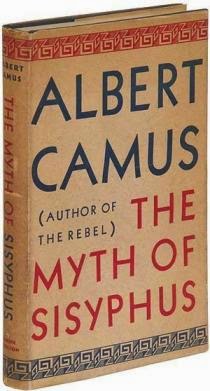
The Laundry of Sisyphus

School can be boring, my 9-year-old daughter reminded me recently. “You do the same thing over and over again, even if you already know how to do it,” she said. You have no choice. It just has to be done.

“Yes. That’s tedious,” I said, in response, which started a conversation about the meaning of the word. “Tedious is something dull and repetitive, something that bores you to tears and that seems to go on forever—but usually, you just have to do it anyway, again and again,” I explained.

“Oh yes, like that Ancient Greek story about the man who had to push the big rock up the hill every day, and then it falls down and he has to do it over again!” she cried.

“You mean Sisyphus.” I thought for a moment. Sisyphus was a king punished by the Greek gods for his offenses (which may have included temporarily chaining up Death, preventing him from taking further victims). His burden in the underworld? To forever push a boulder up a mountain, and then watch it fall to the bottom, only to begin again the next day.

It’s one of my favorite myths, not least because it was explored by French existentialist writer Albert Camus. Camus called Sisyphus “the absurd hero”—admiring his acceptance of his burden and his scorn of the gods as he tenaciously pursued his never-ending task.

I love this story. In a way, it captures so much of adult life. Especially the parts we did not really think about as kids when we fantasized about the freedom and excitement of growing up.

Take laundry. I know I should be thankful that I am probably among a pretty small percentage worldwide who has an excellent electronic setup in my own home, able to complete numerous loads a day. Yet I dread doing the laundry just because of the repetition of putting it in, taking it out, putting it into the dryer, taking it out, folding it (the most tedious and therefore the most neglected part of this task) and putting it away. It isn’t difficult; it isn’t challenging. It’s just time-consuming and tedious, and for a family of four, it has to be done frequently if not daily.

The Laundry of Sisyphus.

I had forgotten that this myth also applies to children’s lives at school. Take timed math tests. Or spelling quizzes. Or all sorts of busy-work that our children do in order to prepare for standardized tests or school-wide tests or district tests or just class tests. It can feel never-ending. Maybe that’s why growing up seems so cool to kids sometimes. Not only the freedom but also the variety appeals.

The frequent tediousness of school is one reason why I don’t send my daughters to “school after school.” We live in Silicon Valley, an area of highly-educated parents and their heavily programmed children. Many attend academic classes after the regular schoolday ends, complete with more worksheets, assessments, tests.

Not here. My kids are outside jumping on the trampoline, just about the least tedious type of repetition there is for a child. Every bounce produces a fresh movement, a new sensation, a unique jump or flip. A weightless feeling that lends itself to imagination and creative chaos.

Or practicing an instrument. That’s another repetition that can be beautiful. It leads to improvement and learning, and to breakthroughs in creativity that happen every once in a while.

This just shows what we should remember while working away at the laundry: Not all repetition is bad. Some of it can transform us.

And perhaps we could adopt a philosophical, or even a Zen-style approach to laundry, etc. We could find a way to meditate as we fold, to relax as we carry, to reflect as we straighten and put away.

Sisyphus would approve. And so would Camus. He ends his famous essay about the Greek myth this way:  For Sisyphus, “each atom of that stone, each mineral flake of that night-filled mountain, in itself forms a world. The struggle itself toward the heights is enough to fill a man’s heart. One must imagine Sisyphus happy.