The magic of new clothes

IMG_4115
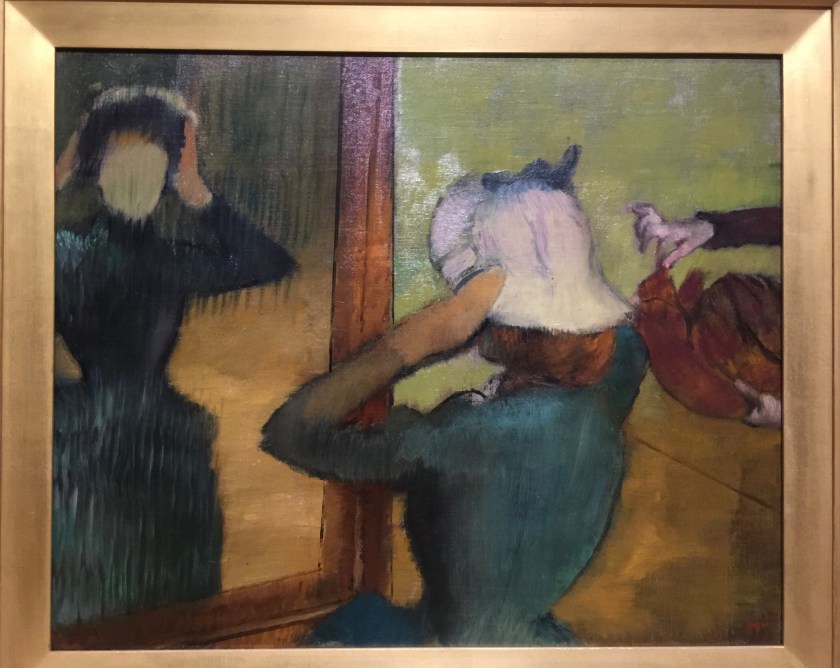
The magic of a new hat as depicted by Edgar Degas. Here, the hat seems to remake its wearer, whose face is a blank slate.

Every year, as the school year gets underway and fall approaches, something happens me: I begin to want new clothes.

This year the feeling is bolstered by my own new endeavors. More on that in a moment. But first, back to school. I have two school-age daughters (one elementary, the other middle school). By the end of summer, their bedraggled t-shirts, shorts, and capris need a refresh. Returning to class, they will encounter new teachers and meet new friends and see old ones they’ve missed all summer, so it’s natural for them to want to look decent. My husband and I often take them shopping for a few new things.

We just had the first day of school last week, and my older daughter selected a white sleeveless button down blouse with a loose black bow tie. My younger daughter found a creative combination, a blue lacy shirt with a mint green gauzy skirt. Snazzy in both cases, and their own ideas of what looked good. A bit out of the ordinary, and a little magic.

For me, when a new beginning rolls around, it feels like the right time for the magic of new clothes. The magic, at its core, is about the way we imagine our near-future selves. We picture ourselves in a new place, with new people, new environment—”a new you,” as they say in TV commercials. Somehow having a set of fresh clothes seems to solidify this image and ensure success.

During these imaginings, the mental picture I create in my head shows me looking far more glamorous that I do in reality, and that’s a good thing. It boosts my confidence and makes me feel capable of trying something new—in my case, a job as a science writer and editor working with an innovative research lab.

Of course, when you embark on adding to your wardrobe, you don’t need to go overboard; nothing I wear is designer or custom or even sold at full retail price. I seek out sales. But a few fresh things can make a subtle psychological difference, whether from the dollar store or a high-end department store.

So as much as I adore the wisdom of Henry David Thoreau, I disagree with his famous passage about clothes in Walden:

“I say, beware of all enterprises that require new clothes, and not rather a new wearer of clothes. If there is not a new man, how can the new clothes be made to fit? If you have any enterprise before you, try it in your old clothes. All men want, not something to do with, but something to do, or rather something to be. Perhaps we should never procure a new suit, however ragged or dirty the old, until we have so conducted, so enterprised or sailed in some way, that we feel like new men in the old…”

Notice the operative use of “man” and “men” here—indicative of another era when it would seem that only males attempted new things and only in suits.

We have more freedom today, and let’s revel in it. Maybe our (occasional) new outfits can help us feel like new women and new men as we transform from within, an appealing suit not of gabardine but of armor to strengthen us for “any enterprise.” An outer indication that we can be something of value. Like the super heroes we celebrate in popular culture, we too can don a new outer layer to perform feats that require energy and creativity.

So I say long live the magic of (a few) new clothes.

Not exactly restored, but returned

I am just now emerging from a terrible flu, a vicious bug that knocked me out for nearly two weeks. I’ve been thinking about it a lot and can say this: It is only when we are forced to stop doing everything that we normally do that we find out how unimportant most of it is (just like when we’re forced to live without 95% of our stuff when we travel, we realize how unnecessary that stuff is).

For me, those noticeably unimportant things (that I normally place far too much emphasis on) were:
1) Email: sorry, friends, I just couldn’t manage to sort through my messages; not that very many of you were actually trying to get ahold of me. Mostly it was the online equivalent of telemarketers.
2) Keeping up with news: yes, I was aware that people were shot in Afghanistan, and that it was horrible; but I did not follow the details or analysis, and the world did not end. Likewise I think there were more Republican primaries… My guess is, some were surprised by the outcomes but no one dropped out, but I can’t be sure; seems as if there are new primaries twice a week these days…
3) Shopping: both in its real and virtual forms; I’m one of those weak, semi-recreational shoppers who keep lists in my mind and am always refreshing them, and with the ease of online shopping, it has become far too habitual. I was able to get by with no shopping at all thanks to a grocery run made for us by my mom.

And of course work had to be put aside and delayed, both of the office and home varieties. When you’re lying in bed sweating profusely through a fevered delirium is one of the very few times when you just can’t feel guilty about pushing back a deadline or ignoring a stack of very dirty laundry.

(Pause while coughing lays me low for three minutes; now back.)

Illness can be important when we do recover, because we are “recalled to life” with a new sense of priorities and perspective. Again, just like when you come back from that vacation where you left your regular “stuff” behind. Only instead of a tan (or even a sunburn), I’m back with big circles under my eyes and the kind of pallor that normally indicates months spent in grad student library carrels…. That is to say, not exactly restored, but returned. And most thankful for it.

Fake It Until You Make It

What is “fake”–and does it matter? When it comes to the spaces in which we live, work, and play, it’s not a simple question. I pondered this idea as I strolled up the Ramblas-style avenue bisecting Santana Row, San Jose’s self-created shopping mecca.

The Row doubles as a “downtown” in a section of the city that’s a bit of a no-man’s land, in between Santa Clara and San Jose. In an area where before, there had only been a huge indoor mall with (obviously) no sense of street life, now there’s an island of capitalist and epicurean pleasure. Gucci, Burberry and Tesla Motors (typical car starting at $109,000) storefronts rub shoulders with sushi, steak, and other high-end fare. At one end, a movie theatre shows art films; on the other, just off the main drag, Crate and Barrel sells stuff you want because it’s pretty and the Container Store (next door) sells you big plastic bins to stash it in.

By all accounts, I should hate this place. It’s so fake. But I don’t react that way. In fact, it’s a ton of fun to walk around here, and I’m not the only fan—hundreds of local residents flock here on the weekends, especially at night, to experience our best shot at “street life” on this side of suburbia. People strut around in heels and designer jeans, looking ultra-cool even if a fair few are pushing baby strollers. It’s a scene, and you hear every language under the sun from passers-by.

I think Santana Row proves a theory that’s gotten a little higher in my book lately: the idea that “faking it” can change attitudes enough to create a new reality. This street was wholly conjured out of nothing, built to look like a Barcelona boulevard replete with fountains and lounge chairs. Just looking around, you start to imagine what life might be like if you actually could have a mid-day siesta away from work and other obligations just to hang out here. A lot of people object to how “fake” it is to fabricate street life this way. But they did build it, and people did come, and now it’s a real pleasure to walk in your brand-new shoes from bubble tea right to tapas to grab a Japanese birthday card while you wrap up a little gift of costume jewelry.

That is, if your wallet can stand it—this is a very expensive date.

But there are a few semi-bargains. Did I mention the Pinkberry? Yes, in the center aisle of the street, surrounded by comfy outdoor chairs, is my favorite frozen yogurt place, with huge chunks of mango and pineapple just waiting to be scooped into your cup…

Yes, I enjoy the fantasy. And maybe that’s because it’s all fantasy on some level. I’ll give you an example. Americans think of the Eiffel Tower as an unchanging symbol of the outrageous stylishness of the French, and a trip to Paris wouldn’t be complete without going up this steel shaft. But in fact, many of the French originally hated this “monstrosity” and couldn’t understand why it was built. It was new and ugly and, I’m sure, pretty silly looking. But now it’s an icon.

That’s just one small case in point. Even more importantly, I’ve learned over the years that you can actually change your feelings about things by faking it. Hang on—I’m not referring to what Elaine (of Seinfeld fame) called out as “fake, fake, fake, fake!” I’m talking about recent studies that show that just by smiling—no matter how you feel inside—you eventually start to feel happier.

So join me in our fake world and take a stroll on the Ramblas of San Jose. Now, if only they’d finish that pedestrian mall in Sunnyvale, surrounded by the huge Target and Macy’s….. then I could actually walk to a “downtown shopping experience” of my very own.