The Ironies of Arles: Part 2

The Dutch painter Vincent Van Gogh’s dream of making the Southern French city of Arles an arts destination is finally becoming a reality. Now, a brand-new, Frank Gehry-designed, 184-foot tower dedicated to the arts is being constructed on the site of an old rail yard, where it seems to rise up out of nowhere when seen from afar.

We saw it at a distance this June from the vantage point of the Arles Roman amphitheater when we climbed to the top of the ancient stones, its shiny, twisty newness looking out across the horizon past old church steeples.

DSCF1209

According to the Wall Street Journal, the silver structure is already covered in nearly 12,000 “microstressed” steel blocks. It’s set to open soon and is already hosting events. The driving force behind this structure is a contemporary Francophile with far more influence than Van Gogh ever achieved in his lifetime: A 62-year-old Swiss art patron, Maja Hoffmann, key funder for “Luma Arles.” A scion of the Hoffmann-La Roche pharmaceutical company, she has worked in the arts and film production for decades.

Nearby is the well-known Actes Sud, an independent publisher with a big reputation; its director, Françoise Nyssen, recently was tapped as the French cultural minister under President Emmanuel Macron.

And it is this old vs. new that defines the rest of Arles. Visiting the city, we sought out numerous Roman ruins as well as the still-in-use amphitheater. You really can’t help but see them even if you’re not looking—they are central and prominent in this small city.

DSCF1233.jpg

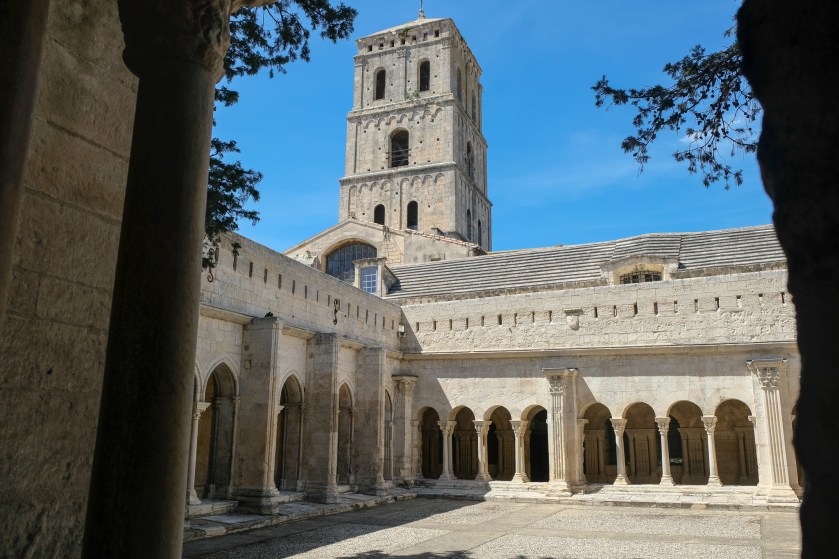
We stood on a Roman stage and looked out at Roman stadium seating (invented by the Greeks, but a staple of Roman bread and circuses). We saw old Roman marble columns being repurposed in medieval cloisters. A Turkish marble obelisk, also ancient, sits at the center of a main square.
DSCF1256.jpg

A huge modern museum covers Arles’ ancient history extremely well, showcasing an ancient boat and many marble busts, as well as small-scale reproductions of what it was like in the really old days.

But there is a great deal of newness evident in Arles, too, and not just in the arts buildings. There’s also the contemporary photography emphasis, including an educational institution and a huge multi-site exhibit event that was happening just after our departure. (Our rental apartment featured some interestingly photographed female nudes in black-and-white, and a restaurant we ate at was displaying and selling artfully captured male semi-nudes.)

You’ll find numerous hip boutiques and trendy restaurants that dot side streets and places. A fun one: a store named after the mosquito, La Moustique, carrying all kinds of creative things with images of the hated insect (this one gave my older daughter PTSD from the 40+ mosquito bites she sustained at summer camp the year before… and her propensity to attract the critters wherever she goes).

And one more innovative establishment to add to the list: a Michelin-starred restaurant, recommended by a colleague, that we were lucky enough to enjoy. The Atelier de Jean-Luc Rabanel is a retreat from the dusty streets into quite another world of upscale dining. We began in a bamboo-laced room with large comfy seats, consuming a cherry gazpacho with garlic sorbet and fish with anisette broth and tiny vegetables. The chef, Jean-Luc, stopped by to say hello. Even the number of breads on offer, around 6 kinds, amazed us (hint: skip the squid ink, try the chocolate).
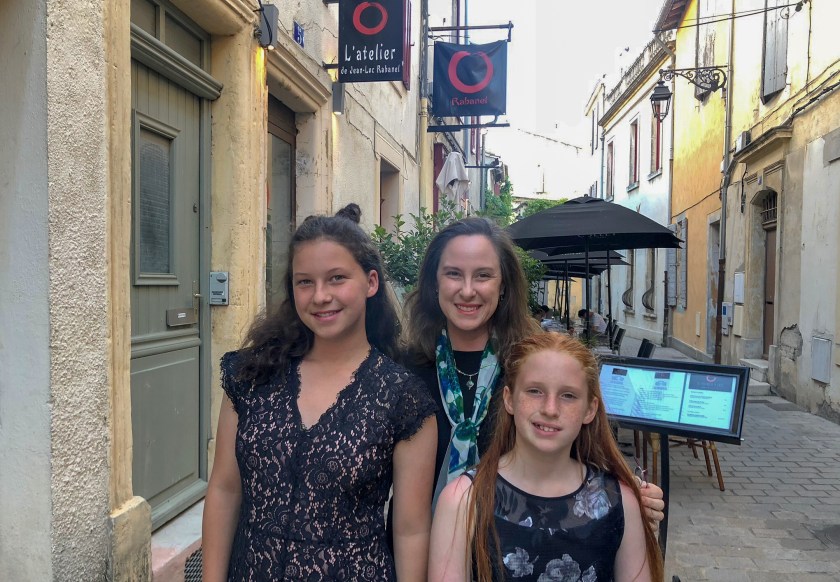
IMG_7674-2

As we enjoyed our first courses, we noticed other diners being whisked away—odd, we thought. Are they finished with their multicourse meal so soon?
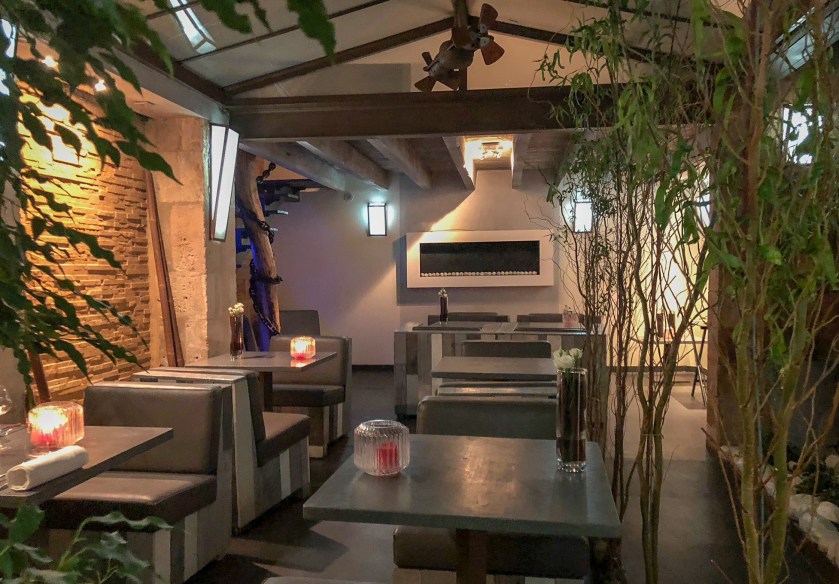
IMG_7704-2.jpg

No. They (and we) were being moved to a separate dining room, one with fanciful photos of beautiful women in toreador outfits and the mysterious bulls they loved (OK, I might not have that exactly right, but it was something along those lines!).
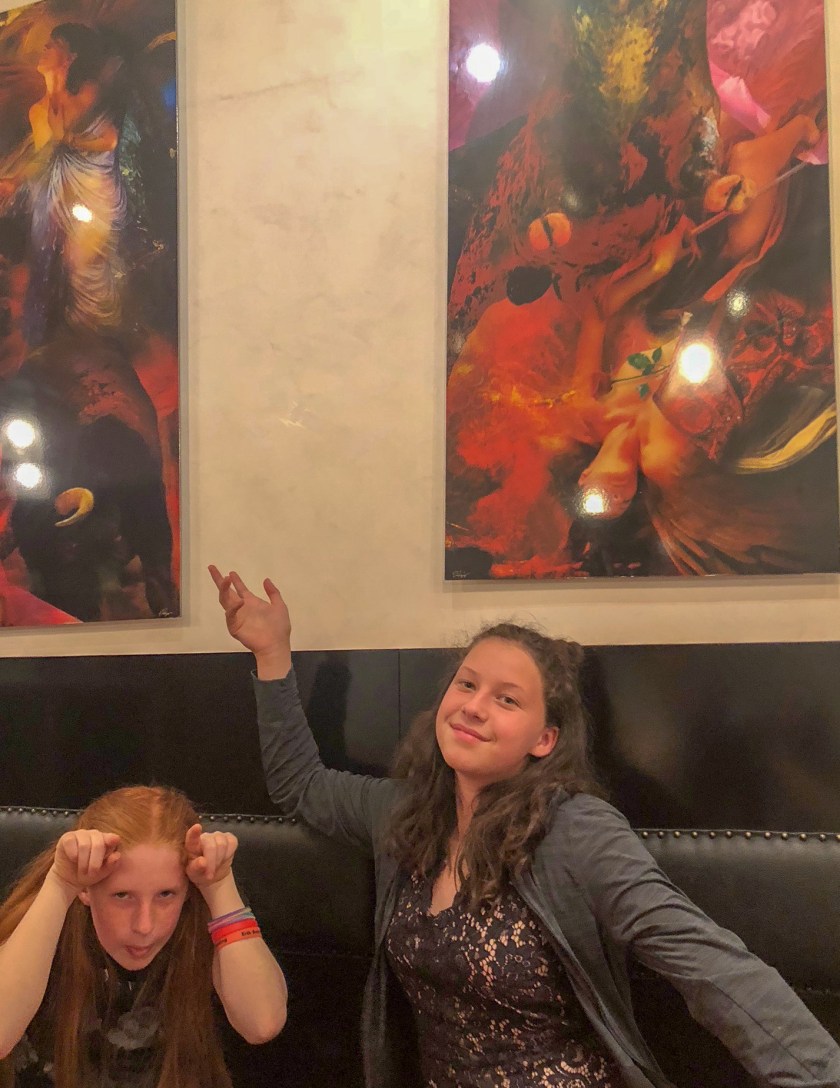
IMG_7689-2

We were indeed given a plate of “taureau,” a popular dish of “bull meat.” The Camargue marsh area around Arles is known for wild bulls. I don’t know much about their lives, but I picture them enjoying the southern sun until they enter the amphitheater for a bullfight (nonlethal in France these days) or they end up on our dinner plates (definitely lethal).

But despite its solid ancient roots and its artistic sparkle, Arles often feels like an out-of-the-way place. It’s a city that hasn’t been discovered yet by Uber drivers, for example. We did meet up with one, just by luck: he was from Marseilles, and normally worked there, but a passenger at the Marseilles airport had asked for a ride to Arles. Hence he was available to take us across town.

When I asked him why Arles is not serviced by ride sharing companies, the young, smooth-headed driver answered, “C’est une ville qui ne marche pas.” (It’s a city that doesn’t work… or pay.) I wondered what Arles’ famously Communist mayor would say to that?

In one odd way the city does “marche” (work) with enviable civility. It may seem obvious in this ancient city, but it’s important to note that the medieval streets in the old town are narrow—VERY narrow. These one-way passages can barely accommodate one medium-size car and often wind around blind corners. We found ourselves navigating through these streets in our rented Opel Zafira hatchback numerous times, with my husband (a fearless and experienced stick driver) at the wheel.
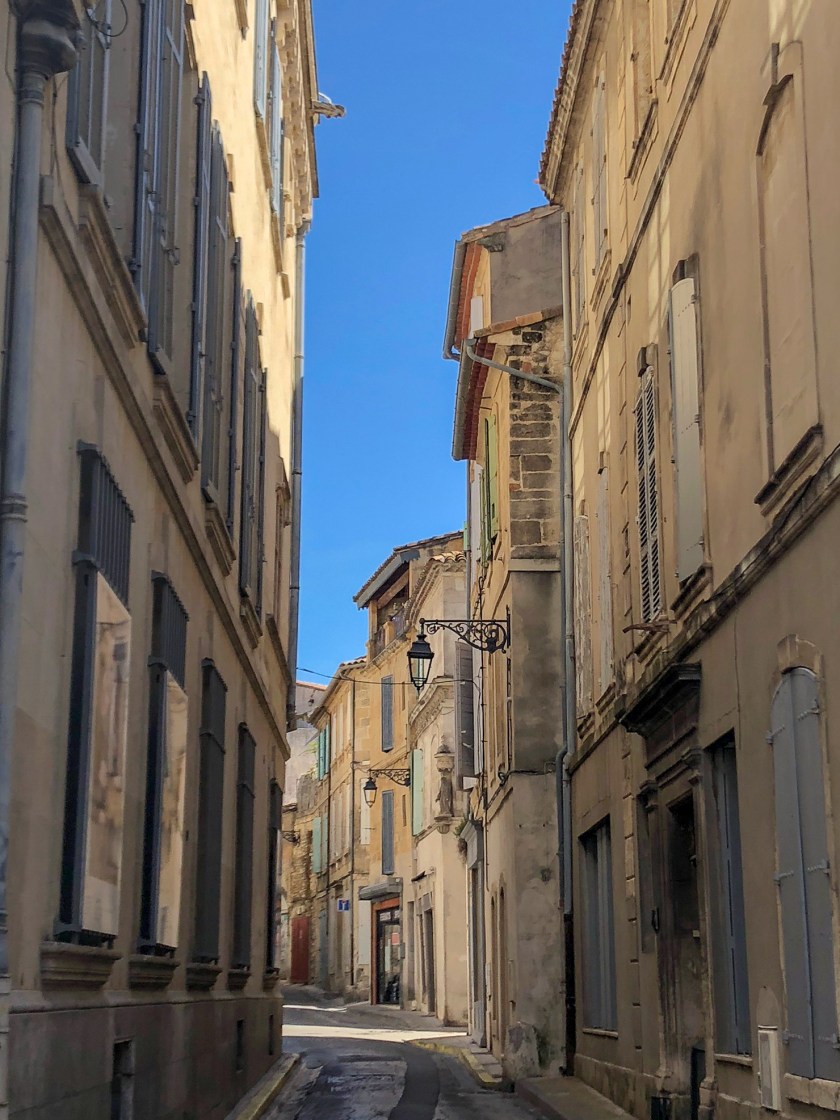
IMG_7608-2

When we first arrived in the city after departing from an airy boulevard-like street near the train station in Aix-en-Provence (albeit torn up by construction), we were somewhat shocked. We approached the address our GPS gave us for our lodging. Was this tiny street really the road housing the furnished apartment building where we’d rented a place? There was just a sliver of sidewalk in front of the door with its old brass knocker, and no place to pull over without blocking all traffic behind us. I jumped out with my kids while my husband planned to circle the side streets and figure out a parking spot.

When we found the caretaker, a hip young woman, we asked where should we park to unload our luggage? Oh, just stop your car right in front of the door, she said, and unpack it there. Really? Won’t the drivers behind us be incensed while we block the street to remove 4 suitcases and various backpacks, tote bags, and briefcases?

No, they’ll be fine. That’s how we do it here. (Cue the raised eyebrows of four dubious Americans.)

Without any other option, we stopped and blocked the street while two adults and two kids unspooled all our stuff and deposited it behind the bright blue double doors of the apartment building.

Amazingly, cars stopped behind us, but no one got angry, no one yelled, and no one honked. Because they, too, have to frequently block streets themselves for similar purposes—and the Arlesians are willing to pay it forward.

That small gesture left a lasting impression of this vibrant, historic city.

DSCF1357.jpg

Paris Observations, Part 2

Following my first set of Paris observations, here are a few more thoughts. Read on for  notes on Parisian tattoos, pedestrians, iced tea, underground dining, water, pastries and crepes, and, of course, macarons.

……….

IMG_6166
In the popular Place de la Contrescarpe, and all around Paris, you’ll find many tattoos

Last time, I wrote about a French trend that echoed American fashion: fancy sneakers on everyone with everything. I also wanted to point out that the hipster look of tattoos (on men and women) and beards (men!) has also spread to France in a big way.

I recall reading an article about 15 years ago about how the French, and other Catholic-origin cultures, would never adopt tattoos (or piercings) enthusiastically, as Anglo-Saxon cultures did. That their Roman religious roots somehow made them immune to the idea of defacing their God-given bodies with permanent ink. Clearly that cultural theory has gone the way of the dodo. Tatts are everywhere now among the younger generations in France, just as they are in the US, and tattoo parlors have sprung up too.

It’s odd how, walking along the streets of Paris, Nice, or Aix-en-Provence, the 20-something students were indistinguishable from American hipsters. Levis have long been popular, but now it’s every aspect of their look that mirrors Americans. My French friend attributes this to Netflix, which is popular in France. Young people see American trends there. Instagram, too, and all kinds of social media spread the desire for the same styles around the world. The French are not setting the fashion pace when it comes to lower budget streetwear.

One upside is how little me, my husband, and my pre-teen daughters stood out as different in our American clothes, shoes, and accessories. In fact, people seemed to mistake us for natives. Normally, in the past, that would have made me smile, but now, I view it as a part of the homogenization of all cultures, trends, and self-expression: A little dispiriting.

We also had trouble recognizing who was a local and who wasn’t. I sometimes asked a fellow traveler for directions, and usually it turned out to be an American. When I realized their confusion, I’d rapidly switch from Parisian French to American English to rephrase my question. This amazed my kids. (As my husband said: “It’s your mom’s super power!”)

……….

Parisians walk VERY fast.

Our second night in town, we were strolling around the 6tharrondissement after dinner. We were tired, and full, and taking our time.

I heard behind us an exasperated voice. “Oh, les touristes,” came from a young woman to her friend. I overheard them scheming to jaywalk across the street to get away from our too-slow steps. Just then, Bob said we should cross together as well, and unknowingly stepped right in front of them.

The young women angrily muttered and marched around us, and I called out, “Oui, les touristes!” my voice somewhat bitter. I am not quite sure if they heard me or even cared. But it helped me to acknowledge that I knew they were talking about us…. and didn’t appreciate the attitude.dscf0404.jpg

A few days later, walking down a Parisian street, I heard myself saying, “My God, these tourists are SO slow. We’ve got to get around them.”

When in Paris, I guess, one can become slightly more Parisian.

The only problem is, when trying to pass other pedestrians on a very tight walkway, you might end up walking in the road, and there, the motorcycles (or cars) might get you. They come out of nowhere in the tiny old streets.

I am certainly not the first to observe the Parisian pedestrian rapidity. The late British author Peter Mayle, who wrote about his experiences living in Provence, reminded readers that you could always tell visiting Parisians in the South of France apart from the locals by how extremely fast they walked.

……….

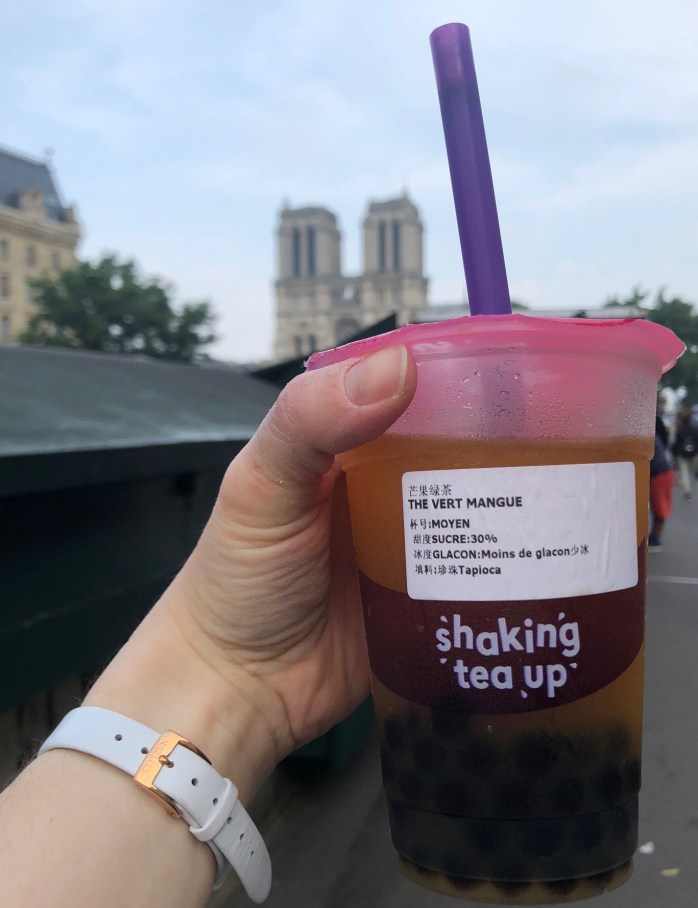
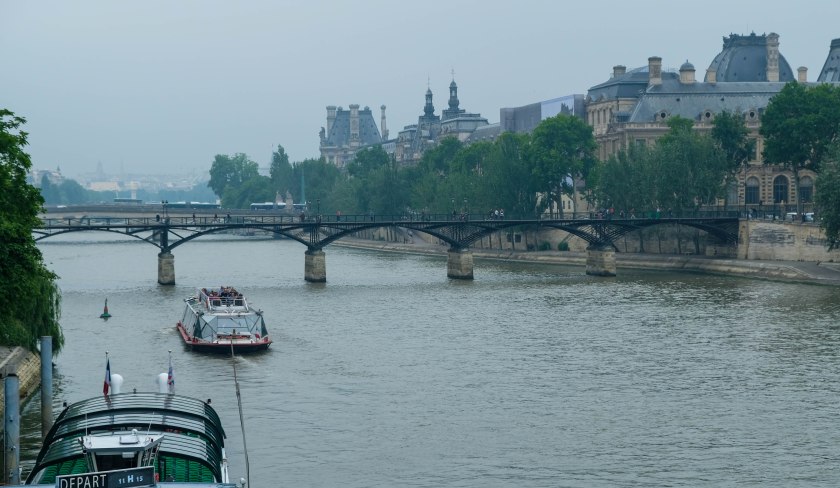
img_5898.jpgIt’s official: the French have bubble tea (aka pearl tea, aka boba tea). We tried “Chatime,” a small storefront facing the Seine near the Place St Michel.
It’s like the bubble tea served in America, with a similar list of flavors (I got mango green tea), only even more expensive (at least 5 euros per serving). Happily, the tapioca pearls were quite tender, just how I like it. My daughters gave it a thumbs up as well.

……….

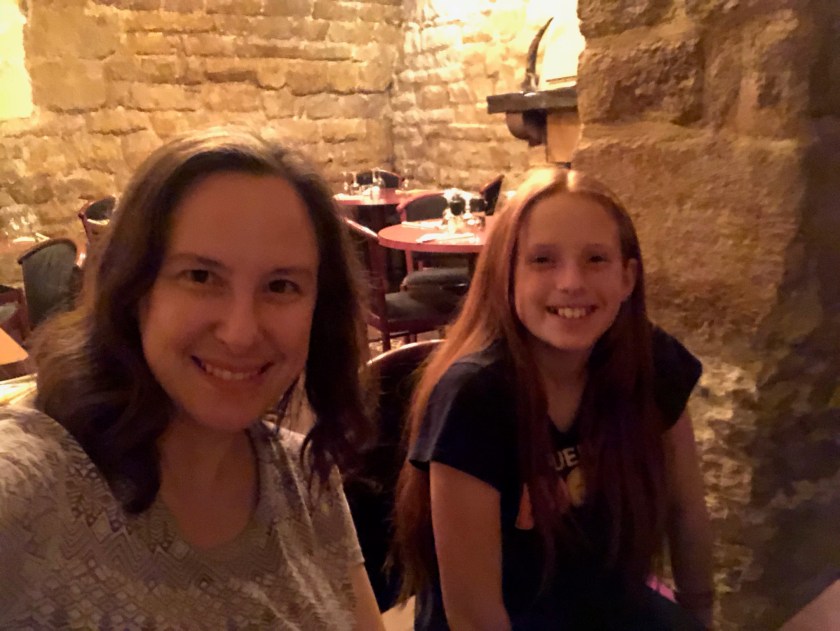
Eating in a wine cellar is quaint, but once you’re down there, expect a long stay. (This is not ideal for the claustrophobic or the super hungry.)

We enjoyed dining in the “caveau” on the basement level of a small restaurant on Paris’ charming Ile St Louis. The thick stone walls had a certain charm and had clearly been cleaned and refreshed. However, it was slightly musty and dank, and “out of sight out of mind” is surely true in France as well. We saw our server approximately once per half hour and eventually had to ascend to ground level three hours later to pay our bill and move on with our lives.

I did enjoy the endive salad and fish, though, and we had plenty of time to talk and visit as a family. But I confess, I breathed easier as we emerged into the open air.

IMG_6454
Caveau dining, a long (and slightly caustrophobic) experience

IMG_0884

……….

Water is a precious resource. We all know this, but as Americans, we have come to expect water served at restaurants as our due. During the long California draught, we noticed more restaurants posting signs saying “to save water, we won’t serve you water unless you request it,” and we were somewhat annoyed. Americans want our access to free water to begin just as soon as we arrive at an eatery, thank you very much! You know, “give us your tired, your thirsty,” etc. (Yes, this is a generalization, but I challenge you to find evidence to the contrary.)

Well, in France (and Europe overall) getting water is a different story, one that tells of scarcity rather than abundance.

Few water fountains grace French public places. French restaurants are required to serve you free water if you request it, my French friends tell me. Yet they are not exactly happy about it, since they make no money off the tap water itself, and probably resent having to wash your water glasses “for free.”

So when you politely request “un carafe d’eau” with your meal, be prepared to wait. And wait. And the carafe that the water brings will be small, and you will have to ask for multiple refills, especially if you are traveling with parched, potentially dehydrated, tour-weary children.

(Also: Be sure not to ask for just “water”–“eau”–because often they will bring you Evian or another expensive bottled water. Word to the wise: “carafe d’eau” is the way to go.)

The water dearth in France did make us value our free-flowing American water. We are used to large, ice-filled glasses of the wet and refreshing stuff set down in front of us almost as soon as our rear ends hit the seats.

(The only kind of water we saw a lot of in Paris was the Seine, and of course the waves and waves of rain that fell on our heads.)

DSCF0388……….

Speaking of ice: You may know that ice is not really a “thing” in France if you’ve ever traveled there before. But there’s often a unique twist in the Gallic mind. What got me this time around is that there are more restaurants serving “iced tea”—just don’t expect ice. (As I mentioned above, bubble tea, a.k.a. pearl tea, has made it to Paris, but it’s still a rarity.)

After leaving Paris, I ordered and consumed a lovely “thé glacé” in the Rothschild Villa restaurant in Cap Ferrat on the French Riviera (a longer story for another time). Quality tea, and was served cold. Well chilled, but not an ice cube to be found, just a foamy layer on the top.

Be warned: most places in France that serve “iced tea” will give you Nestea Pêche in a can, or some other syrupy disaster.

DSCF0252……….

My kids never thought they’d get sick of pastries. And yet…. temporarily, they did. Numerous croissant breakfasts, both to-go from bakeries and seated at cafés, seemed to put them over the edge.

My older daughter tried brioche and almond pastry; my younger daughter preferred chausson aux pommes, an applesauce-filled puff pastry. But after nearly a week of this, they started to rebel. The kids were quite eager to return to cereal, toast, and eggs.

They even seemed to tire of crepes, which I also didn’t think was possible. Within three days we had crepes three times for lunch. The frequency took the fun out of it for them.

Personally, I really did enjoy the “crepes de sarrasin,” I ate, also known as “galettes de blé noir.” In this country, we’d call it a buckwheat crepe or pancake. It’s uniquely hearty and savory, especially with swiss cheese, mushrooms, and a touch of egg or ham. Those crepes are the “salée” or “salted” version you often find in France (and especially in Bretagne, birthplace of great crepes). They are perfect with a bowl of hard cider, also from Brittany (I prefer brut, but some like doux, or sweet).

The “sucrée” crepe, on the other hand, is made with a more typical white flour and served sweet with a range of flavors (Nutella or chestnut being favorites). It can also be tangy with a lovely sprinkling of fresh lemon juice.

I’m getting hungry.

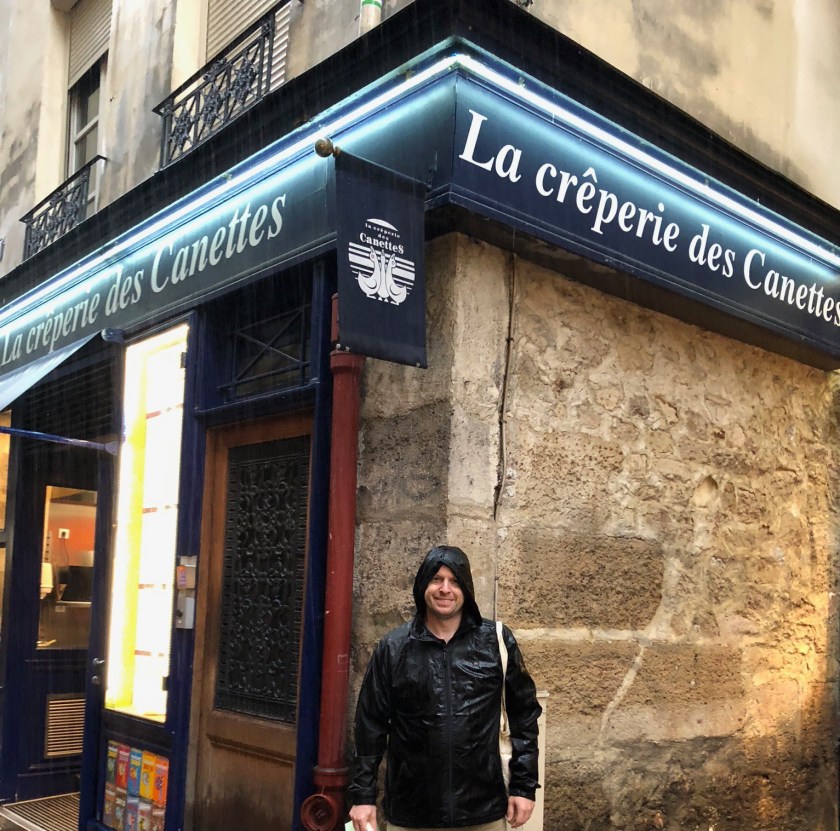
IMG_6022
The site of the best crepes we had in Paris, in the pouring rain that sent us running inside

……….

And once more back to food: macarons. If you like things French and live in a major metropolitan area, you’ve undoubtedly tried these upscale delights. If you don’t know them, I do recommend you seek some out. I wouldn’t exactly call them cookies, but they are in the cookie/pastry family. They are essentially two fluffy rounds with flavored cream or preserves inside.

On this trip, we were struck by the expansion of macarons across Paris and France. More than ever, they seemed very widely available. We stopped several times at La Durée, where the macarons on offer were light and delicate and delicious. My daughters surprised me by loving the rose and geranium flavors. I’m partial to raspberry and lemon. Mmm.

Sadly, I lost my sense of taste for a time during my Paris stay. This happened because, unfortunately, I’m allergic to the city. Its high ozone levels and diesel pollution make me ill after even a short stay. But through the wonder of allergy pills, I regained my senses in time to take in a few last macarons, and the memory lingers.

IMG_6018


Paris Observations (Part 1)

DSCF0182-2

Paris is a very old place, and yet it has remained dynamic over the centuries. Every time I return to the City of Light, I see something new—some detail or quirk that I’d never noticed in numerous visits, or something that’s actually changed as generations of Parisians shift and evolve.

In this post, I’ll share the first part of my Paris observations from June 2018, when I visited with my husband and two daughters.

……….

As soon as I arrived in the heart of the city, I spotted a trend. Just about everyone—both men and women—sported fancy sneakers.

These are specific kinds of sneakers: Adidas, Nike, and New Balance, primarily. Only certain colors and styles that qualified as somewhat upscale. Gentrified sneakers, not so much running shoes as urban fashion sneakers. And compared with two years ago, it was a vast uptick.

My older daughter, wearing slightly beat-up Adidas Superstars (the kind popular at her school), fit right in, whereas in ages past, any sneakers-wearing tourist would have been immediately branded an American and pointed/laughed at. (When I was a student in Paris, I selected my footwear just as carefully as my clothing, to try to fit in. Leather oxfords, flats, or sandals seemed acceptable then.)

Screen Shot 2018-08-02 at 6.18.54 PM

Our first night in the city, my husband and daughter spent a couple hours watching feet go by the Place St. Michel as we sat at the Café St-Severin. Nearby, Saint Michael himself watched us from his mighty statue, wings spread and sword in hand, judging us all.

Screen Shot 2018-08-11 at 9.59.22 PM

Sneakers with wide culottes. Sneakers with dresses. Dodging puffs of smoke from  neighboring diners, my family members spied dozens of Adidas and Nikes coming in and out of the Metro stop.

Interesting that the French seem to have now embraced healthier approaches in some areas—wearing supportive footwear, drinking detox teas, enjoying spa treatments, and taking up running—while still continuing to smoke like chimneys.

……….

In Paris, we walked. And walked. And walked (in our well-designed footwear). And then we did what the French do, alongside tourists, in public parks—we propped our weary feet up on the edges of large fountains.

We did this at the Palais-Royal, the famous royal courtyard now populated with black-and-white columns, leafy trees, and a traditional round fountain basin encircled by metal chairs (this site was featured in Mission Impossible: Fallout, along with many other Paris locales).

Screen Shot 2018-08-11 at 10.23.39 PM.png

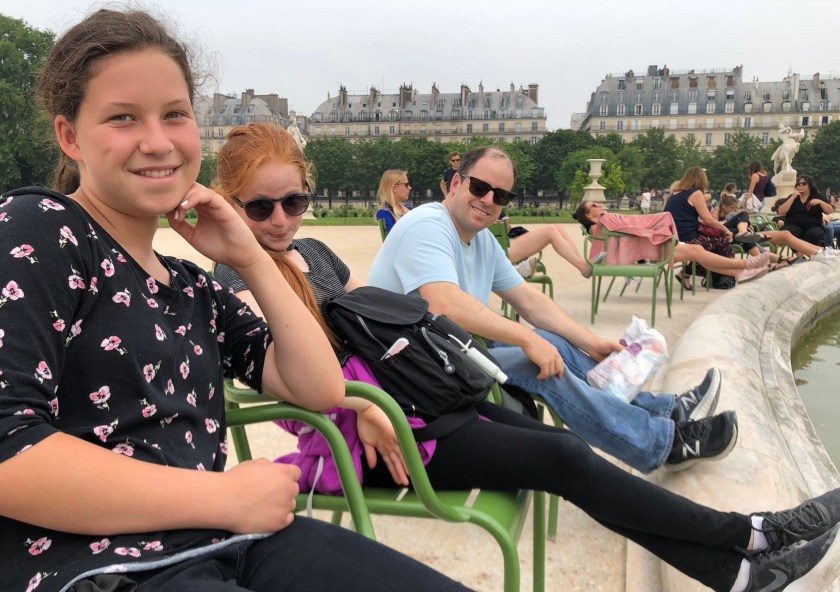
Later, in the Tuileries garden, by an even larger round pool, where many tourists sat to take in the view of the Louvre, statuary, and patches of (off-limit to feet) very green grass.

The weather was humid and damp, not exactly hot, but sticky. (It got cooler and much wetter as our Paris stay went on.) Given our jetlag and the longer-than-usual walks often fighting against the traffic waves of cars or of other tourists, it felt good to relax à la française.

img_5786-e1533017095808.jpg

……….

Have you ever been shamed into silence by a museum guard? My family has.

“Un peu de silence, s’il vous plaît,” alternated with “quiet, please” (same thing, in English, and less poetic-sounding). This happened in two places: the Orangerie museum was the first. It’s a gem located in the Tuileries garden, not far from the Place de la Concorde. The museum houses remarkable wrap-around waterlily paintings by Monet, who wanted the space to be a sanctuary for “working men” (and women, one hopes) far from the hustle and bustle, a place of rest and peace. I sort of got the point of honoring his wishes in the Monet rooms.

DSCF0292-2

But in other rooms, featuring riotous post-Impressionists, the same rule seems to hold—guards asked us to keep our voices down. And they did that too, with other patrons who had not yet learned to communicate with each other silently, in a special exhibit featuring the influence of Monet on contemporary New York artists.

Really? “New York modern art scene” and “silence” are a very unlikely combo, in my opinion.

The second spot of voice-shaming was the mausoleum in the basement of the Pantheon, where Voltaire, Rousseau, Victor Hugo, Alexandre Dumas, and many others are entombed and memorialized. I understand that it’s a solemn place.

But the female guard yelled “silence” and “quiet” through the labyrinth of echoing halls so vociferously that it was unsettling. Her voice created its own disturbance. (My younger daughter continued to invoke the hypocrisy of this approach long after.)

……….

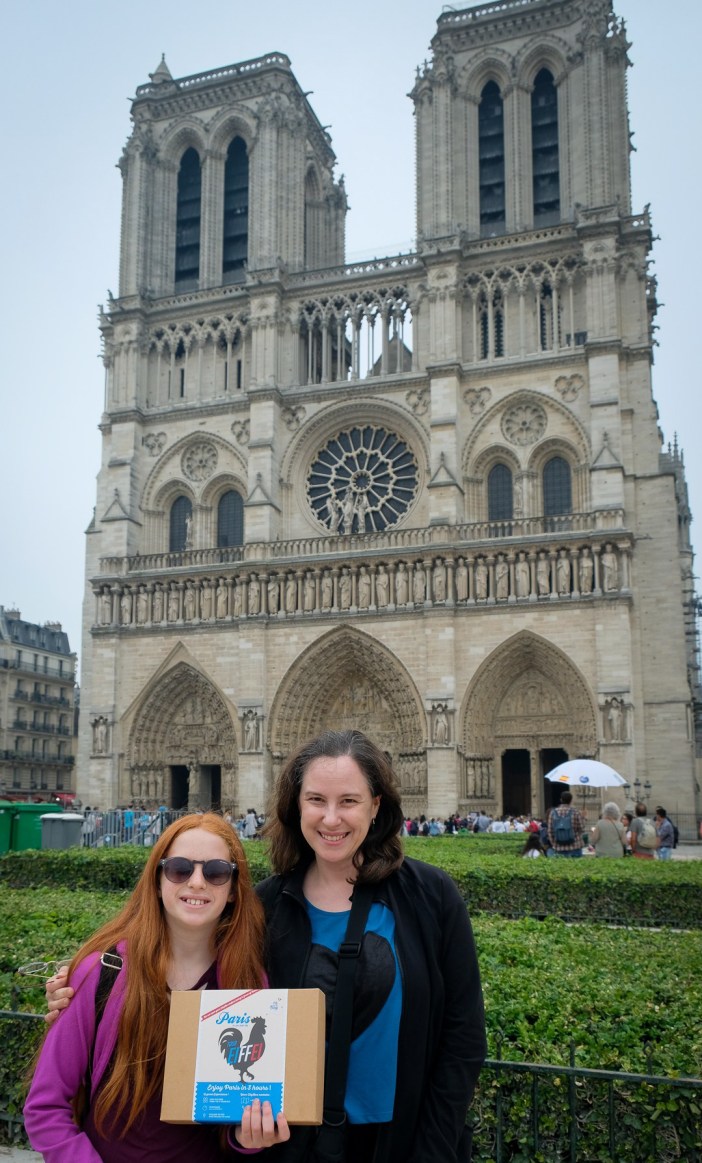
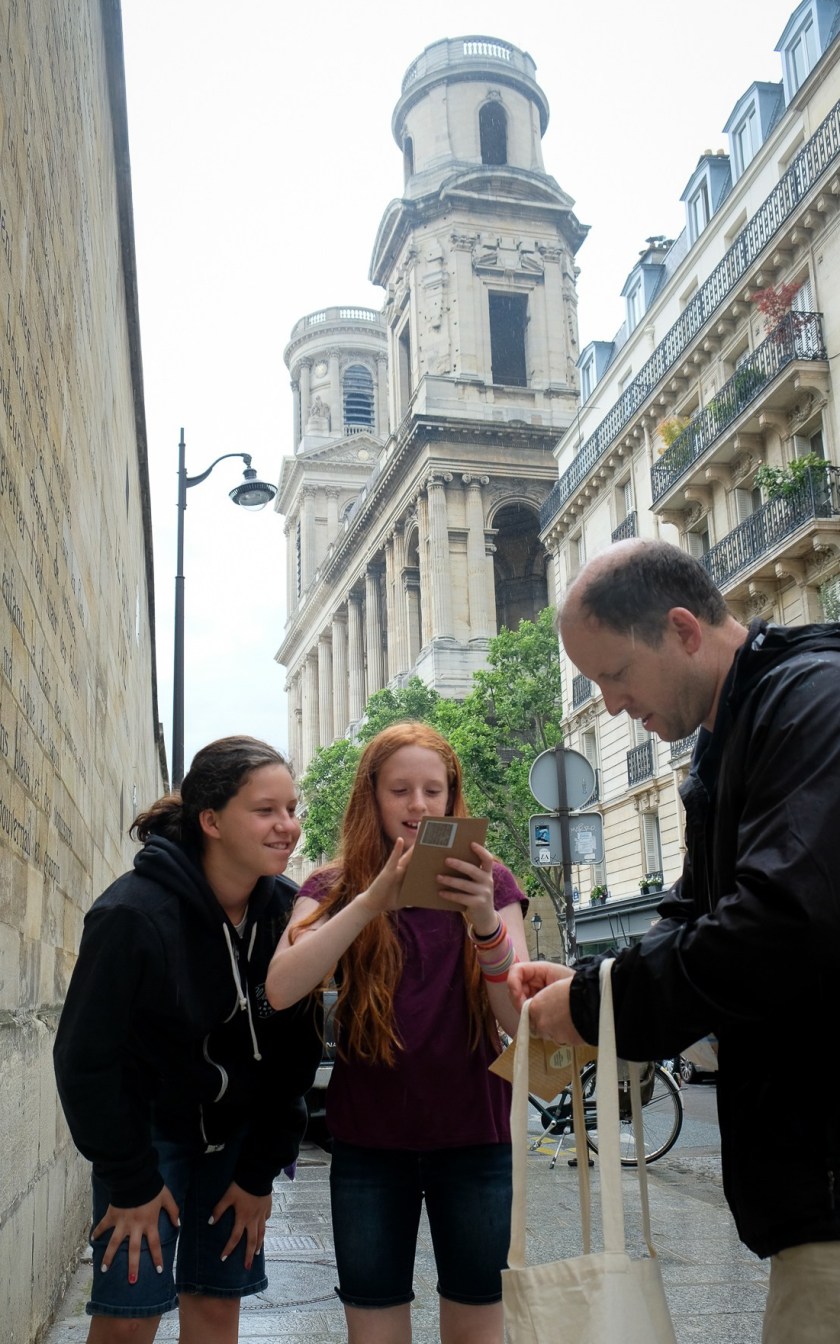
Also in Paris, we learned that if you design a treasure hunt, it’s best not to offer as clues “water” and “a ledge.”

The otherwise-clever City in My Bag Paris treasure hunt overlooked this notion.

DSCF0349-2

The experience as a whole was quite fun and we enjoyed the little gifts and treasures we could “unlock” along the way by solving location puzzles. However, one visual clue was a photo of water from above. In a city that 1) has a large river running right through it 2) has numerous (aforementioned) fountains everywhere and 3) is constantly being rained on and fairly frequently flooded, a picture of water does not really distinguish things much.

The ledge image, a different clue, was also kind of funny. It turns out that specific sizes of these items were used by the French as they converted to the metric system more than 200 years ago. Physical ledges, built into walls, told the citizens how long a meter was.

(Are we meant to picture people walking up to these ledges, taking their measurement, and then being forever informed of its size? Or did they have to go back over and over again to check their work?)

There’s one such ledge still in existence, and we think it’s somewhere near the Luxembourg gardens. The only problem was, what was happening near the gardens when we visited that day was an aggressive protest. A passerby told us it was striking railway workers, but with all the smoke bombs and torches and loud megaphones booming, as well as the armored swat teams ready to pounce, it was a bit hard to tell.

DSCF0401-2

The rest of the week, my younger daughter kept pointing to random ledges and asking, “Is this the ledge? Is it this one?”

dscf0407-2.jpg

……….

We may have made it onto the B roll of a French film.

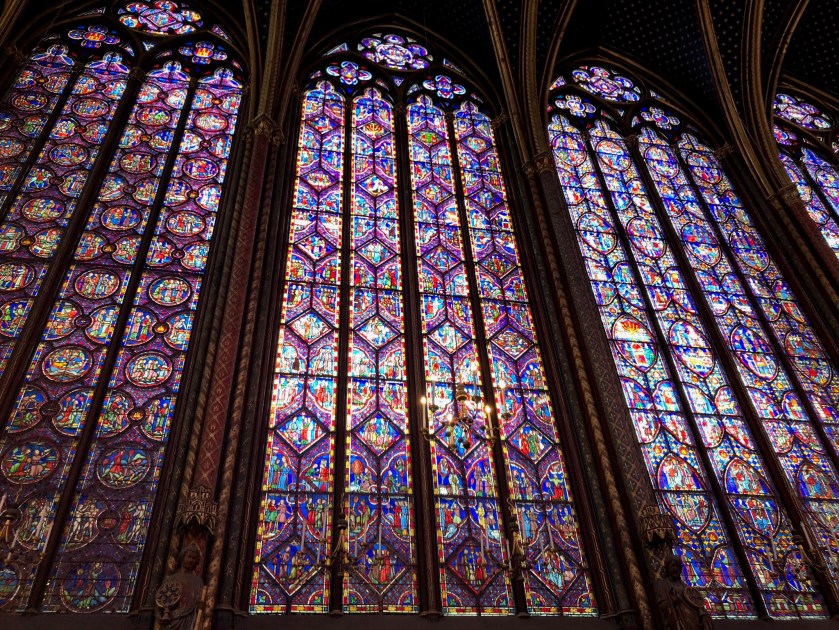
I can’t be sure. I really have no idea what they were recording with a professional-grade video camera when my kids and I visited Sainte Chapelle. We were admiring the gem-like windows, coated in brilliant red and blue stained glass. They surround you on all sides in the former royal chapel, an outstanding example of medieval artistry and modern cleaning/repair work.

IMG_6169

And then the woman in red appeared, and with her, an encourage. A large camera, a mic on a small boom, and some people hovering about trying to ensure a good shot.

At one point she ascended to the top of the pulpit area. And her camera person seemed to be seeking something else to shoot. Another person–the assistant director perhaps–pointed in our direction as we were carefully observing windows from the sidelines. The camera pointed our way for sometime. I could swear it moved with us.

I wanted to ask what they were filming, but they were intensely focused, and I didn’t find a good opportunity to interrupt their work.

So who knows? “Coming soon, on a screen far from you: Meredith and daughters touring Paris, hot on the heels of a mysterious woman in red…”

……….

Next time: Paris musings, part two. Please return for the sequel!