We are banished
Kings and Queens
This season,
Shut out and huddled
Far from the court of life.
Marking one gray day
After the next,
Stones to hang
Around our drooping necks.

A time of great shedding,
Of unwinding…

If we find what’s new
And beautiful in spring,
Love it fully in summer,
Lose it unwittingly in fall—
We then mourn it bitterly
In winter.

Outside our back window:
Tree of leaves sucked dry
By sun and season,
Turned so quickly from
Supple lithe green
To brittle tan,
now denuded.
Sign of the times.

Build a fire.
Warm your hands.
Keep your blood pumping
And your limbs intact
To wait it out—
Teeth clenched
Knuckles white
Lungs burning—
For another
Spring.


-      Meredith Alexander Kunz, © 2019
Category: writing
Poem: New Car
New Car

We’ve built a beautiful box
to withstand the storm.

As it whips through
The ink dark sky
We sit inside,
Our seats warm,
Our bodies sound,
Our breathing steady.

And still it howls.
Branches are thrown
Across the street just
Beyond our windshield
And wheels slide atop
Crunchy spiked seed pods,
Thick clusters of fall leaves
Still attached to the wood
Littering the road
In the driving sideways rain.

We careen
Through the gale,
Faster now,
Flying past
Lanes of traffic,
Cars three times
The size of ours
Bearing down
While we whirl
Into the night,
Lights turned on
Extra bright.

In this new car
I am reminded:
It’s been so long that
We have felt this warm,
This comforted,
This insulated -
Sweetly held in this mercy
Of our own devising,
Cradle of metal and glass
Rocked by the wind and rain’s
Fierce lullaby.


-      Meredith Alexander Kunz © 2019
Poem: There is so little we actually know
There is so little we actually know

We see a face, a smile.
Yet deeper—below skin deep—
Muscles work, pull and stretch,
Contracting to cause a grimace,
Relaxing to sigh, synchronizing
Speaking, whistling, screaming.

And that’s just to make
An expression, on the face of it
A superficial thing.
What about
What lies beneath
My torso’s taut layer
Of epidermis?

Larger mystery by far,
A complex city of cells—
Organs, tissues, blood, and sinew…

I’ve heard that some
Who meditate long and deep
Can feel their organs working:
Kidneys filtering,
Livers metabolizing,
Bladders flushing,
Veins filling and flowing,
And of course, hearts pumping.

I am not so very evolved, yet.

And also, I try to recall
It’s not all
About me,
Even though these things
Are me:

I know each citizen
Of this odd metropolis
Has its own mind.

Each tiny attribute contributes,
Yet heeds its own programming—
Its own personality, its own destiny.

Some rebel against the system.
Some profess a disregard
For fairness, cooperation.
For doing their jobs.

And we’ll never even know
A subterfuge is underway
Until it may well be too late.

And for all we say and do,
For all we promise and swear,
For all we hate and love and judge
And laugh and disdain—

When it comes to
What’s in us,
What’s lost, we cannot
Bring back again.


-      Meredith Alexander Kunz © 2019
New Poem: The Artist Asks
The Artist Asks

We pause from inboxes
And Powerpoints
To hear her ask:

   Who are you?
   Define yourself
   Without your jobs, roles,
   Location, upbringing.
   Who ARE you?
   And how do you
   Make your way
   In this world?

In this giant Etch-a-Sketch
Called life
No one looks down:

We assume a kind of
Brownian motion,
Never quite able
To float above
Our own ramblings
For long enough
To see better.

But if we ARE
Then shouldn’t there be
A kind of flight path,
Series of ups, downs,
Sideways movements,
Our self in action
Punctuated by the influence
Of extreme externals?

A birth, a death.
A first date, a fifth.
Decades of marriage.
A job offer. A home.
A lack of a home.
A job lost, a job found,
A child born, a child
Grown up and moved away.

Every decision is a revolution
In the true sense of the word,
A turning, revolving,
Head-spinning
Change.

Each time,
Time etches into us—
Carves into our bodies
Its relentless data—

Who you are and
Who you’ll become
When all the veering around
is done.


-      Meredith Alexander Kunz © 2019
Verse for the season
When the muses smile on me, I write poetry. Here’s a short poem written on an autumn evening here in Northern California:
Night, Fall

Moon beams
Slice into the sky—

From nests of stems and
Tangled branches,
Half-molded leaves,
A wind-swept scraping—

Night full of notes,
A volume above
My mind’s silence
After a striving day.

Inside, the white noise
Of bodies at rest
As we settle to sleep—

While others out there
Awake, subtle shapes
Enshadowed,
Moving unknown,
Unrecorded
Into the night.

- Meredith Alexander Kunz
Living the dream
I always dreamed of becoming a writer and artist. And I did—just not exactly in the way I dreamed it. I am a writer professionally, focused in my job on science and technology. In my personal time, I write about modern life as a woman and mother, about what holds us back and what helps us thrive, and about philosophies of life going back to ancient times. My art projects are a combination of creative crafts and, when time permits, a range of other classic forms.
I’ve realized some of my dreams, and I have also worked hard to change my focus as my interests have evolved. I’ve tried to keep learning and growing, to build new strengths and keep the old.
Now, in some ways, it feels as if I’m returning home.
I find myself surrounded by science and technology researchers at my new job. Almost all have PhDs in engineering or computer science fields. They share many of the traits of focused intellectuals everywhere: a sense of purpose, a belief that theirs is the most important work, and a brainy concentration able to tune out all else.
This all feels very familiar to me. My dad was a mathematician. He was also a self-trained computer scientist, the first one who taught courses in that field at his university. He was a pioneer.
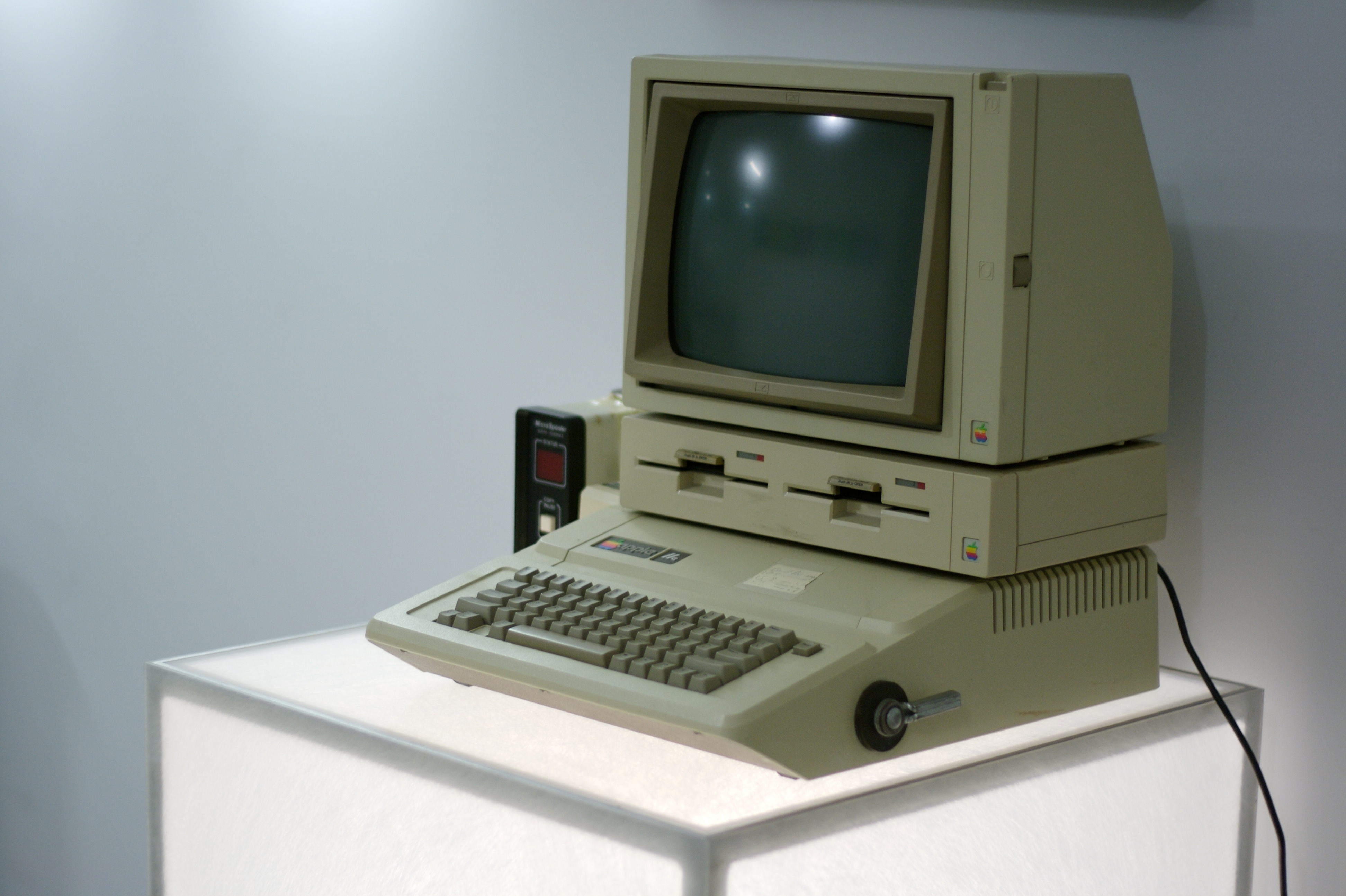
His interest in computers permeated some of my early memories. Like when he brought home our first computer, an Apple IIe, in 1983.
On a tiny desk in the corner of our dining room, the boxy black screen lit up with green characters when you typed on the keyboard. Magic! At the time, none of my friends had computers. It was cutting-edge.
At first, it seemed more like a science experiment than a useful tool. That was 1983, remember! What did you do with a computer back in those days if you weren’t a computer science researcher?
There were no GUI interfaces or desktop-computer video games or digital photos or social media or instant messaging. No icons, just typed-in text. My teachers did not require we word-process homework and there was no Internet (at least that I could access) to help us research assignments. None of my friends had email (although I believe Dad did, very early on).
In a search to make the computer fun, Dad soon found a “cool” piece of software (on a floppy disk that made horrible crunching sounds when you inserted it) for me and my sister.
It was an early text-based role-playing game that asked a series of yes or no questions. The player would type in answers in an effort to find hidden treasure deep within a castle. I never won. I got stuck at the well. And later I found myself standing in front of an armed knight. Was I armed too? I can’t remember. And I cannot ask my dad, because he died much too young in 1999.
At my new office, a woman I encountered at a social event said to me: “You’re living the dream! You’ll get to write about a lot of very cool things in that job.” She works for a different team and seemed quite taken with the innovative efforts of the researchers I’m surrounded with.
When I heard that, I felt that Fortuna was smiling down on me. Fate willing, as the ancient Stoic philosophers say, I will enjoy this work. Fate willing, I will teach my daughters that you can change and grow what you do professionally and land in a good place.
And no matter what may come, I will continue to feel a connection to my father and his groundbreaking work whenever I turn on a computer.
Not an Expert
Growing up, I saw myself as a future expert. Someone who knew her stuff, who could exude wisdom and knowledge to others. It was a goal I worked on throughout junior high, high school, college, and graduate school.
It took a long, long time to figure out that I didn’t want to be defined as an expert. I’ll tell you a bit about how it happened, and where it took me.
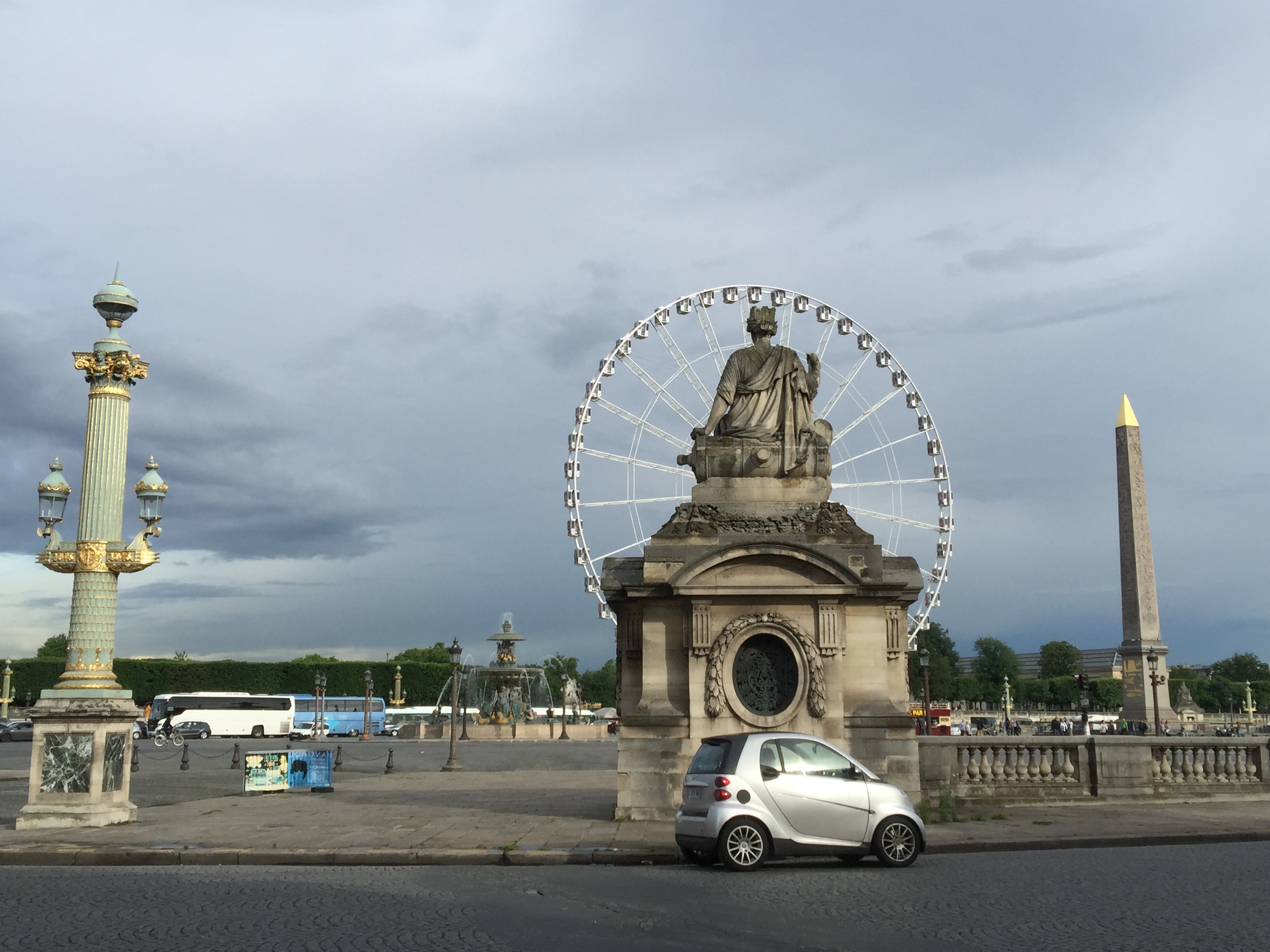
My steps along the expert path began early. As a young kid, I was lucky enough to travel from the Chicago area to Paris when I was turning seven. My parents got me excused from my first-grade class to accompany them and my younger sister on a once-in-a-lifetime journey, a chance for my dad to work with French colleagues and for the rest of us to experience life as Parisians. My mom and dad were both confirmed Francophiles and relished the idea of several weeks in the heart of the Latin Quarter, and they were brave enough to bring their two young daughters.
I was amazed by what I saw on that trip. Even as a child, I was blown away by the sheer force of so much art, history, architecture, culture, and a fascinating language—with echoes of English, but more melodic and rich to my ear.
When I got home, I started studying French. Combining my recent exposure with a natural affinity for language, I was able to copy a Parisian accent better than my classmates. My teachers heaped praise on me. I spent years striving to learn to speak authentic French so that I could truly experience a country steeped in art and history, could live like the students I saw roaming confidently through major French cities, sipping their tiny cups of coffee and flipping their long hair.
My parents took me back to France a few years later after receiving another invitation, and we explored Toulouse and the Southwest. The visit reenforced my love of the place.
As a student, I’d heard that there were opportunities to get back to France if I aced academic competitions—which I did. I made it through a competitive high school (a big public institution in suburbia) and into the college of my dreams. I focused on European history and literature, specifically that of France, and won grants to study in Paris during summers. I then went on to a year-long exchange scholarship stay to study in Paris again, and from there, attained my goal of being accepted into an excellent program for graduate studies. I was, I thought, living the intelligentsia dream.
But things had begun to fall apart. During my time studying in Paris, I struggled to find a research topic that I thought was worth pursuing. I knew it was an extraordinary opportunity to learn something, yet I flitted from class to class, hoping to uncover some hidden meaning there. The most memorable course I was in focused on the history of European government and law, and the only part I really recall was my effort to understand and translate the group discussion about a new European Union human rights law against dwarf tossing. Yes, you read that right—they were talking about whether it would be legally permissible to throw human beings for sport. I seemed to find myself in an alternate universe, and not just because I couldn’t always speak (or comprehend) the language.
I felt lost.
What exactly was I trying to become an expert in? As I trolled the libraries, I asked myself, how much could I really learn about European history as a modern American, hundreds of years after the period I studied? What could I actually glean from old documents molding in the archives… and who would care what I had to say about these distant events and people? An even larger question hovered: What was the point of this exercise?
It was beginning to dawn on me that inhabiting a purely academic sphere did not suit me. In the midst of my master’s program, I made a decision: I would leave academia to become a journalist and a writer. I would start over, putting aside my expertise in French and European history, and take on the goal of telling stories about the people around me, their passions, and their discoveries. I would learn from their lives and work, and maybe find ways to apply that learning to my own experience. Expert no more—except in the craft of writing itself.
My first paid writing job was at a legal newspaper. My second was at a weekly business and technology magazine (sadly, now defunct). My next roles were writing and editing for a foundation and then for Stanford University.
All the while, I wrote about people and topics far outside my own knowledge and experience, including: lawyers suing Microsoft; conserving wilderness through smart land deals; the legal rights of pets and their “guardians”; motorcycle personal injury work; margin lending; stock wealth on paper and its rapid disappearance in the economic downturn; ancient practices of making music from conch shells and worshipping jaguars; the Stanford prison experiment; how to secretly meet intelligence officers in Moscow and live to tell about it; bioengineering molecules to fight cancer; using light to activate the brain; crab migration and survival in changing climates; improving testing for tuberculosis; women’s volleyball star turns; a college quarterback returning from his Mormon mission; prehistoric horsemen who invaded Western Europe; the genius of Buckminster Fuller; and the ethics of self-driving cars. I talked to experts often, to tell stories about discoveries and ideas and human lives.
It was not just liberating—it felt true.
All around us are stories that are worth telling, innovations worth understanding, people worth knowing more deeply. I still carry a deep interest in European history, culture, and French language, and I treasure my French experiences and friends, but I’ve opened my world far beyond the limits of that expertise.
I am reminded of Shakespeare’s famous lines, voiced by Hamlet: “There are more things in heaven and earth, Horatio, than are dreamed of in your philosophy.” As a non-expert, I was free to explore all those things. And I still feel that way now.
Each day, learn a little. Each month, interview new people, write about something I’m not knowledgeable about. Each year, rediscover that there is more out there than I will ever know—feeling a sense of satisfaction not from expertise itself, but from the ability to ask good questions and find new answers.
Now on WordPress: MeredithInk, even better
I’m excited to now be writing to you from WordPress, my new web home for MeredithInk. Glad to be here. More soon…
Re-Tweeter
I’ve discovered that I love Twitter.
I’m by no means a power user – right now, my number of total tweets is paltry. I have a tiny handful of followers. I am not an outrageous tweeter or an expert tweeter or a hilarious tweeter.
Mostly, for the time being, I’m a re-tweeter.
To me, the re-tweet is one of the best things invented on social media. Re-tweeting allows me to quickly say something to the world (well, at least to my small number of followers), sharing a little sliver of wisdom without having to do a ton of research myself. Best of all, I get to “curate” content and put on my editor’s cap: what would represent my thoughts and random yet interesting discoveries today?
Sometimes I add a comment to a re-tweet. I’d like to do this more, to provide another layer in the rich palimpsest that is Twitter.
But quite honestly, I don’t always have such a short comment to add. We all know the character limit is pretty harsh. I realize I’m coming late to this party… and I’m not always so short-winded.
I’m working on that.
I think it’s an incredible discipline to winnow an idea, thought, or really any communication worth saying down to such a short, brilliant length. And not just by oversimplifying or adding shock value (can you guess which political candidate I might be thinking of?). No – a good tweet is really quite an art.
I am enjoying Twitter these days largely because I’m choosing the folks I follow very, very carefully. I am also electing not to read the various layers of comments on many tweets, the space where the Internet “trolls” hang out and share their venom. I try to stick with the source material, actual tweets and re-tweets.
Twitter is bringing back a touch of the magic of social media for me right now. Gone – in my world at least – are the early days, like my first efforts on Facebook… where everybody added everybody to everything to gain a large list of “friends,” making for a bigger network. Knowing now the tendency of some to overshare, on Twitter, I’m selecting for those voices I really want to hear on topics other than announcements of singular personal achievements or parents’ musings on potty training (which, I grant you, is a VERY important issue – but I have dealt with that enough in my own family life, thank you very much).
Some folks I’m following on this platform are take me outside my normal sphere, in a good way. For example, I didn’t realize I’d become a fan of the tweets of “neurodiversity” writer Steve Silberman(@stevesilverman) when I got into Twitter. He shares genuinely interesting thoughts and news for those interested in the human brain and in the fields of autism, Aspergers, and mental health.
I am also a fan of any Twitter denizen who posts or reposts really interesting infographics. Recently saw one about tuberculosis worldwide posted by Bill Gates (@BillGates). Again, not a topic I knew very much about. But there it was, staring me in the face, that globally, 1.5 million die from TB annually. This is important.
(In addition to that global point of view, I’ll be watching for time-sensitive local news on Twitter, too. It’s kind of useful to know if a water main broke near your house, or if a raging brush fire has shut down a stretch of the freeway.)
In today’s moment, I have discovered that Twitter can be a great place to turn to for a sip of sanity in this largely crazy ocean we’re swimming in right now, especially on the political waterfront. I’ve followed a couple commentators that I like “live tweeting” campaign speeches or political debates, and their words made me laugh and also breath a sigh of relief that someone else out there gets it.
Granted, I realize that Twitter can reinforce one’s own biases because of this self-selecting of voices. But hey, we make our own choices when we pick people to hang out with – at least as adults – and when we decide which newspapers to read or which novels to buy or which movies to watch, etc. This is just another format for choice – though for me, it’s certainly not my only source of news.
Of course you could fill up thousands of tweets with speculations on the Taylors and Kanyes and a lot of other celebrity or salacious stuff. I choose not to.
And so far, I’m loving it.
Thanks for reading this non-Tweet-sized post about Twitter. You can find me there @MeredithK55should you be so inclined.
Overcommunicating: The Key to Freelancing Success
Recently, a writer colleague asked me for my thoughts on freelancing. As a writer and editor, I have often done freelance work, both longterm projects and one-off assignments. After years of doing this, I have some thoughts to share.
My top advice: Build on existing relationships and really, really communicate! In fact, I suggest that you “overcommunicate.”
Why focus so much on communicating about your project? One of the hardest things about freelancing is trying to fully understand the client’s real needs and expectations. The more you talk about it, the more you will begin to comprehend what that client is hoping to achieve.
Overcommunicating will also help you to figure out how much work will be required for a particular project. Whenever possible, it’s best to get a very realistic picture of the amount of work for you as the writer or project manager at various stages—in addition to the deadline, of course.
If an editor is going to want four rounds of edits, that’s something the writer should know ahead of time. If you are expected to fact-check, and provide documentation that you did, you’ll want to know that, too. If complete rewrites are sometimes required, that’s very important to be aware of in advance.
But above all, you should really drill down on the assignment. That is best done face to face. If you can’t, using Skype would be a good idea (better than phone). Email is never enough to really get the full picture.
Think of getting your assignment pinned down just like any other in-depth interview you might do as a reporter. Ask the big and small questions, find out the nuances of what’s needed and how you can be most helpful. Make sure you feel you really get it before embarking on a piece of writing.
I suggest also asking about any political landmines the editor foresees. As an outsider to the organization or publication that is hiring you as a freelancer, you can’t see the political landscape without an insider’s help (and without that extra dose of communication on their side–which, admittedly, can be hard to find the time to do for busy assigning editors/managers).
Another aspect of overcommunicating is to try to check in on the direction of your piece or work part way through the project before you really get into writing. Scheduling some sort of call or talk midway though could be helpful.
Ask for samples of what the editor considers good work and any examples of similar projects (this is somewhat obvious but can be overlooked!).
Given how much time and effort you’re going to want to spend on this level of communication, I advise that you be careful to bite off only as much as you can chew in terms of projects–especially when you are just beginning freelancing. This can be hard to determine at first, so I suggest starting small and working your way up to more ambitious projects.
Freelancing can be a tough business, but it can also be a good way to build relationships and a reputation. The more you communicate, on every level, the better off you will be.
 MeredithInk