I just finished reading The Paris Wife, a novel by Paula McLain that traces the relationship of Ernest Hemingway and his first wife, Hadley Richardson, from their meeting in Chicago through their wedding and married life in 1920s Paris. A large section of the book covers their time visiting Pamplona, where they watched the running of the bulls and numerous bullfights. In the book, Hadley accuses Ernest of lifting large parts of the dialogue among their friends from their Pamplona trips and inserting the material into his novel, The Sun Also Rises. I decided to go back and read that book, to dig deeper into the period and the source.
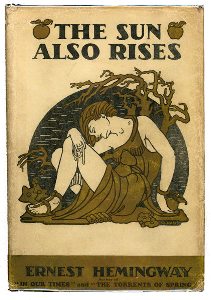
There are stretches of dialogue where nothing really happens; then there are very tense scenes where all the book’s male characters try desperately to get the attention of the lead female character, Brett. She’s a serial romantic, who, at age 34, can’t seem to settle down with one man. The narrator, Jake Barnes, is a thinly veiled version of Hemingway himself; he, too, wants Brett but a war wound has left him impotent, and, apparently, she’s not really interested in someone who is lacking in that department.
Although it’s clearly a roman a clef about Hemingway’s friends and his romantic interest in a female friend, Duff, there is one person he left out entirely: Hadley never figures in the book in any form. The novel still feels quite fresh in spots (some of the flirty dialogue reads well, and there is a rather delightful pastoral section where a couple of the men go fishing in the Pyrenees) though it is also horribly dated in many ways.
Especially bad is the treatment of Robert Cohn, an American Jewish Princeton grad who competes for Brett’s affections. Admittedly, Robert is a cad who is pitted up against Brett’s fiance–who naturally hates him–but even so, the Jewish references come off as anti-Semitic for their nasty focus on his “Jewish superiority” complex.
The way Hemingway wrote this novel (described well in The Paris Wife) reminds me of my youthful attempt at a novel, which I wrote right after graduating from college when I spent the academic year in Paris. Maybe it’s time for me to return to that text. Like Hemingway, I tried to capture the sounds of how smart, privileged young people talk to each other–what is said and what’s left out, the wit and the humor, but really just the banter of those faced with immense possibility and already feeling a sense of loss–or of incapacity–in their efforts to fulfill their wild dreams of love, genius, and fame.
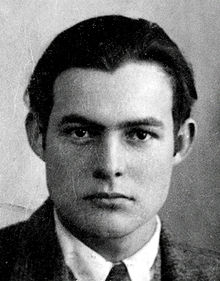 |
| Hemingway in the early 1920s (Wikipedia) |
 MeredithInk