We are banished
Kings and Queens
This season,
Shut out and huddled
Far from the court of life.
Marking one gray day
After the next,
Stones to hang
Around our drooping necks.

A time of great shedding,
Of unwinding…

If we find what’s new
And beautiful in spring,
Love it fully in summer,
Lose it unwittingly in fall—
We then mourn it bitterly
In winter.

Outside our back window:
Tree of leaves sucked dry
By sun and season,
Turned so quickly from
Supple lithe green
To brittle tan,
now denuded.
Sign of the times.

Build a fire.
Warm your hands.
Keep your blood pumping
And your limbs intact
To wait it out—
Teeth clenched
Knuckles white
Lungs burning—
For another
Spring.


-      Meredith Alexander Kunz, © 2019
Poem: New Car
New Car

We’ve built a beautiful box
to withstand the storm.

As it whips through
The ink dark sky
We sit inside,
Our seats warm,
Our bodies sound,
Our breathing steady.

And still it howls.
Branches are thrown
Across the street just
Beyond our windshield
And wheels slide atop
Crunchy spiked seed pods,
Thick clusters of fall leaves
Still attached to the wood
Littering the road
In the driving sideways rain.

We careen
Through the gale,
Faster now,
Flying past
Lanes of traffic,
Cars three times
The size of ours
Bearing down
While we whirl
Into the night,
Lights turned on
Extra bright.

In this new car
I am reminded:
It’s been so long that
We have felt this warm,
This comforted,
This insulated -
Sweetly held in this mercy
Of our own devising,
Cradle of metal and glass
Rocked by the wind and rain’s
Fierce lullaby.


-      Meredith Alexander Kunz © 2019
Poem: There is so little we actually know
There is so little we actually know

We see a face, a smile.
Yet deeper—below skin deep—
Muscles work, pull and stretch,
Contracting to cause a grimace,
Relaxing to sigh, synchronizing
Speaking, whistling, screaming.

And that’s just to make
An expression, on the face of it
A superficial thing.
What about
What lies beneath
My torso’s taut layer
Of epidermis?

Larger mystery by far,
A complex city of cells—
Organs, tissues, blood, and sinew…

I’ve heard that some
Who meditate long and deep
Can feel their organs working:
Kidneys filtering,
Livers metabolizing,
Bladders flushing,
Veins filling and flowing,
And of course, hearts pumping.

I am not so very evolved, yet.

And also, I try to recall
It’s not all
About me,
Even though these things
Are me:

I know each citizen
Of this odd metropolis
Has its own mind.

Each tiny attribute contributes,
Yet heeds its own programming—
Its own personality, its own destiny.

Some rebel against the system.
Some profess a disregard
For fairness, cooperation.
For doing their jobs.

And we’ll never even know
A subterfuge is underway
Until it may well be too late.

And for all we say and do,
For all we promise and swear,
For all we hate and love and judge
And laugh and disdain—

When it comes to
What’s in us,
What’s lost, we cannot
Bring back again.


-      Meredith Alexander Kunz © 2019
New Poem: The Artist Asks
The Artist Asks

We pause from inboxes
And Powerpoints
To hear her ask:

   Who are you?
   Define yourself
   Without your jobs, roles,
   Location, upbringing.
   Who ARE you?
   And how do you
   Make your way
   In this world?

In this giant Etch-a-Sketch
Called life
No one looks down:

We assume a kind of
Brownian motion,
Never quite able
To float above
Our own ramblings
For long enough
To see better.

But if we ARE
Then shouldn’t there be
A kind of flight path,
Series of ups, downs,
Sideways movements,
Our self in action
Punctuated by the influence
Of extreme externals?

A birth, a death.
A first date, a fifth.
Decades of marriage.
A job offer. A home.
A lack of a home.
A job lost, a job found,
A child born, a child
Grown up and moved away.

Every decision is a revolution
In the true sense of the word,
A turning, revolving,
Head-spinning
Change.

Each time,
Time etches into us—
Carves into our bodies
Its relentless data—

Who you are and
Who you’ll become
When all the veering around
is done.


-      Meredith Alexander Kunz © 2019
Verse for the season
When the muses smile on me, I write poetry. Here’s a short poem written on an autumn evening here in Northern California:
Night, Fall

Moon beams
Slice into the sky—

From nests of stems and
Tangled branches,
Half-molded leaves,
A wind-swept scraping—

Night full of notes,
A volume above
My mind’s silence
After a striving day.

Inside, the white noise
Of bodies at rest
As we settle to sleep—

While others out there
Awake, subtle shapes
Enshadowed,
Moving unknown,
Unrecorded
Into the night.

- Meredith Alexander Kunz
We do not fall out of the universe
On September 10, 2001, I was scheduled to fly back to the West Coast from New York City. I’d attended my friend’s wedding, and I recall strolling around Manhattan on a warm afternoon with a sense of leisure the day before.
At the airport that morning, I boarded the United Airlines plane normally. But then, with that beautiful late summer day just outside the oval window, we sat stuck on the tarmac for hours, waiting for the go-ahead to take off for San Francisco.
Eventually, people on the flight became so restless and annoyed that they started getting up. The pilot announced that those who didn’t want to stay on the plane could get off and board a later one.
“Air travel has reached a new low,” I remember thinking to myself, a veteran of cross-country flights.
Little did I know. In the wee hours of 9/11, I landed in San Francisco safely. Just a few hours later disaster struck in the form of terrorists on planes just like the one I’d been on.
I’ll never know what happened to those people who got off my flight. Did some of them end up on one of the West Coast-bound planes that were hijacked and crashed by the 9/11 terrorists? Or did they stay overnight and get stuck in NYC when the government shut down all flights after the attacks?
What about their families, their friends, people in their communities? How many people lost someone that day?
Stoic philosophy teaches us that death could strike at any minute and to be prepared. 9/11 happened long before I discovered this approach. I wouldn’t have been prepared in any possible way.
The acceptance of our mortality is a lifelong effort, one that we keep working on every day we are alive. It’s a reality that we’ll never fully understand.
Epictetus was quite sharp in his admonitions about death:
“Sooner or later, your poor body must be separated from its scrap of vital spirit, just as it was formerly. Why be upset, then, if it should come about now? If it is not separated now, it assuredly will be.”
– Epictetus, Discourses, 2.1.17
But it is Marcus Aurelius’ words that I find more helpful as a way to inch towards acceptance. Indeed, many of his writings seem intended to urge himself to embrace the concept of mortality. This one sticks with me:
“That which has died falls not out of the universe. If it stays here, it also changes here, and is dissolved into its proper parts, which are elements of the universe and of thyself. And these too change, and they murmur not.”
– Marcus Aurelius, Meditations VIII, 18
It is poetry, but more than that, it is an idea that may give us a shred of hope, or balance. It expresses the unity of all nature. That’s central to those who seek to live in accord with nature, the basis of Stoicism. And it reminds us of the constancy of change for us and all things.
This September, I remember the tragedy, and those who died. I like to think that they did not fall out of the universe.
In the Room Where It Happened

My younger daughter is obsessed with Hamilton, the modern musical by Lin-Manuel Miranda about the “founding father without a father” Alexander Hamilton. Nonstop I hear it in my house, both in recordings and on her lips.
It started with my older daughter a couple years ago when she began middle school. She still loves the musical, but now my younger child is the most vocal super-fan, reciting the words rapid-fire on the playground with a few other Hamilton-adoring kids. She said she learned to sing better from this effort. She spent her special spending money ordering (with my help) two Hamilton t-shirts online. So yeah, it’s big around here.
There are some fringe benefits. I, too, love the mashup of hip-hop, R&B, pop, jazz, soul, big band, and show tunes-style music. Inspired by the show, I’ve learned more about foundation of the national bank. Both of my kids have aced a few history projects thanks to the energy generated by this musical track.
Now that my daughters have exposed me to enough of the musical that I’ve memorized my fair share of songs. I was lucky enough to see the show live recently. In “the room where it happened”—that is, in the theater —I was even more taken by its dramatic tangle of emotions, ideas, and historical characters, all set to pitch-perfect musical narration.
(Spoiler alert: if you haven’t listened to, seen, or read about Hamilton, and want to be surprised by the show, you may wish to stop here!)
Aaron Burr, the lawyer and politician who was Hamilton’s greatest rival, serves as the show’s narrator, in a sense. In a musical about Hamilton, we expect to hate Burr, but it’s far more nuanced.
We, the audience, come to understand Burr’s point of view. In “Wait for It,” Burr sings “I am the one thing in life I can control.” The whole song is about self-control in the face of whatever life throws at you. Burr, unlike the frenetic, constantly moving Hamilton, is willing to wait for success, to wait for his destiny. (Unfortunately that destiny left him known primarily as Hamilton’s killer and as the loser in a presidential race.)
Burr, like Hamilton, is also keenly aware that death is always lurking, unpredictably, for all of us, no matter our achievements or goodness:
“Death doesn’t discriminate
Between the sinners
And the saints
It takes and it takes and it takes
And we keep living anyway
We rise and we fall
And we break
And we make our mistakes…”
The vulnerability expressed in this song creates sympathy for a man that you might, otherwise, despise. Burr is thoughtful, emotionally vivid, and very human.
Hamilton, too, is a complex and highly sympathetic character whose biography drives the show forward. His tremendous productivity is motivated by his impending sense of death. “Why do you write like you’re running out of time?” asks Eliza Hamilton, Alexander’s wife. He’s fixated on the potential for failure before he’s done with his life’s work, before he can make the best use of “his shot.”
Hamilton puts it this way in “The Room Where It Happened”:
“God help and forgive me
I wanna build
Something that’s gonna
Outlive me…”
Hamilton’s character is summed up by the song “Not Throwing Away My Shot.” (Yes, there is a lot of irony there, given his final duel.) His key idea: “Just act.” We cannot wait for someone else to make things right. Instead, we need to take action, and stand up for what we care about. If we do, we might just achieve something lasting.
The script depicts Hamilton’s main critique of Burr as centered around Burr’s lack of core principles. From Hamilton’s perspective, Burr doesn’t “stand for” anything. Political games (and jealousy over lack of access to Washington and power more generally) seem to consume Burr.
Hamilton views Burr as an opportunist and supports another rival, Jefferson, for the presidency because “Jefferson has beliefs, Burr has none.” In the show’s version of events, this friction ultimately leads to the duo’s deadly last dispute.
Hamilton is also the story of a man who destroys himself because he lacks a specific virtue: Self-control.
He’s got courage and a keen sense of justice, but his wisdom fails him in a few important moments and he flairs out of control. The show demonstrates how his infamous extra-marital affair and angry sense of self-justification bring about his undoing in politics and in his personal life. Jefferson and Madison ask: “You ever seen somebody ruin his own life?”
Sucked in by bad passions and insults, guilty over his son’s demise after receiving his unfortunate advice, Hamilton is not able to recover the sense of honor that he has lost. He seems obsessed with proving his own righteousness to others, especially his fiercest rivals. With an almost suicidal intent, he enters the duel with Burr that he doesn’t survive.
Despite Hamilton’s ill-fated end, we can take away a few key ideas to live our own lives better.
- “I’m not throwing away my shot” to pursue a meaningful life. 🔥
- Act on your good intentions now—not in some distant future. 🏃🏻♀️ After all, we don’t know how much time is left, as Hamilton points out. “I imagine death so much it feels like a memory. When’s it going to get me?” he says. “We have to make this moment last.” We must fully engage in the present, and live out our principles as best we can.
- And for a little more inspiration: Figure out what matters to you and why. Then stand up for what you think is right, and give your work your best effort—no matter what others say. To quote Hamilton once more: “You got skin in the game, you stay in the game. But you don’t get a win unless you play in the game. You get love for it, you get hate for it. You get nothing if you wait for it.” 💪
A Friend’s Wisdom

Marion and I first met in seventh grade at our middle school library. I think we were browsing the magazines at the resource center. Little did I realize the impact that encounter would have.
She was even taller than I was—and I was tall for my age—and immediately seemed more like a teacher than another student. It was instantly clear that she was poised, inquisitive, funny, and brilliant. After just a few minutes, I knew I wanted to be her friend.
From the start, I was blown away by Marion’s command of every situation. She seemed to have no anxiety or trepidation.
I remember when Marion, then a 12-year-old girl with thick plastic glasses and feathered brown hair, introduced herself to my parents. She walked up to them and said confidently, “Hello Mr. and Mrs. A. It’s nice to meet you. I’m a friend of your daughter’s. How are you?”
This girl seemed on a level with my highly-educated, crazy-smart mom and dad, harboring no qualms about having an actual conversation with them.
That was her persona: no fear. Underneath, I know she had her doubts. We all do. But she lived her life by a bold and brave set of principles that pushed her forward.
All this made it unspeakably painful when she died far too young in her mid-thirties, from cancer.
Her legacy lives on with me and so many of her friends and family. I learned a lot from Marion: she helped me become more comfortable with social situations, more able to talk to people, and more open. She showed me how to express opinions to peers and even to take joy from debating with them. We shared a love of language that led to lots of clever wordplay.
Marion and I bonded during a trip we won in a language contest, traveling to Paris to spend a month studying at the Sorbonne. Though we were never exactly joined at the hip—we were both too strong-minded to be utterly dependent on each other—we shared loves (anything French, and, by extension, European) and hates (boys who tried too hard to seem cool but weren’t; anyone who was fake). We laughed at our experiences (riding the public bus, no matter the smell, me trying to shield my nose with my t-shirt, and Marion ridiculing me), and in many a long-distance call, we decried the injustices and idiocies of the world, trying valiantly to live a higher truth.
Her own search for her true self took her to live in Greece, where her dad was from, and to start a school there. It was a tough journey, joyful one day, difficult the next, and downright tragic at the end.
In honor of Marion in what would have been her birthday (and yet another year without her), I offer some notes I found while sorting through an old box of office stuff from my last move.
Likely I made the jottings during one of Marion’s visits, or after a long phone call. My long search for the virtues was ongoing, and I clearly wanted to memorialize her philosophical thoughts. I’ve always been a seeker of wisdom, and I look for it everywhere. Today I study practical life philosophy in my free time, and now I’m guarding these notes in my curated stash of wise words.
This was written more than 10 years before her death, in around 2000. Literally, the title I wrote at the top was:
Marion’s wisdom
And here are the nuggets that I recorded:
If you’re the best in one thing, you’ll never have time for other things. If you’re third or fourth, you’ll be able to participate in other things.
Find a group of people you like and surround yourself with them.
Plant a garden if you can.
People who spend too much time exclusively with computers get stupid.
Be happy with yourself.
Meredith is perfect. [sic!]
It’s hard to go against the stream.
Money isn’t everything.
See those people you disrespect or who do bad things as little ants moving in the distance.
Don’t let other people’s judgments of you become your judgment of you.
This January, as we set our resolutions, I’ll be taking these thoughts to heart. I hope to be more like my wise friend.
The Ironies of Arles: Part 2
The Dutch painter Vincent Van Gogh’s dream of making the Southern French city of Arles an arts destination is finally becoming a reality. Now, a brand-new, Frank Gehry-designed, 184-foot tower dedicated to the arts is being constructed on the site of an old rail yard, where it seems to rise up out of nowhere when seen from afar.
We saw it at a distance this June from the vantage point of the Arles Roman amphitheater when we climbed to the top of the ancient stones, its shiny, twisty newness looking out across the horizon past old church steeples.
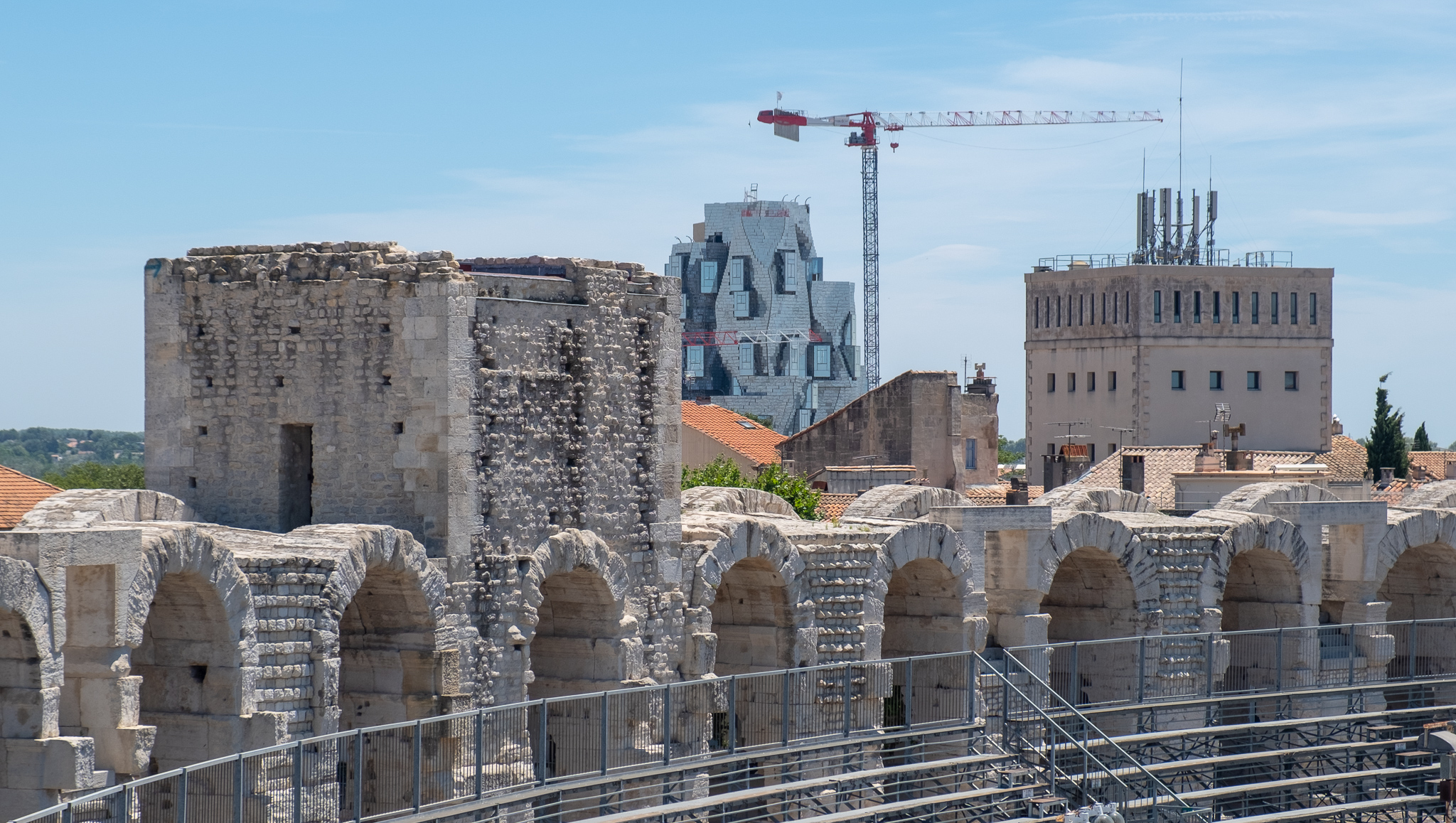
According to the Wall Street Journal, the silver structure is already covered in nearly 12,000 “microstressed” steel blocks. It’s set to open soon and is already hosting events. The driving force behind this structure is a contemporary Francophile with far more influence than Van Gogh ever achieved in his lifetime: A 62-year-old Swiss art patron, Maja Hoffmann, key funder for “Luma Arles.” A scion of the Hoffmann-La Roche pharmaceutical company, she has worked in the arts and film production for decades.
Nearby is the well-known Actes Sud, an independent publisher with a big reputation; its director, Françoise Nyssen, recently was tapped as the French cultural minister under President Emmanuel Macron.
And it is this old vs. new that defines the rest of Arles. Visiting the city, we sought out numerous Roman ruins as well as the still-in-use amphitheater. You really can’t help but see them even if you’re not looking—they are central and prominent in this small city.
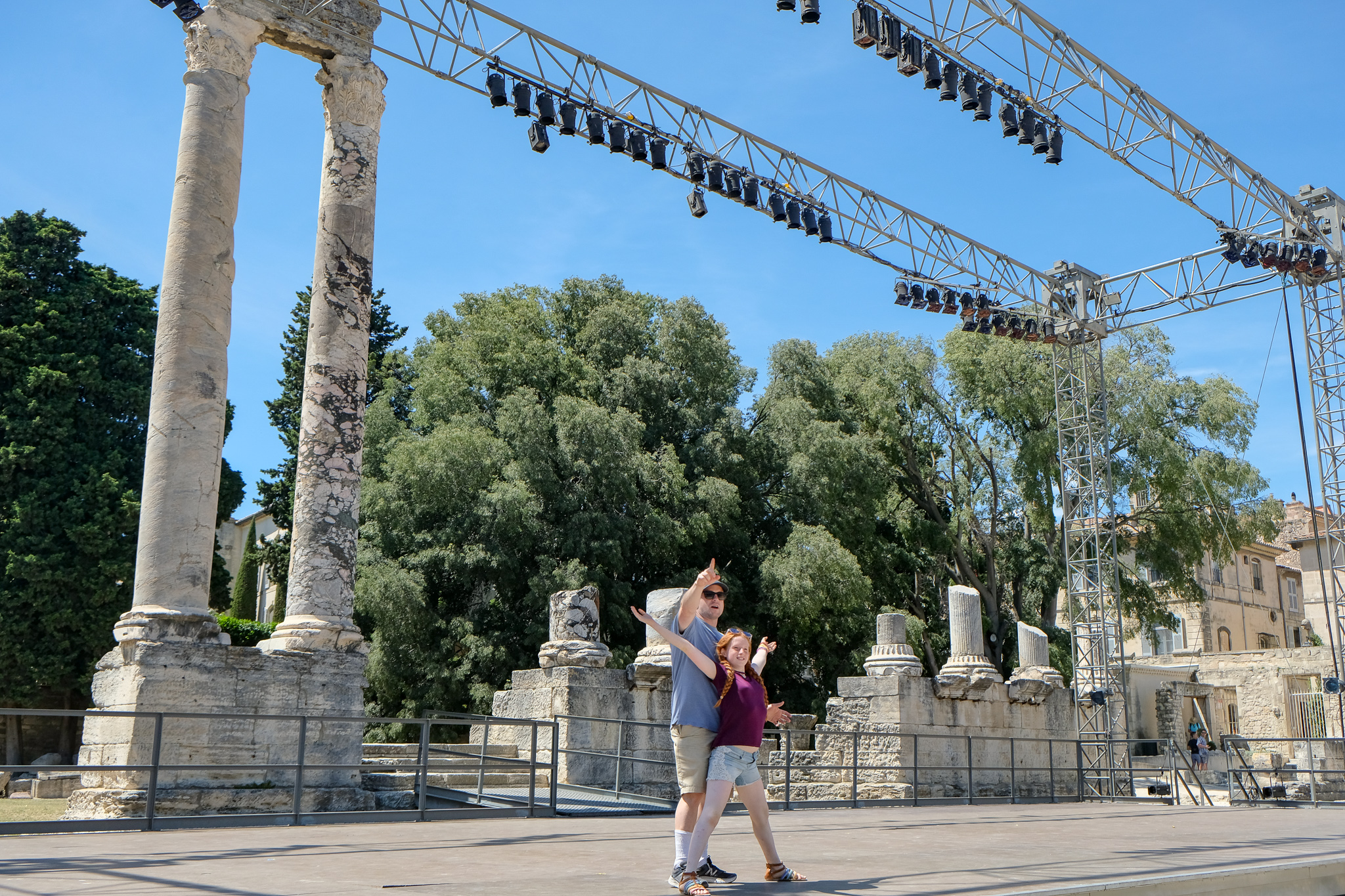
We stood on a Roman stage and looked out at Roman stadium seating (invented by the Greeks, but a staple of Roman bread and circuses). We saw old Roman marble columns being repurposed in medieval cloisters. A Turkish marble obelisk, also ancient, sits at the center of a main square.

A huge modern museum covers Arles’ ancient history extremely well, showcasing an ancient boat and many marble busts, as well as small-scale reproductions of what it was like in the really old days.
But there is a great deal of newness evident in Arles, too, and not just in the arts buildings. There’s also the contemporary photography emphasis, including an educational institution and a huge multi-site exhibit event that was happening just after our departure. (Our rental apartment featured some interestingly photographed female nudes in black-and-white, and a restaurant we ate at was displaying and selling artfully captured male semi-nudes.)
You’ll find numerous hip boutiques and trendy restaurants that dot side streets and places. A fun one: a store named after the mosquito, La Moustique, carrying all kinds of creative things with images of the hated insect (this one gave my older daughter PTSD from the 40+ mosquito bites she sustained at summer camp the year before… and her propensity to attract the critters wherever she goes).
And one more innovative establishment to add to the list: a Michelin-starred restaurant, recommended by a colleague, that we were lucky enough to enjoy. The Atelier de Jean-Luc Rabanel is a retreat from the dusty streets into quite another world of upscale dining. We began in a bamboo-laced room with large comfy seats, consuming a cherry gazpacho with garlic sorbet and fish with anisette broth and tiny vegetables. The chef, Jean-Luc, stopped by to say hello. Even the number of breads on offer, around 6 kinds, amazed us (hint: skip the squid ink, try the chocolate).
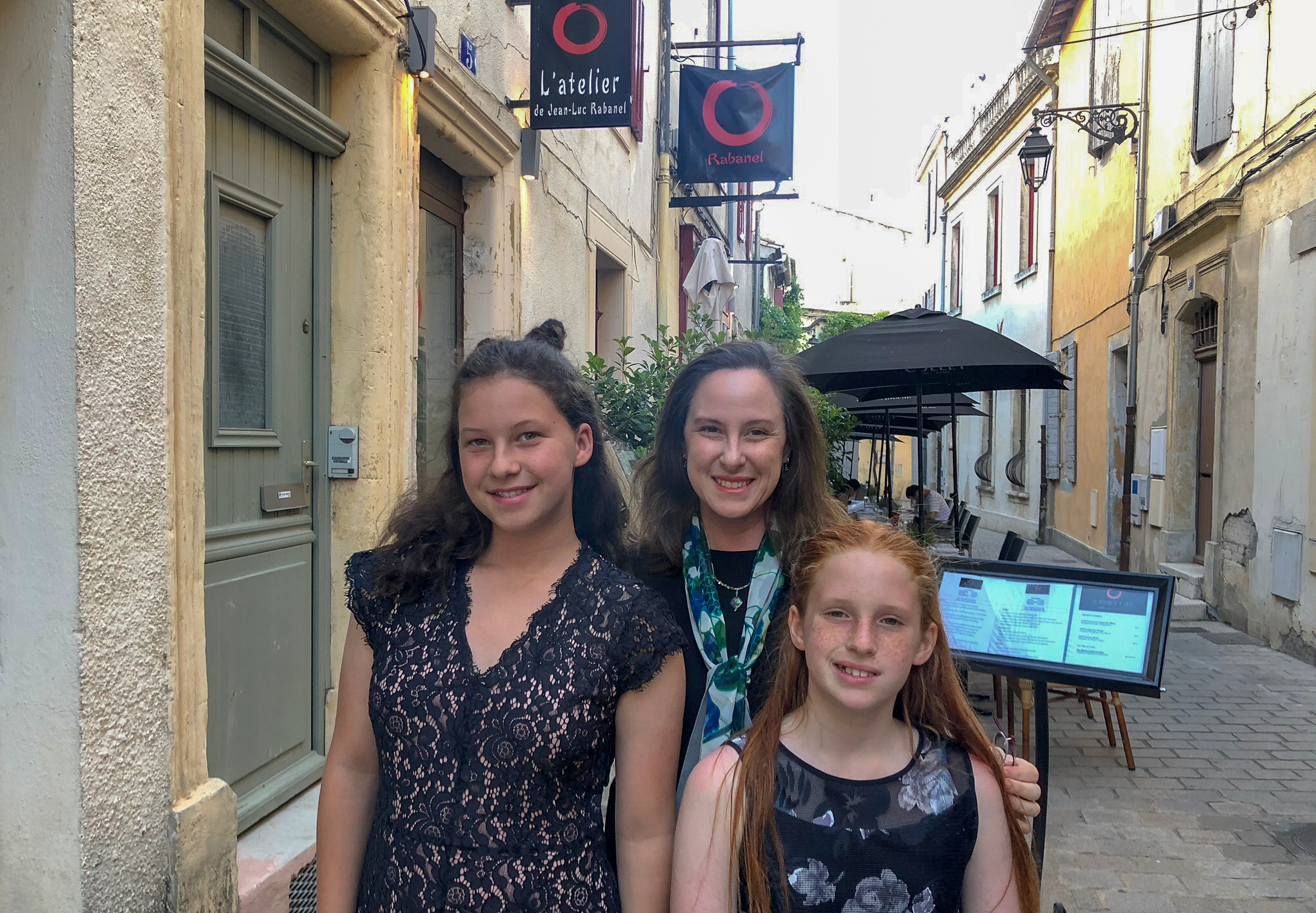
As we enjoyed our first courses, we noticed other diners being whisked away—odd, we thought. Are they finished with their multicourse meal so soon?
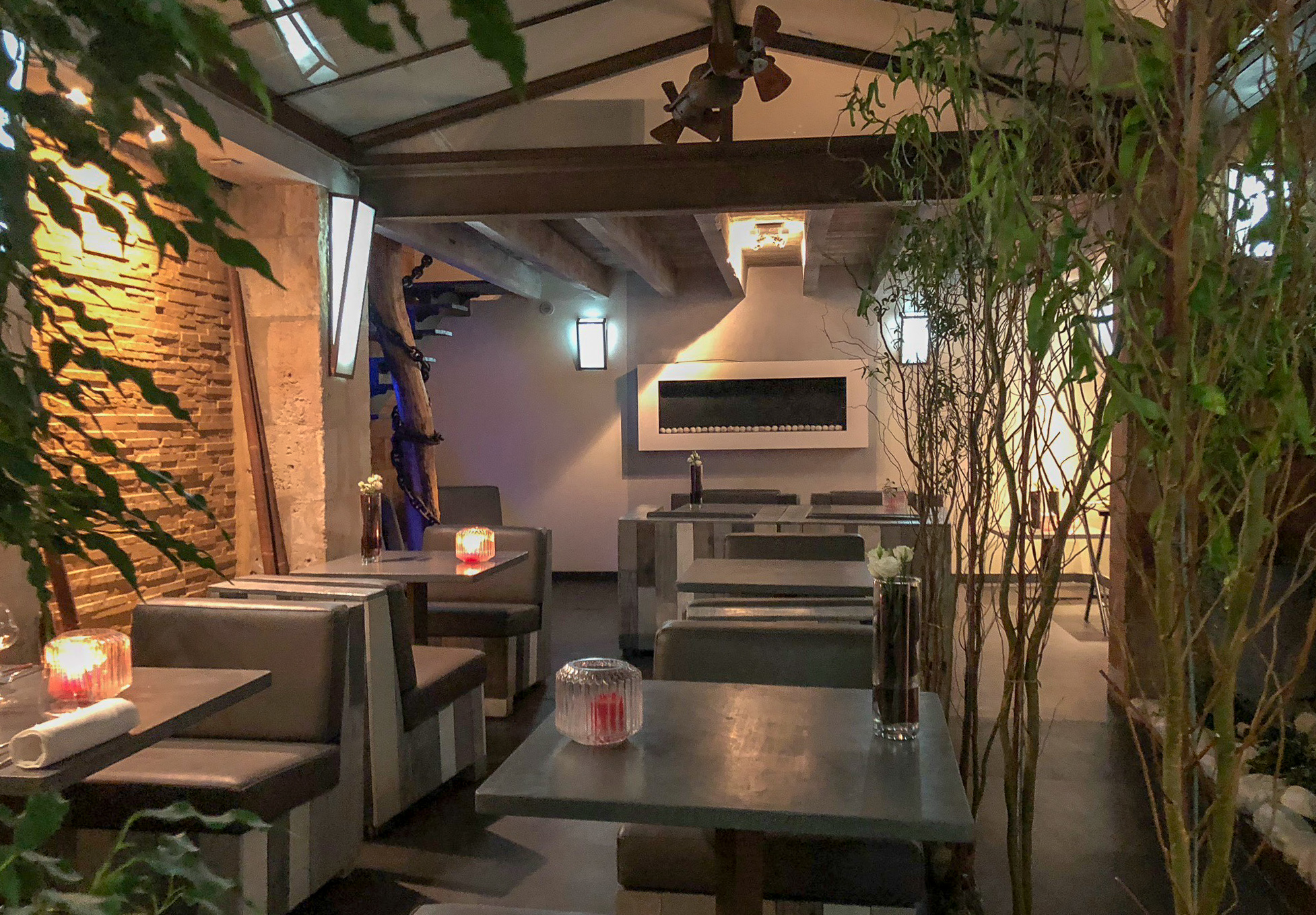
No. They (and we) were being moved to a separate dining room, one with fanciful photos of beautiful women in toreador outfits and the mysterious bulls they loved (OK, I might not have that exactly right, but it was something along those lines!).
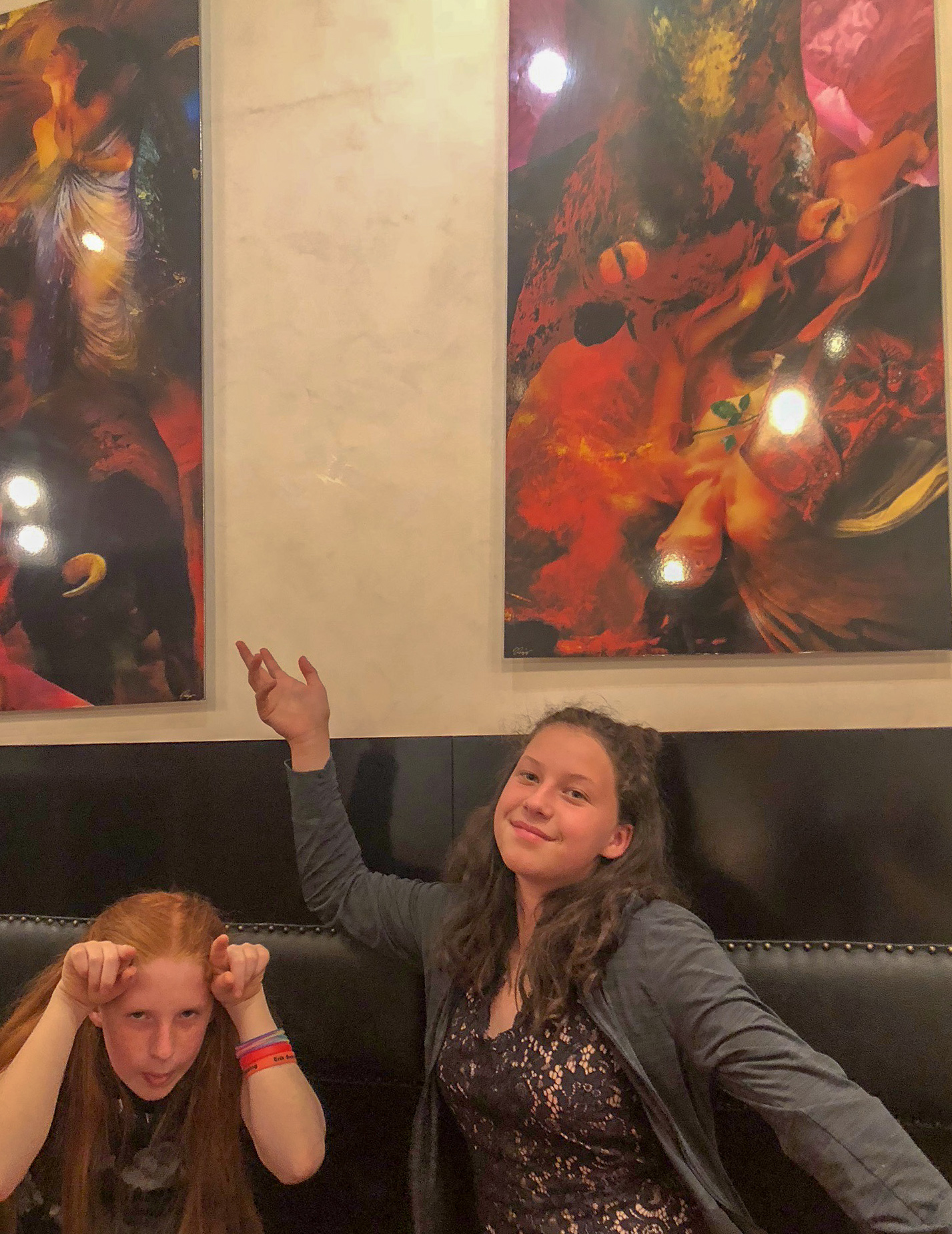
We were indeed given a plate of “taureau,” a popular dish of “bull meat.” The Camargue marsh area around Arles is known for wild bulls. I don’t know much about their lives, but I picture them enjoying the southern sun until they enter the amphitheater for a bullfight (nonlethal in France these days) or they end up on our dinner plates (definitely lethal).
But despite its solid ancient roots and its artistic sparkle, Arles often feels like an out-of-the-way place. It’s a city that hasn’t been discovered yet by Uber drivers, for example. We did meet up with one, just by luck: he was from Marseilles, and normally worked there, but a passenger at the Marseilles airport had asked for a ride to Arles. Hence he was available to take us across town.
When I asked him why Arles is not serviced by ride sharing companies, the young, smooth-headed driver answered, “C’est une ville qui ne marche pas.” (It’s a city that doesn’t work… or pay.) I wondered what Arles’ famously Communist mayor would say to that?
In one odd way the city does “marche” (work) with enviable civility. It may seem obvious in this ancient city, but it’s important to note that the medieval streets in the old town are narrow—VERY narrow. These one-way passages can barely accommodate one medium-size car and often wind around blind corners. We found ourselves navigating through these streets in our rented Opel Zafira hatchback numerous times, with my husband (a fearless and experienced stick driver) at the wheel.
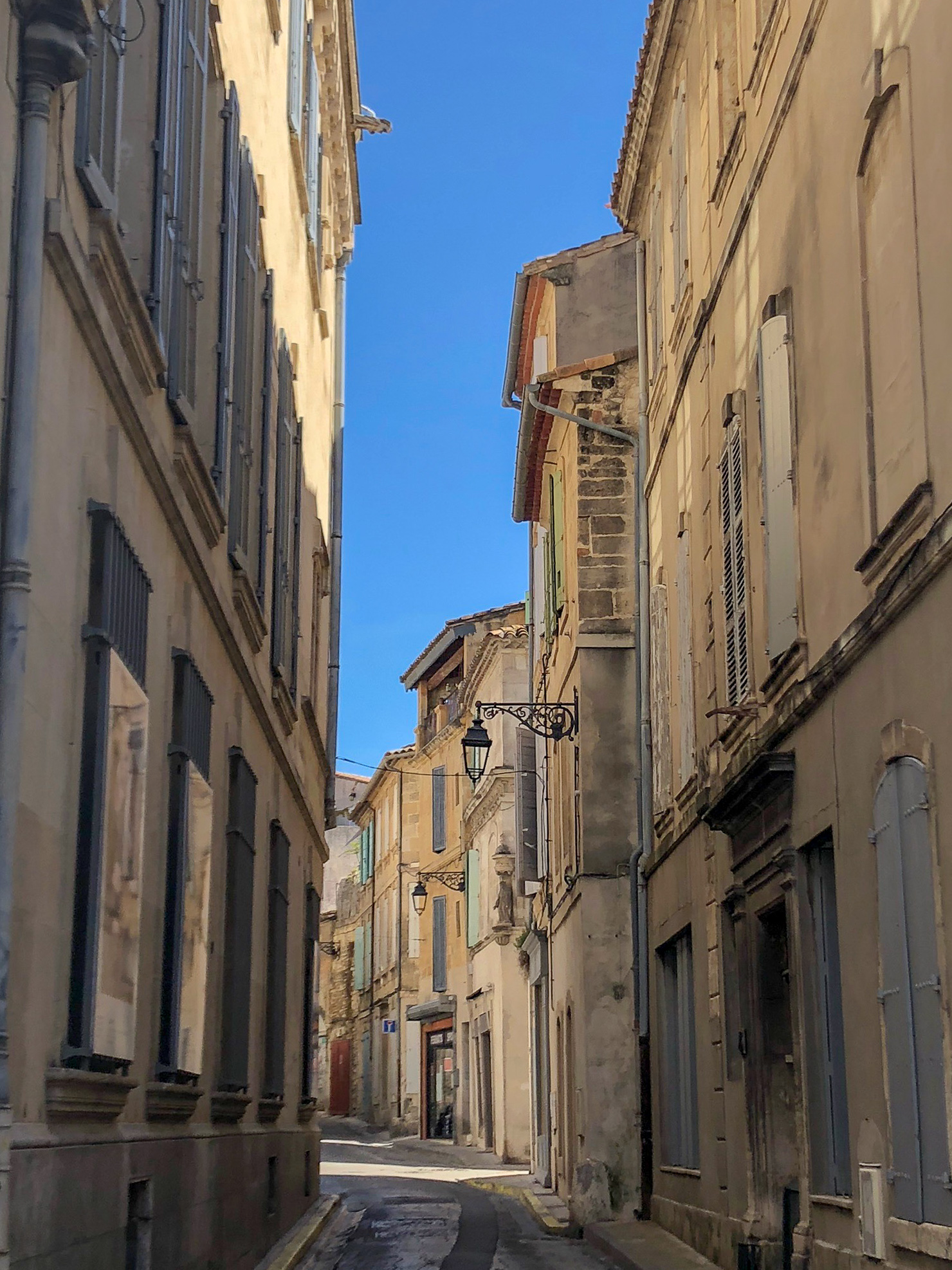
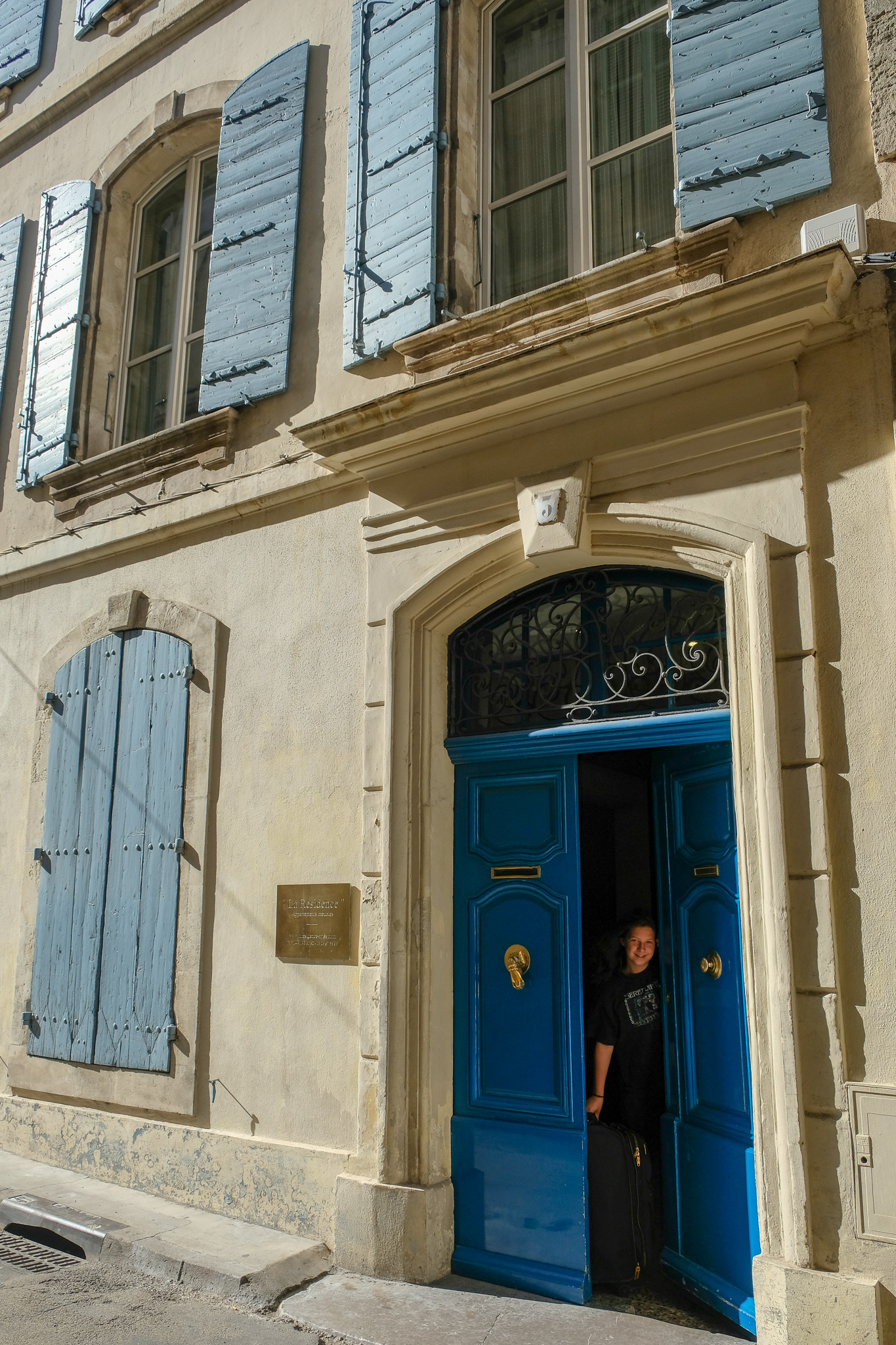
When we first arrived in the city after departing from an airy boulevard-like street near the train station in Aix-en-Provence (albeit torn up by construction), we were somewhat shocked. We approached the address our GPS gave us for our lodging. Was this tiny street really the road housing the furnished apartment building where we’d rented a place? There was just a sliver of sidewalk in front of the door with its old brass knocker, and no place to pull over without blocking all traffic behind us. I jumped out with my kids while my husband planned to circle the side streets and figure out a parking spot.
When we found the caretaker, a hip young woman, we asked where should we park to unload our luggage? Oh, just stop your car right in front of the door, she said, and unpack it there. Really? Won’t the drivers behind us be incensed while we block the street to remove 4 suitcases and various backpacks, tote bags, and briefcases?
No, they’ll be fine. That’s how we do it here. (Cue the raised eyebrows of four dubious Americans.)
Without any other option, we stopped and blocked the street while two adults and two kids unspooled all our stuff and deposited it behind the bright blue double doors of the apartment building.
Amazingly, cars stopped behind us, but no one got angry, no one yelled, and no one honked. Because they, too, have to frequently block streets themselves for similar purposes—and the Arlesians are willing to pay it forward.
That small gesture left a lasting impression of this vibrant, historic city.
The Ironies of Arles: Part 1
 The French city of Arles is filled with contrasts—you could even say ironies.
It begins with geography: an ancient city in the South of France built by the Romans on a marshland beside the Rhone, Arles is swimming in humidity and still heat one day. The next, it is swept by a fierce, dry wind—the Mistral—as sharp and piercing as you might expect before a sandstorm.
In fact, our early impression of the city as a paradise of mosquitos the first night of our visit was soon belied by this blast of Siberian air that blasted the annoying insects straight out of sight. I’d originally thought the Mistral was a sort of Southern French legend without much basis in fact, much like the Yeti or Loch Ness monster. I was quite wrong—the people of Provence were not exaggerating its strength.
But just as striking to the visitor is the legacy of another visitor who came to Arles, Vincent Van Gogh, who seems to hover over the city like a ghost, by turns benevolent and wrathful—and, most of all, lucrative.
The Dutch Van Gogh, who’d previously lived in London and Paris, came to Arles in 1888 for the light, he wrote to his brother Theo, an art dealer who gave him much encouragement. Van Gogh loved how bright everything was there compared to the rain-soaked north. The landscape also reminded him of Japan, he said, a great inspiration. He hoped to found an art colony in Arles and make the city a real destination for artists and art-lovers.

Van Gogh’s painting was incredibly prolific and innovative during his one year and three months in Arles. Many famous works were done in the city and in the nearby town of St Remy-de-Provence, a few miles away (where he went directly after Arles, voluntarily confined to the Saint-Paul-de-Mausole asylum there). He produced around 300 drawings and paintings during the short period he lived in Provence.
Imagine the painter at night, the sweep of the Rhone River below him, sticking candles in his straw hat to provide light in the dark, and then painting a starry night scene over the water.
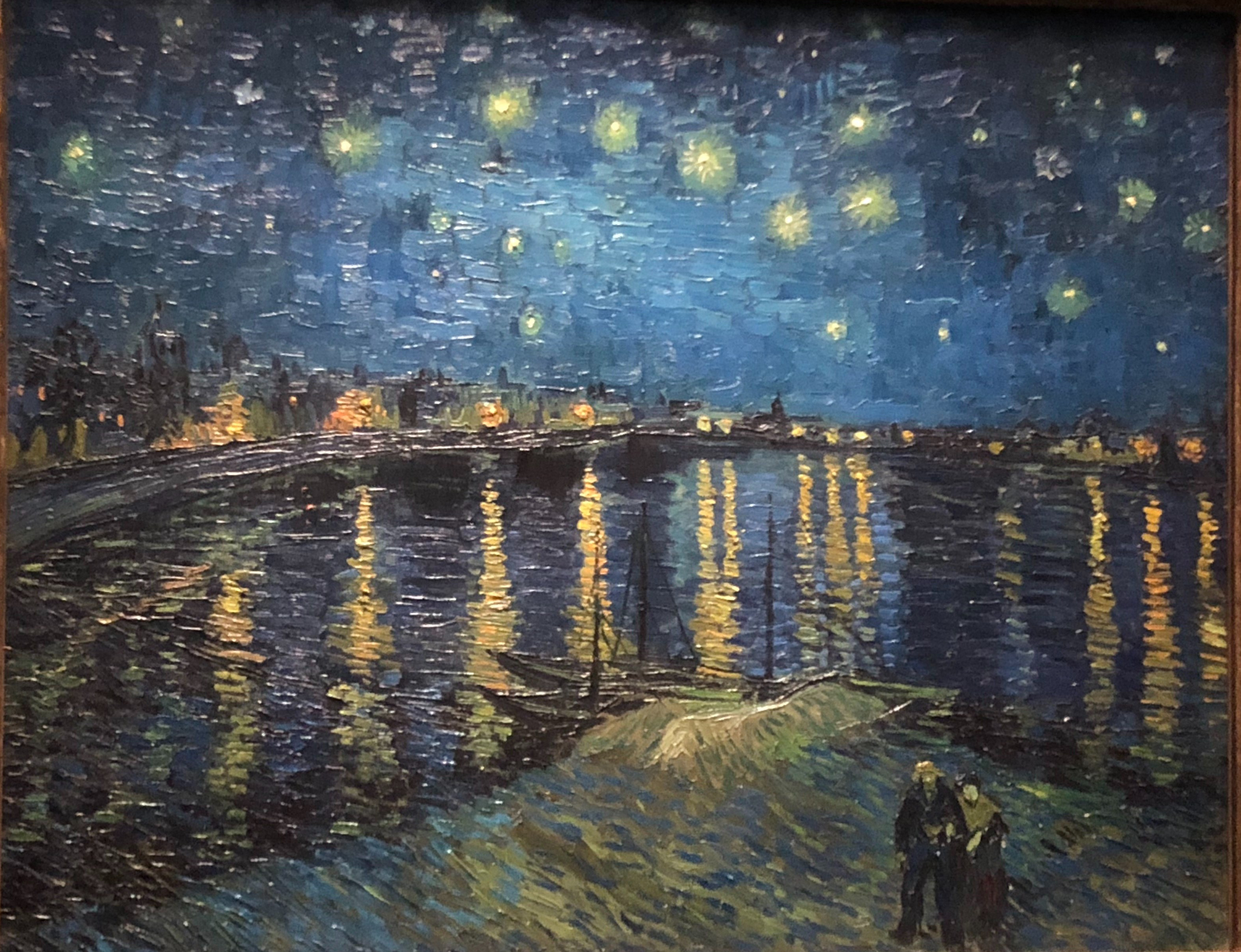
Imagine him depicting a bright yellow café lit up in the evening in the Place du Forum, its wide awning beckoning passersby to come and have a drink.

Imagine the people of Arles, irate, so angry that they started circulating a petition to force Van Gogh to move out of town.
That’s the part of the Van Gogh story that you may not hear so much about if you travel to Arles. Van Gogh, a “redhaired madman” (“fou roux”), as some called him, became known for acting erratically. He had been hearing voices, and he frequented brothels and drank heavily. Some (including his painter friend Paul Gauguin) found him physically threatening. Then—in an incident that has been used to sum of Van Gogh’s madness ever since—he severed his own ear and gave it to a prostitute he knew.
Van Gogh was taken to the hospital in Arles for a period—where he continued to paint, including an image of the flower-filled hospital courtyard—and began to recover, returning to his home. But the hallucinations continued.
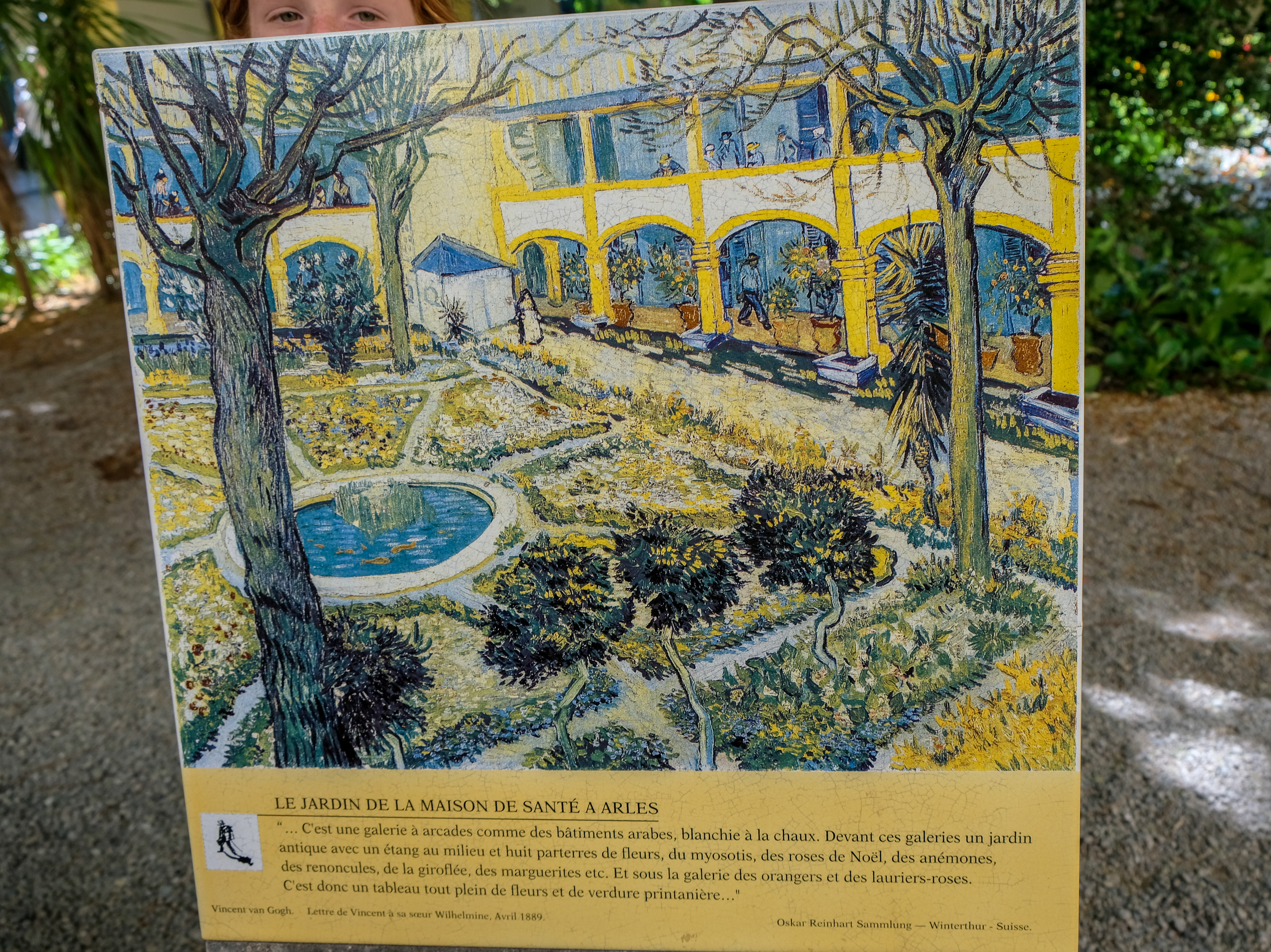
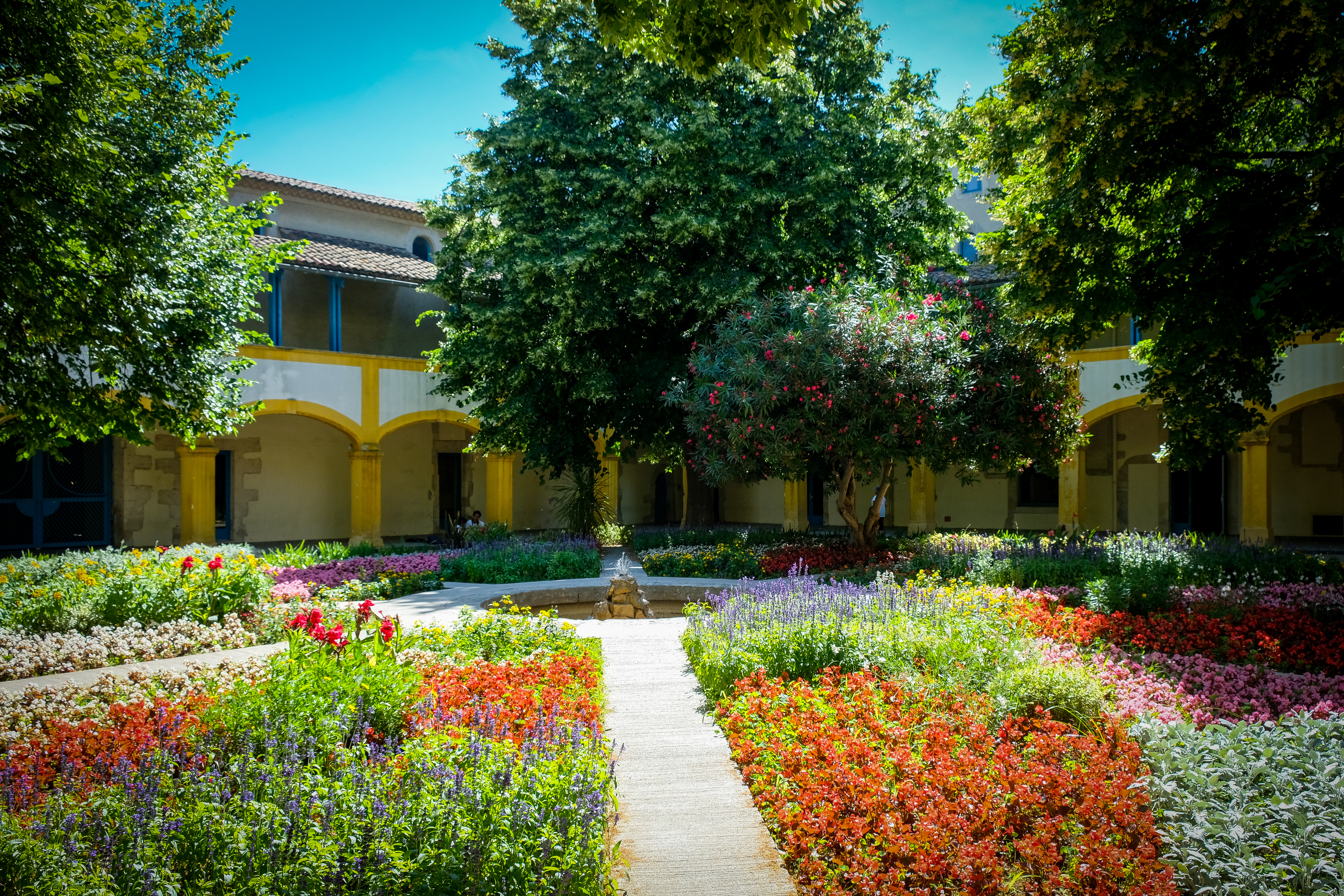
At that point, 30 Arlesians who signed a petition to force out Van Gogh made their wishes known. The authorities made Van Gogh leave the Arles “Yellow House” where he lived, and soon after he made his way to the asylum in St. Remy.
He continued to produce bright, beautiful paintings. Nevertheless, his troubles continued, and he committed suicide near Paris not long after.
Today it’s quite a different reception for Van Gogh in Arles’ tourist materials, local sites, art museums, and shops. Everywhere it’s Van Gogh. There’s the Espace Van Gogh, an art institution that was formerly the hospital, and the Fondation Vincent Van Gogh, housed in a 15th-century mansion, which features a handful of his paintings and many works “inspired” by him as well as other contemporary exhibits.
There are numerous outdoor reproductions of his paintings forming “easels” scattered around town, in spots where Van Gogh created his art. My family used those to organize a walking tour through the city.
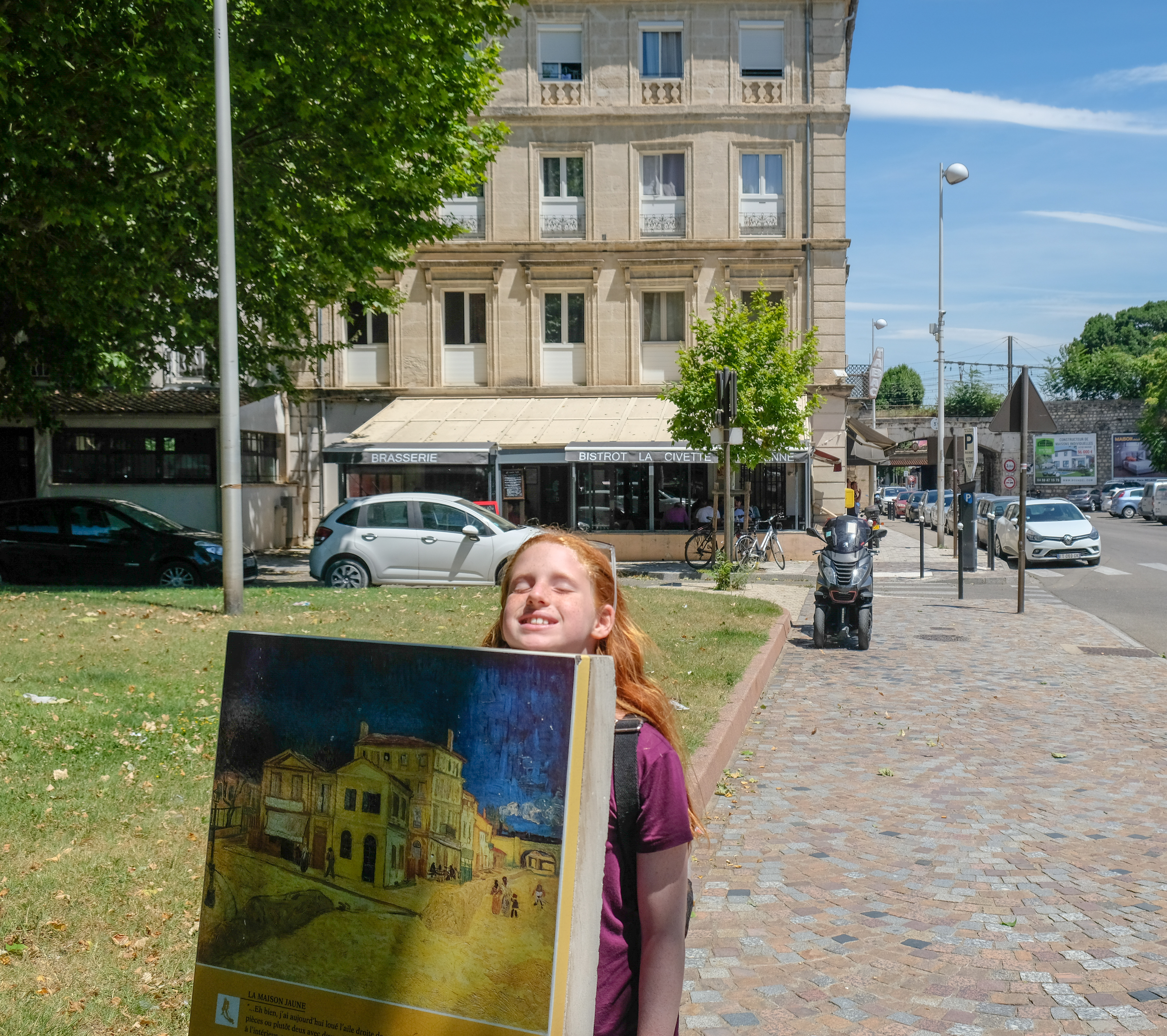

Some have tried to capitalize by recreating what Van Gogh saw. The “Night Café” he painted in bright yellow is there today on the Place du Forum, again brilliant yellow thanks to its current owners. Our guidebook warned it is a tourist trap, so we just walked by and ate at another restaurant. Many foreign tourists we observed seemed to focus almost exclusively on Van Gogh sites in Arles.
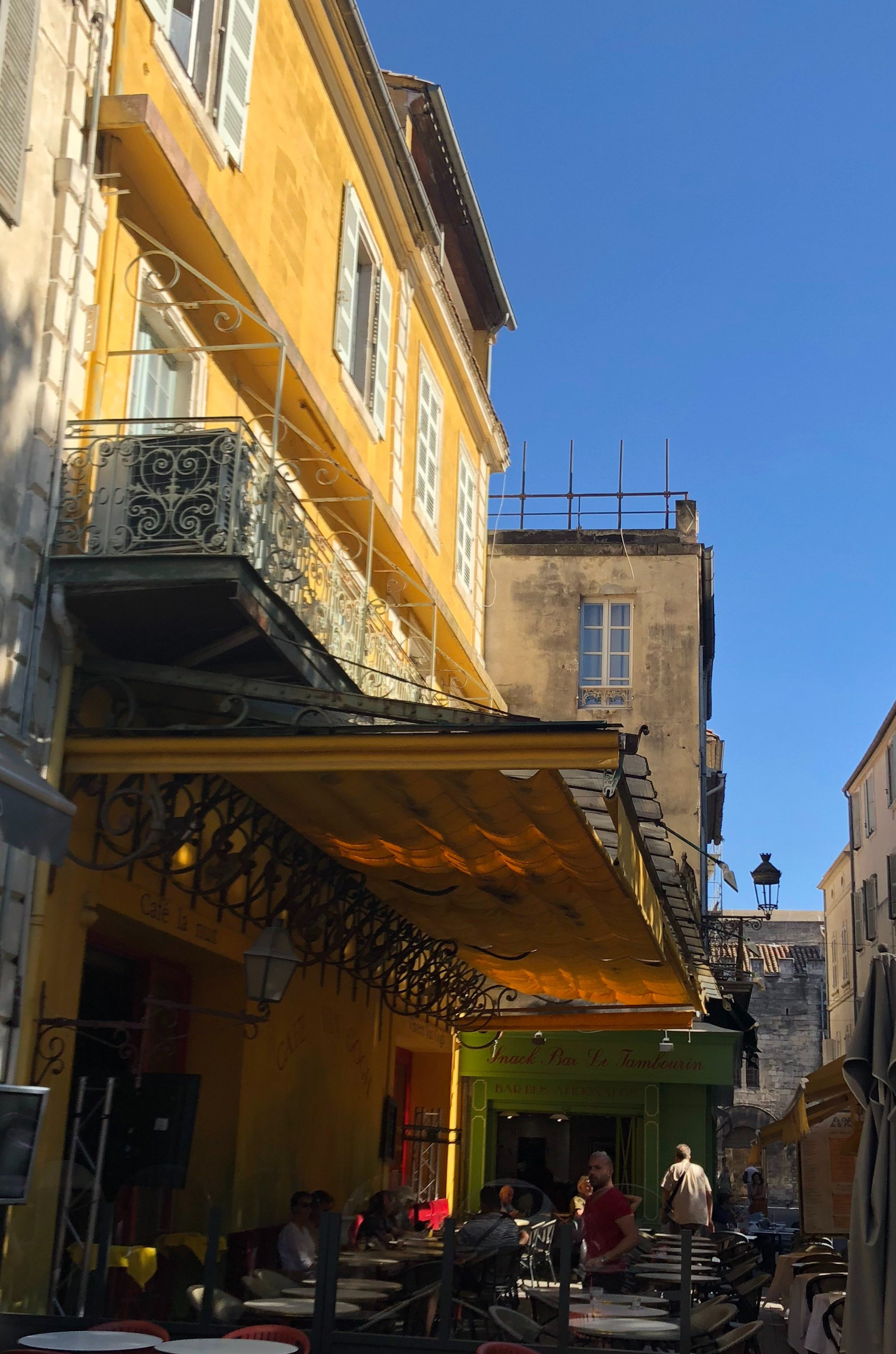
What was once hatred has blossomed into love, appreciation, and international commerce.
It’s a very friendly commerce. Shopkeepers and small stall-keepers in Arles were among the nicest and most patient that I’ve encountered anywhere in France. They explained, guided, and even made a little conversation with yet another tourist in their midst. I didn’t begrudge them at all wanting to give the public a piece of Van Gogh’s artistic legacy to take home, and to make a few Euros in the process.
I happily participated in the capitalist celebration of this tragic genius, coming home with a Van Gogh tote bag, Van Gogh calendar, Van Gogh pocket flashlight, and pillbox, not to mention a magnet and numerous postcards. (In my defense, several of these were gifts.)
And now, when I see artwork by the master, I’ll think of the windswept streets, the quiet gardens, and the expansive riverbanks of Arles.

Next time: Van Gogh’s dream of making Arles an arts destination is becoming a reality today. Find out how.
 MeredithInk