Paris Observations, Part 2

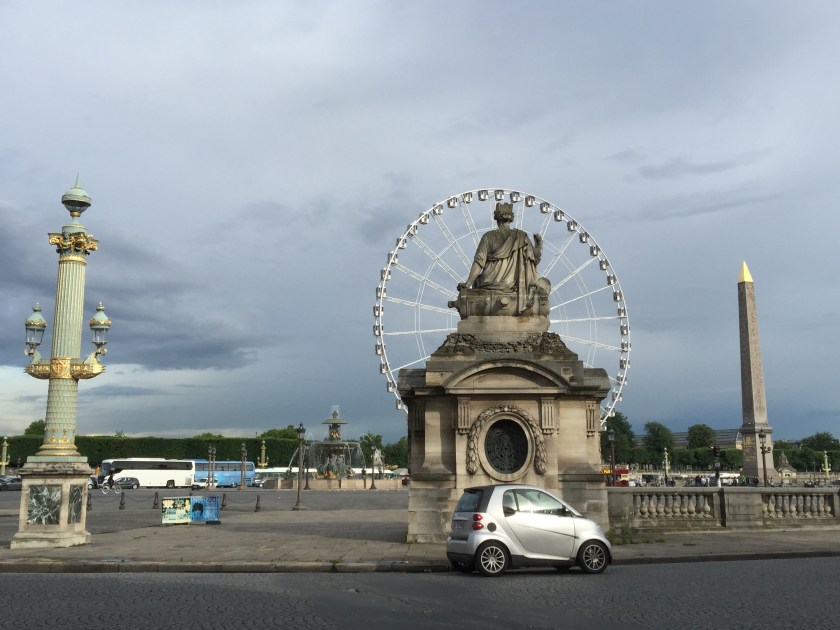
Following my first set of Paris observations, here are a few more thoughts. Read on for  notes on Parisian tattoos, pedestrians, iced tea, underground dining, water, pastries and crepes, and, of course, macarons.

……….

IMG_6166
In the popular Place de la Contrescarpe, and all around Paris, you’ll find many tattoos

Last time, I wrote about a French trend that echoed American fashion: fancy sneakers on everyone with everything. I also wanted to point out that the hipster look of tattoos (on men and women) and beards (men!) has also spread to France in a big way.

I recall reading an article about 15 years ago about how the French, and other Catholic-origin cultures, would never adopt tattoos (or piercings) enthusiastically, as Anglo-Saxon cultures did. That their Roman religious roots somehow made them immune to the idea of defacing their God-given bodies with permanent ink. Clearly that cultural theory has gone the way of the dodo. Tatts are everywhere now among the younger generations in France, just as they are in the US, and tattoo parlors have sprung up too.

It’s odd how, walking along the streets of Paris, Nice, or Aix-en-Provence, the 20-something students were indistinguishable from American hipsters. Levis have long been popular, but now it’s every aspect of their look that mirrors Americans. My French friend attributes this to Netflix, which is popular in France. Young people see American trends there. Instagram, too, and all kinds of social media spread the desire for the same styles around the world. The French are not setting the fashion pace when it comes to lower budget streetwear.

One upside is how little me, my husband, and my pre-teen daughters stood out as different in our American clothes, shoes, and accessories. In fact, people seemed to mistake us for natives. Normally, in the past, that would have made me smile, but now, I view it as a part of the homogenization of all cultures, trends, and self-expression: A little dispiriting.

We also had trouble recognizing who was a local and who wasn’t. I sometimes asked a fellow traveler for directions, and usually it turned out to be an American. When I realized their confusion, I’d rapidly switch from Parisian French to American English to rephrase my question. This amazed my kids. (As my husband said: “It’s your mom’s super power!”)

……….

Parisians walk VERY fast.

Our second night in town, we were strolling around the 6tharrondissement after dinner. We were tired, and full, and taking our time.

I heard behind us an exasperated voice. “Oh, les touristes,” came from a young woman to her friend. I overheard them scheming to jaywalk across the street to get away from our too-slow steps. Just then, Bob said we should cross together as well, and unknowingly stepped right in front of them.

The young women angrily muttered and marched around us, and I called out, “Oui, les touristes!” my voice somewhat bitter. I am not quite sure if they heard me or even cared. But it helped me to acknowledge that I knew they were talking about us…. and didn’t appreciate the attitude.dscf0404.jpg

A few days later, walking down a Parisian street, I heard myself saying, “My God, these tourists are SO slow. We’ve got to get around them.”

When in Paris, I guess, one can become slightly more Parisian.

The only problem is, when trying to pass other pedestrians on a very tight walkway, you might end up walking in the road, and there, the motorcycles (or cars) might get you. They come out of nowhere in the tiny old streets.

I am certainly not the first to observe the Parisian pedestrian rapidity. The late British author Peter Mayle, who wrote about his experiences living in Provence, reminded readers that you could always tell visiting Parisians in the South of France apart from the locals by how extremely fast they walked.

……….

img_5898.jpgIt’s official: the French have bubble tea (aka pearl tea, aka boba tea). We tried “Chatime,” a small storefront facing the Seine near the Place St Michel.

It’s like the bubble tea served in America, with a similar list of flavors (I got mango green tea), only even more expensive (at least 5 euros per serving). Happily, the tapioca pearls were quite tender, just how I like it. My daughters gave it a thumbs up as well.

……….

Eating in a wine cellar is quaint, but once you’re down there, expect a long stay. (This is not ideal for the claustrophobic or the super hungry.)

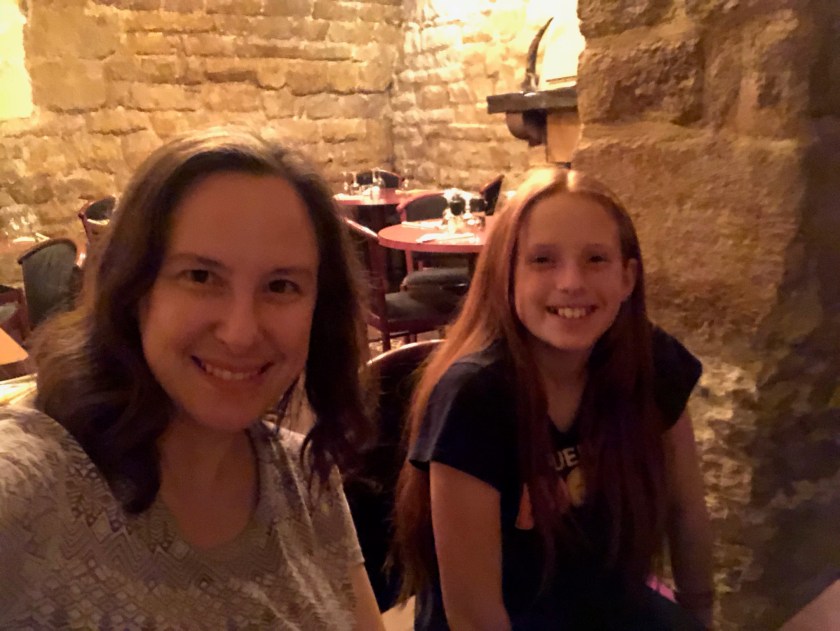
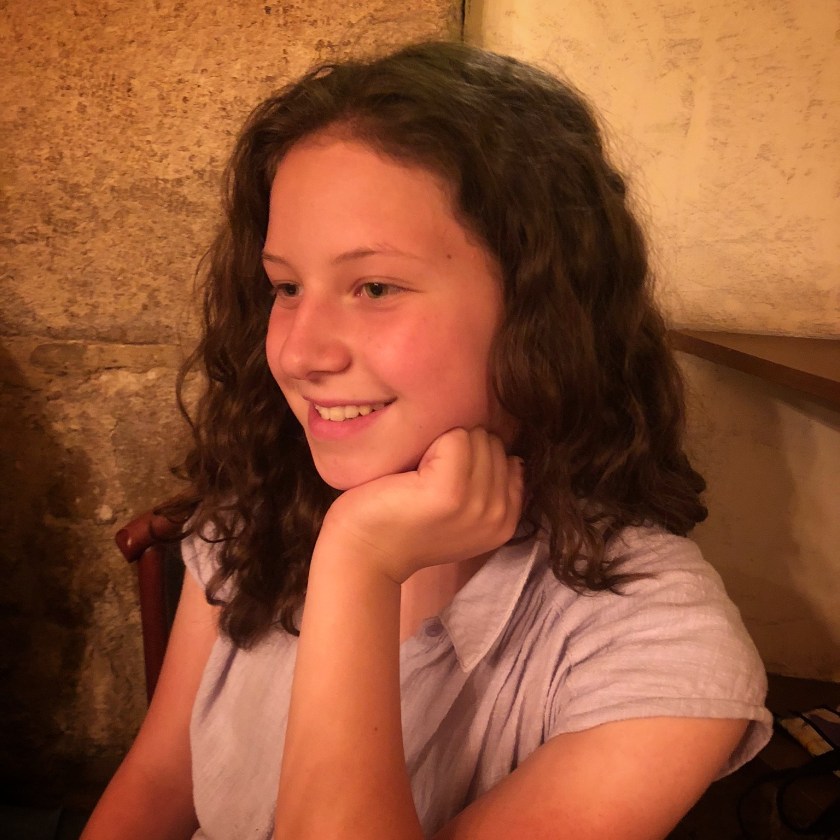
We enjoyed dining in the “caveau” on the basement level of a small restaurant on Paris’ charming Ile St Louis. The thick stone walls had a certain charm and had clearly been cleaned and refreshed. However, it was slightly musty and dank, and “out of sight out of mind” is surely true in France as well. We saw our server approximately once per half hour and eventually had to ascend to ground level three hours later to pay our bill and move on with our lives.

I did enjoy the endive salad and fish, though, and we had plenty of time to talk and visit as a family. But I confess, I breathed easier as we emerged into the open air.
IMG_6454
Caveau dining, a long (and slightly caustrophobic) experience

IMG_0884

……….

Water is a precious resource. We all know this, but as Americans, we have come to expect water served at restaurants as our due. During the long California draught, we noticed more restaurants posting signs saying “to save water, we won’t serve you water unless you request it,” and we were somewhat annoyed. Americans want our access to free water to begin just as soon as we arrive at an eatery, thank you very much! You know, “give us your tired, your thirsty,” etc. (Yes, this is a generalization, but I challenge you to find evidence to the contrary.)

Well, in France (and Europe overall) getting water is a different story, one that tells of scarcity rather than abundance.

Few water fountains grace French public places. French restaurants are required to serve you free water if you request it, my French friends tell me. Yet they are not exactly happy about it, since they make no money off the tap water itself, and probably resent having to wash your water glasses “for free.”

So when you politely request “un carafe d’eau” with your meal, be prepared to wait. And wait. And the carafe that the water brings will be small, and you will have to ask for multiple refills, especially if you are traveling with parched, potentially dehydrated, tour-weary children.

(Also: Be sure not to ask for just “water”–“eau”–because often they will bring you Evian or another expensive bottled water. Word to the wise: “carafe d’eau” is the way to go.)

The water dearth in France did make us value our free-flowing American water. We are used to large, ice-filled glasses of the wet and refreshing stuff set down in front of us almost as soon as our rear ends hit the seats.

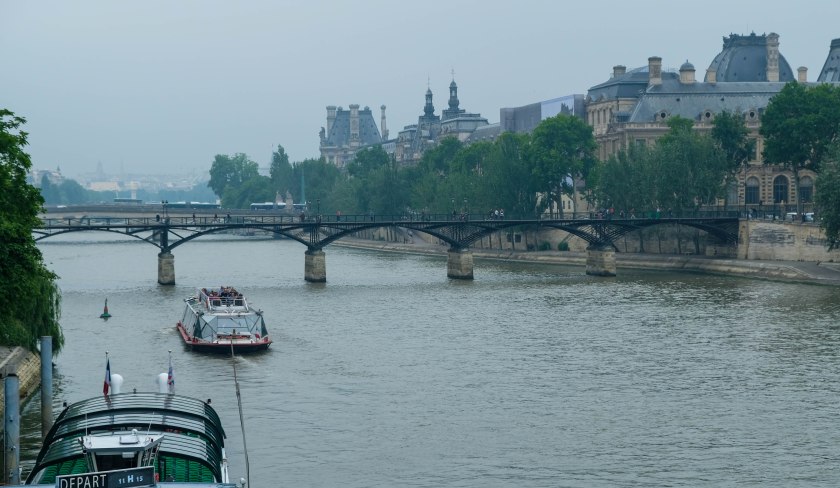
(The only kind of water we saw a lot of in Paris was the Seine, and of course the waves and waves of rain that fell on our heads.)
DSCF0388……….

Speaking of ice: You may know that ice is not really a “thing” in France if you’ve ever traveled there before. But there’s often a unique twist in the Gallic mind. What got me this time around is that there are more restaurants serving “iced tea”—just don’t expect ice. (As I mentioned above, bubble tea, a.k.a. pearl tea, has made it to Paris, but it’s still a rarity.)

After leaving Paris, I ordered and consumed a lovely “thé glacé” in the Rothschild Villa restaurant in Cap Ferrat on the French Riviera (a longer story for another time). Quality tea, and was served cold. Well chilled, but not an ice cube to be found, just a foamy layer on the top.

Be warned: most places in France that serve “iced tea” will give you Nestea Pêche in a can, or some other syrupy disaster.
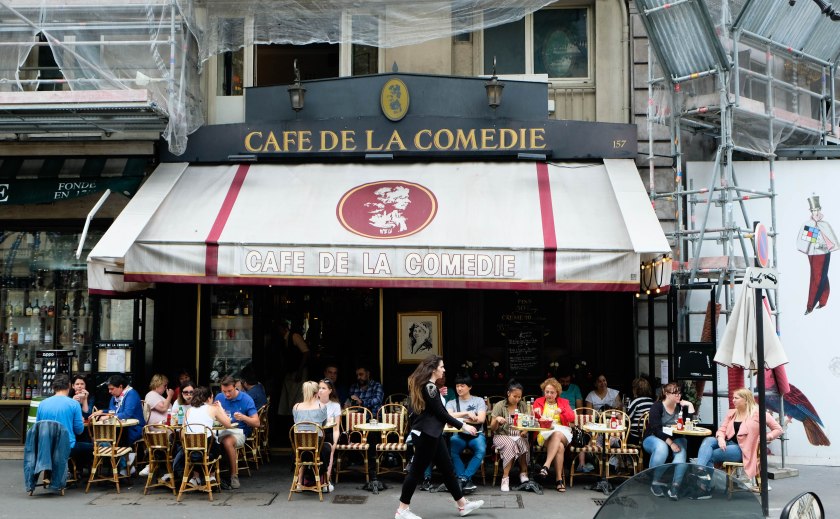
DSCF0252……….

My kids never thought they’d get sick of pastries. And yet…. temporarily, they did. Numerous croissant breakfasts, both to-go from bakeries and seated at cafés, seemed to put them over the edge.

My older daughter tried brioche and almond pastry; my younger daughter preferred chausson aux pommes, an applesauce-filled puff pastry. But after nearly a week of this, they started to rebel. The kids were quite eager to return to cereal, toast, and eggs.

They even seemed to tire of crepes, which I also didn’t think was possible. Within three days we had crepes three times for lunch. The frequency took the fun out of it for them.

Personally, I really did enjoy the “crepes de sarrasin,” I ate, also known as “galettes de blé noir.” In this country, we’d call it a buckwheat crepe or pancake. It’s uniquely hearty and savory, especially with swiss cheese, mushrooms, and a touch of egg or ham. Those crepes are the “salée” or “salted” version you often find in France (and especially in Bretagne, birthplace of great crepes). They are perfect with a bowl of hard cider, also from Brittany (I prefer brut, but some like doux, or sweet).

The “sucrée” crepe, on the other hand, is made with a more typical white flour and served sweet with a range of flavors (Nutella or chestnut being favorites). It can also be tangy with a lovely sprinkling of fresh lemon juice.

I’m getting hungry.
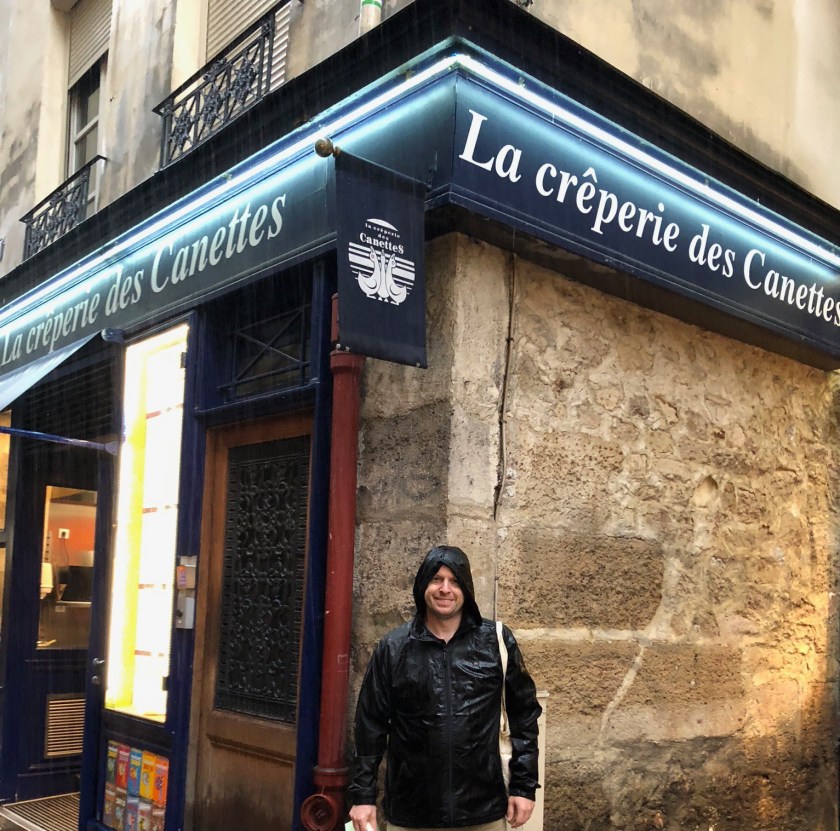
IMG_6022
The site of the best crepes we had in Paris, in the pouring rain that sent us running inside

……….

And once more back to food: macarons. If you like things French and live in a major metropolitan area, you’ve undoubtedly tried these upscale delights. If you don’t know them, I do recommend you seek some out. I wouldn’t exactly call them cookies, but they are in the cookie/pastry family. They are essentially two fluffy rounds with flavored cream or preserves inside.

On this trip, we were struck by the expansion of macarons across Paris and France. More than ever, they seemed very widely available. We stopped several times at La Durée, where the macarons on offer were light and delicate and delicious. My daughters surprised me by loving the rose and geranium flavors. I’m partial to raspberry and lemon. Mmm.

Sadly, I lost my sense of taste for a time during my Paris stay. This happened because, unfortunately, I’m allergic to the city. Its high ozone levels and diesel pollution make me ill after even a short stay. But through the wonder of allergy pills, I regained my senses in time to take in a few last macarons, and the memory lingers.

IMG_6018


Paris Observations (Part 1)

DSCF0182-2

Paris is a very old place, and yet it has remained dynamic over the centuries. Every time I return to the City of Light, I see something new—some detail or quirk that I’d never noticed in numerous visits, or something that’s actually changed as generations of Parisians shift and evolve.

In this post, I’ll share the first part of my Paris observations from June 2018, when I visited with my husband and two daughters.

……….

As soon as I arrived in the heart of the city, I spotted a trend. Just about everyone—both men and women—sported fancy sneakers.

These are specific kinds of sneakers: Adidas, Nike, and New Balance, primarily. Only certain colors and styles that qualified as somewhat upscale. Gentrified sneakers, not so much running shoes as urban fashion sneakers. And compared with two years ago, it was a vast uptick.

My older daughter, wearing slightly beat-up Adidas Superstars (the kind popular at her school), fit right in, whereas in ages past, any sneakers-wearing tourist would have been immediately branded an American and pointed/laughed at. (When I was a student in Paris, I selected my footwear just as carefully as my clothing, to try to fit in. Leather oxfords, flats, or sandals seemed acceptable then.)

Screen Shot 2018-08-02 at 6.18.54 PM

Our first night in the city, my husband and daughter spent a couple hours watching feet go by the Place St. Michel as we sat at the Café St-Severin. Nearby, Saint Michael himself watched us from his mighty statue, wings spread and sword in hand, judging us all.

Screen Shot 2018-08-11 at 9.59.22 PM

Sneakers with wide culottes. Sneakers with dresses. Dodging puffs of smoke from  neighboring diners, my family members spied dozens of Adidas and Nikes coming in and out of the Metro stop.

Interesting that the French seem to have now embraced healthier approaches in some areas—wearing supportive footwear, drinking detox teas, enjoying spa treatments, and taking up running—while still continuing to smoke like chimneys.

……….

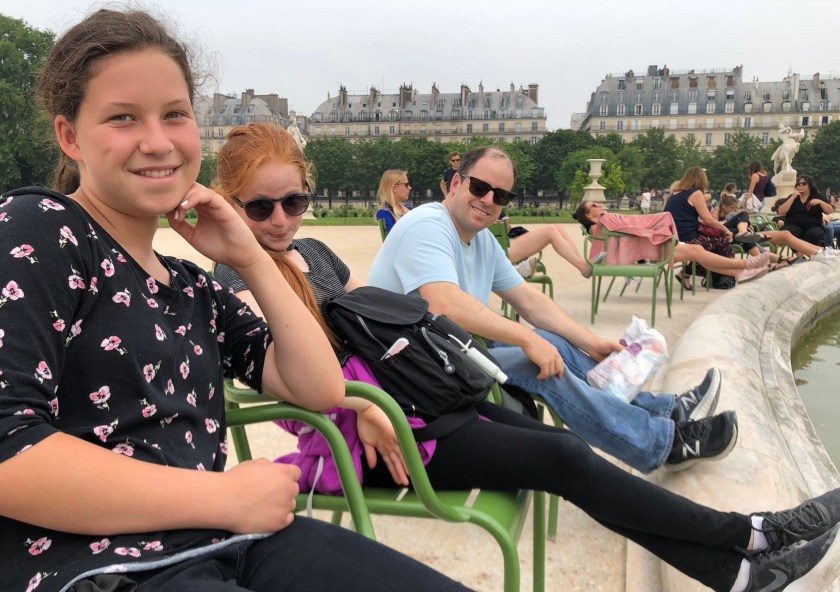
In Paris, we walked. And walked. And walked (in our well-designed footwear). And then we did what the French do, alongside tourists, in public parks—we propped our weary feet up on the edges of large fountains.

We did this at the Palais-Royal, the famous royal courtyard now populated with black-and-white columns, leafy trees, and a traditional round fountain basin encircled by metal chairs (this site was featured in Mission Impossible: Fallout, along with many other Paris locales).

Screen Shot 2018-08-11 at 10.23.39 PM.png

Later, in the Tuileries garden, by an even larger round pool, where many tourists sat to take in the view of the Louvre, statuary, and patches of (off-limit to feet) very green grass.

The weather was humid and damp, not exactly hot, but sticky. (It got cooler and much wetter as our Paris stay went on.) Given our jetlag and the longer-than-usual walks often fighting against the traffic waves of cars or of other tourists, it felt good to relax à la française.

img_5786-e1533017095808.jpg

……….

Have you ever been shamed into silence by a museum guard? My family has.

“Un peu de silence, s’il vous plaît,” alternated with “quiet, please” (same thing, in English, and less poetic-sounding). This happened in two places: the Orangerie museum was the first. It’s a gem located in the Tuileries garden, not far from the Place de la Concorde. The museum houses remarkable wrap-around waterlily paintings by Monet, who wanted the space to be a sanctuary for “working men” (and women, one hopes) far from the hustle and bustle, a place of rest and peace. I sort of got the point of honoring his wishes in the Monet rooms.

DSCF0292-2

But in other rooms, featuring riotous post-Impressionists, the same rule seems to hold—guards asked us to keep our voices down. And they did that too, with other patrons who had not yet learned to communicate with each other silently, in a special exhibit featuring the influence of Monet on contemporary New York artists.

Really? “New York modern art scene” and “silence” are a very unlikely combo, in my opinion.

The second spot of voice-shaming was the mausoleum in the basement of the Pantheon, where Voltaire, Rousseau, Victor Hugo, Alexandre Dumas, and many others are entombed and memorialized. I understand that it’s a solemn place.

But the female guard yelled “silence” and “quiet” through the labyrinth of echoing halls so vociferously that it was unsettling. Her voice created its own disturbance. (My younger daughter continued to invoke the hypocrisy of this approach long after.)

……….

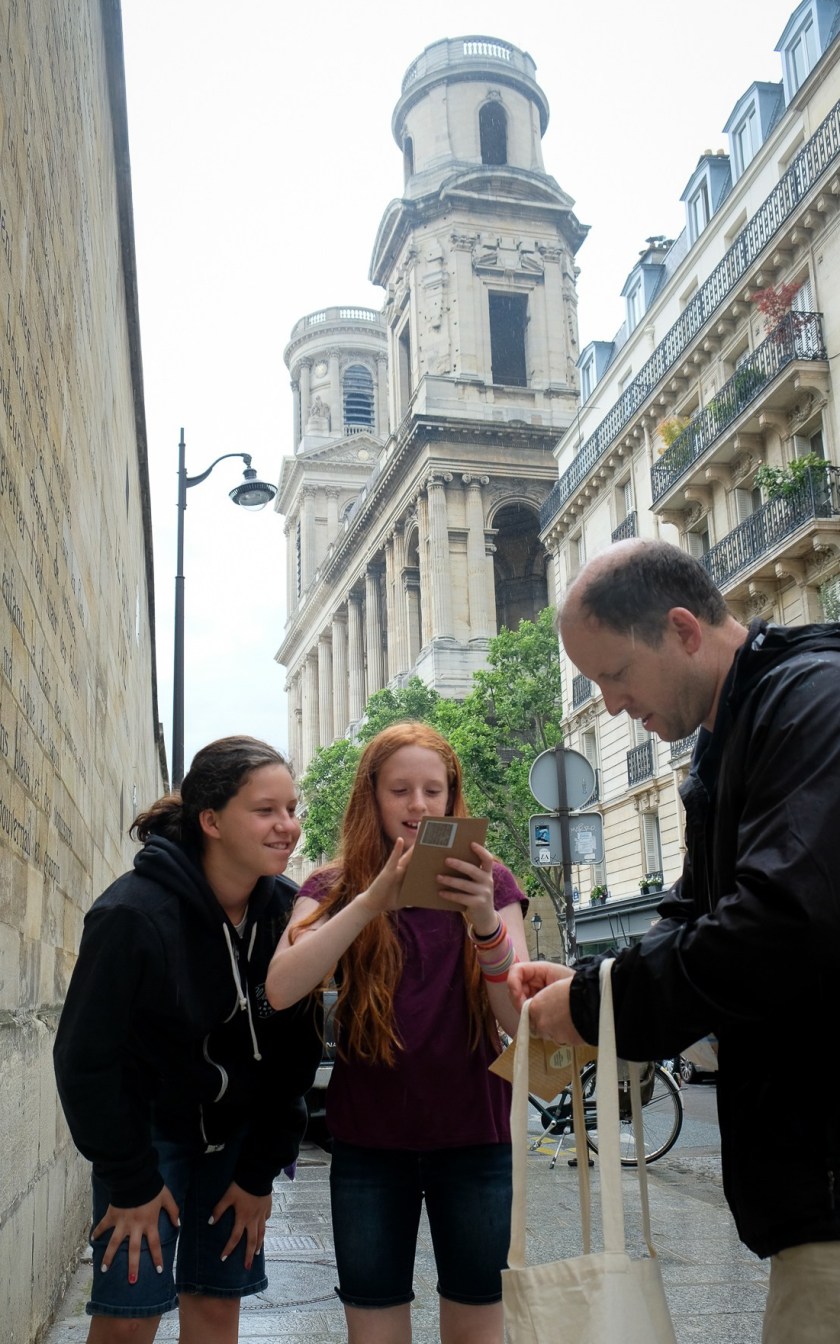
Also in Paris, we learned that if you design a treasure hunt, it’s best not to offer as clues “water” and “a ledge.”

The otherwise-clever City in My Bag Paris treasure hunt overlooked this notion.

DSCF0349-2

The experience as a whole was quite fun and we enjoyed the little gifts and treasures we could “unlock” along the way by solving location puzzles. However, one visual clue was a photo of water from above. In a city that 1) has a large river running right through it 2) has numerous (aforementioned) fountains everywhere and 3) is constantly being rained on and fairly frequently flooded, a picture of water does not really distinguish things much.

The ledge image, a different clue, was also kind of funny. It turns out that specific sizes of these items were used by the French as they converted to the metric system more than 200 years ago. Physical ledges, built into walls, told the citizens how long a meter was.

(Are we meant to picture people walking up to these ledges, taking their measurement, and then being forever informed of its size? Or did they have to go back over and over again to check their work?)

There’s one such ledge still in existence, and we think it’s somewhere near the Luxembourg gardens. The only problem was, what was happening near the gardens when we visited that day was an aggressive protest. A passerby told us it was striking railway workers, but with all the smoke bombs and torches and loud megaphones booming, as well as the armored swat teams ready to pounce, it was a bit hard to tell.

DSCF0401-2

The rest of the week, my younger daughter kept pointing to random ledges and asking, “Is this the ledge? Is it this one?”

dscf0407-2.jpg

……….

We may have made it onto the B roll of a French film.

I can’t be sure. I really have no idea what they were recording with a professional-grade video camera when my kids and I visited Sainte Chapelle. We were admiring the gem-like windows, coated in brilliant red and blue stained glass. They surround you on all sides in the former royal chapel, an outstanding example of medieval artistry and modern cleaning/repair work.

IMG_6169

And then the woman in red appeared, and with her, an encourage. A large camera, a mic on a small boom, and some people hovering about trying to ensure a good shot.

At one point she ascended to the top of the pulpit area. And her camera person seemed to be seeking something else to shoot. Another person–the assistant director perhaps–pointed in our direction as we were carefully observing windows from the sidelines. The camera pointed our way for sometime. I could swear it moved with us.

I wanted to ask what they were filming, but they were intensely focused, and I didn’t find a good opportunity to interrupt their work.

So who knows? “Coming soon, on a screen far from you: Meredith and daughters touring Paris, hot on the heels of a mysterious woman in red…”

……….

Next time: Paris musings, part two. Please return for the sequel!

Take it from Thor: Laugh a Little

Thor (creative commons)

Watching Thor: Ragnarok reminded me: why do we have to take ourselves so seriously?

The genius of this comic-book movie is that everything is played as something of a joke, or at least with a degree of humor.

The most obviously hilarious elements spring from Jeff Goldblum’s perfect “Grandmaster,” and Chris Hemsworth’s Thor is a font of semi-self-aware observations and childish arguments with the Hulk, the neurotic Bruce Banner, and the preening, self-congratulatory Loki. Even the drunken Valkyrie, the rabid fire monster, and the over-the-top villain Hela are absurd in themselves, acknowledging with their smirking expressions that they are—as in a comic book—overdrawn.

This is exactly what a comic-centered movie should be: an entertainment that understands its value lies in larger-than-life characters with awesome strengths and quirky foibles. I give director Taika Waititi credit. He shows us god-like figures (or in Thor’s case, an actual god) who can do it all, and make it look (fairly) easy, while laughing about their absurd predicaments on some level.

The experience as a viewer is a far cry from the “dark,” overly violent, crazy serious comic-book character films we’ve seen in recent years: Spider-Man 3, The Dark Knight, Man of Steel, Batman v. Superman, etc.

If only we could all live with a small smile hovering around the corners of our mouth, like the big-screen Thor. Everywhere I look these days, people are serious. In fact, they demand to be taken seriously, whether they are in favor of something, against something, or just speaking for the most important something: themselves.

Gone are the days of blindly following in one’s father’s or mother’s footsteps, thankfully, but the by-product of our perceived freedom is that the whole of life is now one big game of showmanship.

We believe that we have to appear perfect and convince others of that fact; we must make our case so all can see our value. (It reminds me of the Razzle Dazzle ‘Em scene from the musical/movie Chicago, but without the fun.)

Many people feel that they must defend their own self-importance constantly and attack all who challenge it. Trump daily demonstrates this kind of insecure posturing, sucking the life out of any real public discussion, turning it all into black-and-white, us-vs.-them, I’m-right-you’re-an-idiot.

Heaven forbid we should take a step back and poke fun at ourselves, or make jokes about our own ridiculousness. No wonder people in other countries often see Americans as self-promoting and arrogant.

But how to break out of this humorless zone? Especially given the immense problems our country and our world face, in addition to the challenges of everyday life?

Many days, I just can’t seem to find much to laugh about, even as I pour through my TV, movie, and streaming listings. Great dramas? Yes. Reality TV? Indeed. Science fiction? Check. But humor, for me, is limited to one or two late-night shows, a smattering of stand-up acts, occasional gem-in-the rough, out-of-the-way small screen series, and re-runs of classics that still don’t disappoint like Seinfeld.

I only wish I, too, could be more humorous to add to this limited corpus. I can make my family laugh from time to time, but that’s about it these days. If only the gods had gifted me with great humor! I can appreciate it; I can enjoy it; and I can even cultivate it in my own children, both of whom have done drama performances that made people laugh out loud.

Perhaps the next generation, saddled with ever-increasing problems, will take the comic reins even more forcefully, letting the genie out of the bottle… and easing our self-importance just a bit.

Living the dream

Apple_IIe,_Google_NY_office_computer_museum.jpg
Apple IIe: The computer my dad brought home in 1983. (Photo by Marcin Wichary)

I always dreamed of becoming a writer and artist. And I did—just not exactly in the way I dreamed it. I am a writer professionally, focused in my job on science and technology. In my personal time, I write about modern life as a woman and mother, about what holds us back and what helps us thrive, and about philosophies of life going back to ancient times. My art projects are a combination of creative crafts and, when time permits, a range of other classic forms.

I’ve realized some of my dreams, and I have also worked hard to change my focus as my interests have evolved. I’ve tried to keep learning and growing, to build new strengths and keep the old.

Now, in some ways, it feels as if I’m returning home.

I find myself surrounded by science and technology researchers at my new job. Almost all have PhDs in engineering or computer science fields. They share many of the traits of focused intellectuals everywhere: a sense of purpose, a belief that theirs is the most important work, and a brainy concentration able to tune out all else.

This all feels very familiar to me. My dad was a mathematician. He was also a self-trained computer scientist, the first one who taught courses in that field at his university. He was a pioneer.

His interest in computers permeated some of my early memories. Like when he brought home our first computer, an Apple IIe, in 1983.

On a tiny desk in the corner of our dining room, the boxy black screen lit up with green characters when you typed on the keyboard. Magic! At the time, none of my friends had computers. It was cutting-edge.

At first, it seemed more like a science experiment than a useful tool. That was 1983, remember! What did you do with a computer back in those days if you weren’t a computer science researcher?

There were no GUI interfaces or desktop-computer video games or digital photos or social media or instant messaging. No icons, just typed-in text. My teachers did not require we word-process homework and there was no Internet (at least that I could access) to help us research assignments. None of my friends had email (although I believe Dad did, very early on).

In a search to make the computer fun, Dad soon found a “cool” piece of software (on a floppy disk that made horrible crunching sounds when you inserted it) for me and my sister.

It was an early text-based role-playing game that asked a series of yes or no questions. The player would type in answers in an effort to find hidden treasure deep within a castle. I never won. I got stuck at the well. And later I found myself standing in front of an armed knight. Was I armed too? I can’t remember. And I cannot ask my dad, because he died much too young in 1999.

At my new office, a woman I encountered at a social event said to me: “You’re living the dream! You’ll get to write about a lot of very cool things in that job.” She works for a different team and seemed quite taken with the innovative efforts of the researchers I’m surrounded with.

When I heard that, I felt that Fortuna was smiling down on me. Fate willing, as the ancient Stoic philosophers say, I will enjoy this work. Fate willing, I will teach my daughters that you can change and grow what you do professionally and land in a good place.

And no matter what may come, I will continue to feel a connection to my father and his groundbreaking work whenever I turn on a computer.

The magic of new clothes

IMG_4115
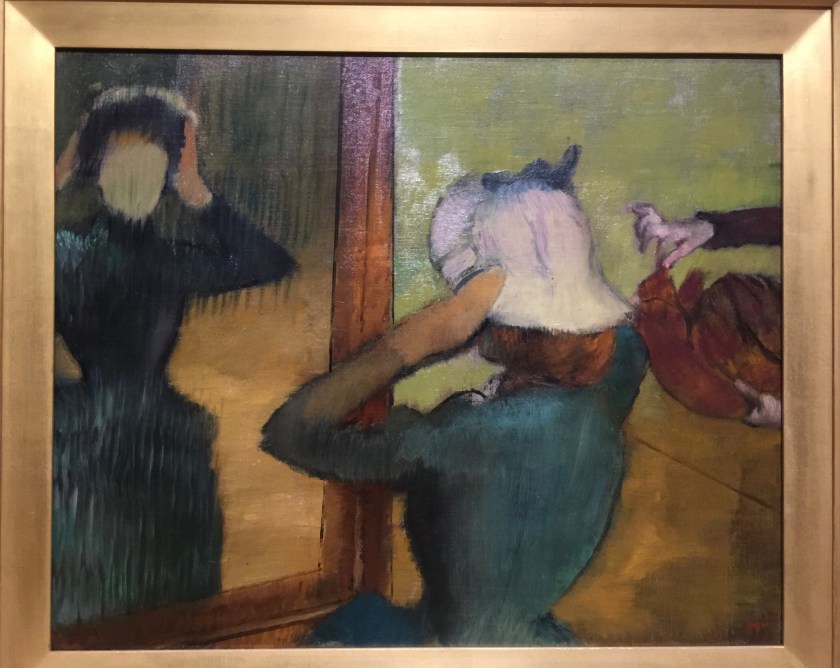
The magic of a new hat as depicted by Edgar Degas. Here, the hat seems to remake its wearer, whose face is a blank slate.

Every year, as the school year gets underway and fall approaches, something happens me: I begin to want new clothes.

This year the feeling is bolstered by my own new endeavors. More on that in a moment. But first, back to school. I have two school-age daughters (one elementary, the other middle school). By the end of summer, their bedraggled t-shirts, shorts, and capris need a refresh. Returning to class, they will encounter new teachers and meet new friends and see old ones they’ve missed all summer, so it’s natural for them to want to look decent. My husband and I often take them shopping for a few new things.

We just had the first day of school last week, and my older daughter selected a white sleeveless button down blouse with a loose black bow tie. My younger daughter found a creative combination, a blue lacy shirt with a mint green gauzy skirt. Snazzy in both cases, and their own ideas of what looked good. A bit out of the ordinary, and a little magic.

For me, when a new beginning rolls around, it feels like the right time for the magic of new clothes. The magic, at its core, is about the way we imagine our near-future selves. We picture ourselves in a new place, with new people, new environment—”a new you,” as they say in TV commercials. Somehow having a set of fresh clothes seems to solidify this image and ensure success.

During these imaginings, the mental picture I create in my head shows me looking far more glamorous that I do in reality, and that’s a good thing. It boosts my confidence and makes me feel capable of trying something new—in my case, a job as a science writer and editor working with an innovative research lab.

Of course, when you embark on adding to your wardrobe, you don’t need to go overboard; nothing I wear is designer or custom or even sold at full retail price. I seek out sales. But a few fresh things can make a subtle psychological difference, whether from the dollar store or a high-end department store.

So as much as I adore the wisdom of Henry David Thoreau, I disagree with his famous passage about clothes in Walden:

“I say, beware of all enterprises that require new clothes, and not rather a new wearer of clothes. If there is not a new man, how can the new clothes be made to fit? If you have any enterprise before you, try it in your old clothes. All men want, not something to do with, but something to do, or rather something to be. Perhaps we should never procure a new suit, however ragged or dirty the old, until we have so conducted, so enterprised or sailed in some way, that we feel like new men in the old…”

Notice the operative use of “man” and “men” here—indicative of another era when it would seem that only males attempted new things and only in suits.

We have more freedom today, and let’s revel in it. Maybe our (occasional) new outfits can help us feel like new women and new men as we transform from within, an appealing suit not of gabardine but of armor to strengthen us for “any enterprise.” An outer indication that we can be something of value. Like the super heroes we celebrate in popular culture, we too can don a new outer layer to perform feats that require energy and creativity.

So I say long live the magic of (a few) new clothes.

Not an Expert

IMG_1233
My passion for things French started young and continues today–but I chose to become a writer, not an expert in academic French-ness.

Growing up, I saw myself as a future expert. Someone who knew her stuff, who could exude wisdom and knowledge to others. It was a goal I worked on throughout junior high, high school, college, and graduate school.

It took a long, long time to figure out that I didn’t want to be defined as an expert. I’ll tell you a bit about how it happened, and where it took me.

My steps along the expert path began early. As a young kid, I was lucky enough to travel from the Chicago area to Paris when I was turning seven. My parents got me excused from my first-grade class to accompany them and my younger sister on a once-in-a-lifetime journey, a chance for my dad to work with French colleagues and for the rest of us to experience life as Parisians. My mom and dad were both confirmed Francophiles and relished the idea of several weeks in the heart of the Latin Quarter, and they were brave enough to bring their two young daughters.

I was amazed by what I saw on that trip. Even as a child, I was blown away by the sheer force of so much art, history, architecture, culture, and a fascinating language—with echoes of English, but more melodic and rich to my ear.

When I got home, I started studying French. Combining my recent exposure with a natural affinity for language, I was able to copy a Parisian accent better than my classmates. My teachers heaped praise on me. I spent years striving to learn to speak authentic French so that I could truly experience a country steeped in art and history, could live like the students I saw roaming confidently through major French cities, sipping their tiny cups of coffee and flipping their long hair.

My parents took me back to France a few years later after receiving another invitation, and we explored Toulouse and the Southwest. The visit reenforced my love of the place.

As a student, I’d heard that there were opportunities to get back to France if I aced academic competitions—which I did. I made it through a competitive high school (a big public institution in suburbia) and into the college of my dreams. I focused on European history and literature, specifically that of France, and won grants to study in Paris during summers. I then went on to a year-long exchange scholarship stay to study in Paris again, and from there, attained my goal of being accepted into an excellent program for graduate studies. I was, I thought, living the intelligentsia dream.

But things had begun to fall apart. During my time studying in Paris, I struggled to find a research topic that I thought was worth pursuing. I knew it was an extraordinary opportunity to learn something, yet I flitted from class to class, hoping to uncover some hidden meaning there. The most memorable course I was in focused on the history of European government and law, and the only part I really recall was my effort to understand and translate the group discussion about a new European Union human rights law against dwarf tossing. Yes, you read that right—they were talking about whether it would be legally permissible to throw human beings for sport. I seemed to find myself in an alternate universe, and not just because I couldn’t always speak (or comprehend) the language.

I felt lost.

What exactly was I trying to become an expert in? As I trolled the libraries, I asked myself, how much could I really learn about European history as a modern American, hundreds of years after the period I studied? What could I actually glean from old documents molding in the archives… and who would care what I had to say about these distant events and people? An even larger question hovered: What was the point of this exercise?

It was beginning to dawn on me that inhabiting a purely academic sphere did not suit me. In the midst of my master’s program, I made a decision: I would leave academia to become a journalist and a writer. I would start over, putting aside my expertise in French and European history, and take on the goal of telling stories about the people around me, their passions, and their discoveries. I would learn from their lives and work, and maybe find ways to apply that learning to my own experience. Expert no more—except in the craft of writing itself.

My first paid writing job was at a legal newspaper. My second was at a weekly business and technology magazine (sadly, now defunct). My next roles were writing and editing for a foundation and then for Stanford University.

All the while, I wrote about people and topics far outside my own knowledge and experience, including: lawyers suing Microsoft; conserving wilderness through smart land deals; the legal rights of pets and their “guardians”; motorcycle personal injury work; margin lending; stock wealth on paper and its rapid disappearance in the economic downturn; ancient practices of making music from conch shells and worshipping jaguars; the Stanford prison experiment; how to secretly meet intelligence officers in Moscow and live to tell about it; bioengineering molecules to fight cancer; using light to activate the brain; crab migration and survival in changing climates; improving testing for tuberculosis; women’s volleyball star turns; a college quarterback returning from his Mormon mission; prehistoric horsemen who invaded Western Europe; the genius of Buckminster Fuller; and the ethics of self-driving cars. I talked to experts often, to tell stories about discoveries and ideas and human lives.

It was not just liberating—it felt true.

All around us are stories that are worth telling, innovations worth understanding, people worth knowing more deeply. I still carry a deep interest in European history, culture, and French language, and I treasure my French experiences and friends, but I’ve opened my world far beyond the limits of that expertise.

I am reminded of Shakespeare’s famous lines, voiced by Hamlet: “There are more things in heaven and earth, Horatio, than are dreamed of in your philosophy.” As a non-expert, I was free to explore all those things. And I still feel that way now.

Each day, learn a little. Each month, interview new people, write about something I’m not knowledgeable about. Each year, rediscover that there is more out there than I will ever know—feeling a sense of satisfaction not from expertise itself, but from the ability to ask good questions and find new answers.

Less than perfect girls

Girls grow up wanting to be perfect. More than that: they think that they have to be perfect to be liked, admired, and successful.

The perfectly behaved young girl is an “angel.” The perfect daughter is a dream–she does what her parents ask and conforms to their wishes. The perfect student always follows her teachers instructions and is at the top of her class. She selects her activities and courses based on those she can perform perfectly, without flaws, deliberately choosing what she’s already best at doing. The perfect friend does what her friends want to do, agrees with their likes and dislikes, and does nice things for them. And underneath it all are very specific expectations about physical appearance, too. After all, the perfect girl (and later on the perfect woman) is pretty, fit, and makes an effort to look attractive.

This outward perfection–and the conformity to others’ wishes, instructions, needs, and desires about their behavior and their appearance–becomes a deep-seated obsession for girls, even at the subconscious level. Somehow girls–and women–feel they will only be loved, respected, and valued if they maintain this facade of being the perfect daughter, student, friend, and later girlfriend, wife, mother, employee, boss. (Note: The mechanism behind this “somehow” needs much more exploration in future posts.)

But while this perfectionism appears to win girls friends and fans, it is incredibly destructive in the long run. Our culture’s expectation that girls and women will behave, and look, a certain way, and that anything outside that is flawed, unwelcome, disruptive, even dangerous, creates an iron-clad box that traps them.

This is not the way to grow women with fresh ideas and plans. This is not the way to raise women leaders.

Leadership is about taking risks and putting your own ideas out there, thinking up original strategies, and–yes, dare I say it?–making mistakes. Errors. Even failing. If you try something outside the boundaries of “perfect” and compliant, rule-following behavior, you might just try something that doesn’t work. You might land face first on the pavement. You might even make enemies and people won’t like you.

What’s more, girls aren’t being encouraged to be true to their own minds and their own potential. Authenticity is rooted being unafraid to voice what you really think–not what your teachers, parents, friends, boyfriend, husband, boss, or social media followers think. It’s about creating your own style–including in your appearance.

So the “teacher’s pet” perfect girl won’t end up at the top of the class in life. Her training in the school of perfection has hampered her, enchained her. This is true behavior-wise and also in the realm of academics and career. And this is something I’ve experienced myself as I try to break away from “good girl” behaviors into taking on new, riskier challenges in my life.

How can we change this situation for girls today? It’s an urgent question to me as the mother of two daughters.

I know I’m not the only person worried about this problem. Numerous Ted talks, research studies, and books are tackling it from various points of view. I’m researching them now and hope to come up with a range of strategies, and then investigate how they are used now and how they could be expanded in the future.

I have come across an approach recently that’s worth exploring: design thinking.

The premise of design thinking is that you should just try things out. Don’t be afraid to fail the first time, because you can always try again. Most endeavors are an iterative process. You can give it a whirl, and if it doesn’t work out, tweak it, and give it another spin. This can apply to marketing products, to creating new inventions, to building an educational program, and even to how you move forward in your life and career, as the incredibly successful book and Stanford course Designing Your Life make clear.

Design thinking has started to make a difference in small ways is the ideas spread. I am eager to see how it could change education, especially for young girls. In my daughter’s third-grade class, her teacher encouraged kids to try out new ways of approaching projects and of doing group classwork. She told them, “It’s OK to try something and to make mistakes. You don’t have to do it right the first time.” The teacher informed students that she did not care if they spelled some words wrong in an essay… or if their handwriting wasn’t perfect. Keep going, keep trying, and keep working on it.

Being the imperfect human beings that we are, making a mistake doesn’t mean you are a bad person–it doesn’t mean you are a “failure.” And it certainly doesn’t mean you are anything less because you are less than perfect.


Re-Tweeter

I’ve discovered that I love Twitter.

I’m by no means a power user – right now, my number of total tweets is paltry. I have a tiny handful of followers. I am not an outrageous tweeter or an expert tweeter or a hilarious tweeter.

Mostly, for the time being, I’m a re-tweeter.

To me, the re-tweet is one of the best things invented on social media. Re-tweeting allows me to quickly say something to the world (well, at least to my small number of followers), sharing a little sliver of wisdom without having to do a ton of research myself. Best of all, I get to “curate” content and put on my editor’s cap: what would represent my thoughts and random yet interesting discoveries today?

Sometimes I add a comment to a re-tweet. I’d like to do this more, to provide another layer in the rich palimpsest that is Twitter.

But quite honestly, I don’t always have such a short comment to add. We all know the character limit is pretty harsh. I realize I’m coming late to this party… and I’m not always so short-winded.

I’m working on that.

I think it’s an incredible discipline to winnow an idea, thought, or really any communication worth saying down to such a short, brilliant length. And not just by oversimplifying or adding shock value (can you guess which political candidate I might be thinking of?). No – a good tweet is really quite an art.

I am enjoying Twitter these days largely because I’m choosing the folks I follow very, very carefully. I am also electing not to read the various layers of comments on many tweets, the space where the Internet “trolls” hang out and share their venom. I try to stick with the source material, actual tweets and re-tweets.

Twitter is bringing back a touch of the magic of social media for me right now. Gone – in my world at least – are the early days, like my first efforts on Facebook… where everybody added everybody to everything to gain a large list of “friends,” making for a bigger network. Knowing now the tendency of some to overshare, on Twitter, I’m selecting for those voices I really want to hear on topics other than announcements of singular personal achievements or parents’ musings on potty training (which, I grant you, is a VERY important issue – but I have dealt with that enough in my own family life, thank you very much).

Some folks I’m following on this platform are take me outside my normal sphere, in a good way. For example, I didn’t realize I’d become a fan of the tweets of “neurodiversity” writer Steve Silberman(@stevesilverman) when I got into Twitter. He shares genuinely interesting thoughts and news for those interested in the human brain and in the fields of autism, Aspergers, and mental health.

I am also a fan of any Twitter denizen who posts or reposts really interesting infographics. Recently saw one about tuberculosis worldwide posted by Bill Gates (@BillGates). Again, not a topic I knew very much about. But there it was, staring me in the face, that globally, 1.5 million die from TB annually. This is important.

(In addition to that global point of view, I’ll be watching for time-sensitive local news on Twitter, too. It’s kind of useful to know if a water main broke near your house, or if a raging brush fire has shut down a stretch of the freeway.)

In today’s moment, I have discovered that Twitter can be a great place to turn to for a sip of sanity in this largely crazy ocean we’re swimming in right now, especially on the political waterfront. I’ve followed a couple commentators that I like “live tweeting” campaign speeches or political debates, and their words made me laugh and also breath a sigh of relief that someone else out there gets it.

Granted, I realize that Twitter can reinforce one’s own biases because of this self-selecting of voices. But hey, we make our own choices when we pick people to hang out with – at least as adults – and when we decide which newspapers to read or which novels to buy or which movies to watch, etc. This is just another format for choice – though for me, it’s certainly not my only source of news.

Of course you could fill up thousands of tweets with speculations on the Taylors and Kanyes and a lot of other celebrity or salacious stuff. I choose not to.

And so far, I’m loving it.

Thanks for reading this non-Tweet-sized post about Twitter. You can find me there @MeredithK55should you be so inclined.

The Laundry of Sisyphus

School can be boring, my 9-year-old daughter reminded me recently. “You do the same thing over and over again, even if you already know how to do it,” she said. You have no choice. It just has to be done.

“Yes. That’s tedious,” I said, in response, which started a conversation about the meaning of the word. “Tedious is something dull and repetitive, something that bores you to tears and that seems to go on forever—but usually, you just have to do it anyway, again and again,” I explained.

“Oh yes, like that Ancient Greek story about the man who had to push the big rock up the hill every day, and then it falls down and he has to do it over again!” she cried.

“You mean Sisyphus.” I thought for a moment. Sisyphus was a king punished by the Greek gods for his offenses (which may have included temporarily chaining up Death, preventing him from taking further victims). His burden in the underworld? To forever push a boulder up a mountain, and then watch it fall to the bottom, only to begin again the next day.

It’s one of my favorite myths, not least because it was explored by French existentialist writer Albert Camus. Camus called Sisyphus “the absurd hero”—admiring his acceptance of his burden and his scorn of the gods as he tenaciously pursued his never-ending task.

I love this story. In a way, it captures so much of adult life. Especially the parts we did not really think about as kids when we fantasized about the freedom and excitement of growing up.

Take laundry. I know I should be thankful that I am probably among a pretty small percentage worldwide who has an excellent electronic setup in my own home, able to complete numerous loads a day. Yet I dread doing the laundry just because of the repetition of putting it in, taking it out, putting it into the dryer, taking it out, folding it (the most tedious and therefore the most neglected part of this task) and putting it away. It isn’t difficult; it isn’t challenging. It’s just time-consuming and tedious, and for a family of four, it has to be done frequently if not daily.

The Laundry of Sisyphus.

I had forgotten that this myth also applies to children’s lives at school. Take timed math tests. Or spelling quizzes. Or all sorts of busy-work that our children do in order to prepare for standardized tests or school-wide tests or district tests or just class tests. It can feel never-ending. Maybe that’s why growing up seems so cool to kids sometimes. Not only the freedom but also the variety appeals.

The frequent tediousness of school is one reason why I don’t send my daughters to “school after school.” We live in Silicon Valley, an area of highly-educated parents and their heavily programmed children. Many attend academic classes after the regular schoolday ends, complete with more worksheets, assessments, tests.

Not here. My kids are outside jumping on the trampoline, just about the least tedious type of repetition there is for a child. Every bounce produces a fresh movement, a new sensation, a unique jump or flip. A weightless feeling that lends itself to imagination and creative chaos.

Or practicing an instrument. That’s another repetition that can be beautiful. It leads to improvement and learning, and to breakthroughs in creativity that happen every once in a while.

This just shows what we should remember while working away at the laundry: Not all repetition is bad. Some of it can transform us.

And perhaps we could adopt a philosophical, or even a Zen-style approach to laundry, etc. We could find a way to meditate as we fold, to relax as we carry, to reflect as we straighten and put away.

Sisyphus would approve. And so would Camus. He ends his famous essay about the Greek myth this way:  For Sisyphus, “each atom of that stone, each mineral flake of that night-filled mountain, in itself forms a world. The struggle itself toward the heights is enough to fill a man’s heart. One must imagine Sisyphus happy.