Overcommunicating: The Key to Freelancing Success

Recently, a writer colleague asked me for my thoughts on freelancing. As a writer and editor, I have often done freelance work, both longterm projects and one-off assignments. After years of doing this, I have some thoughts to share.

My top advice: Build on existing relationships and really, really communicate! In fact, I suggest that you “overcommunicate.”

Why focus so much on communicating about your project? One of the hardest things about freelancing is trying to fully understand the client’s real needs and expectations. The more you talk about it, the more you will begin to comprehend what that client is hoping to achieve.

Overcommunicating will also help you to figure out how much work will be required for a particular project. Whenever possible, it’s best to get a very realistic picture of the amount of work for you as the writer or project manager at various stages—in addition to the deadline, of course.

If an editor is going to want four rounds of edits, that’s something the writer should know ahead of time. If you are expected to fact-check, and provide documentation that you did, you’ll want to know that, too. If complete rewrites are sometimes required, that’s very important to be aware of in advance.

But above all, you should really drill down on the assignment. That is best done face to face. If you can’t, using Skype would be a good idea (better than phone). Email is never enough to really get the full picture.

Think of getting your assignment pinned down just like any other in-depth interview you might do as a reporter. Ask the big and small questions, find out the nuances of what’s needed and how you can be most helpful. Make sure you feel you really get it before embarking on a piece of writing.

I suggest also asking about any political landmines the editor foresees. As an outsider to the organization or publication that is hiring you as a freelancer, you can’t see the political landscape without an insider’s help (and without that extra dose of communication on their side–which, admittedly, can be hard to find the time to do for busy assigning editors/managers).

Another aspect of overcommunicating is to try to check in on the direction of your piece or work part way through the project before you really get into writing. Scheduling some sort of call or talk midway though could be helpful.

Ask for samples of what the editor considers good work and any examples of similar projects (this is somewhat obvious but can be overlooked!).

Given how much time and effort you’re going to want to spend on this level of communication, I advise that you be careful to bite off only as much as you can chew in terms of projects–especially when you are just beginning freelancing. This can be hard to determine at first, so I suggest starting small and working your way up to more ambitious projects.

Freelancing can be a tough business, but it can also be a good way to build relationships and a reputation. The more you communicate, on every level, the better off you will be.

Harry Potter and the Books of Childhood

For my daughter, Harry Potter and The Sorcerer’s Stone is a two-pillow book. It’s the longest one she’s tackled so far at age 7. The heavy hardcover from her school library inspired her to grab two giant-sized throw pillows on the sofa—one for underneath her, and one for underneath the book. Reading a book this “big” (in size and reputation) is indeed a big deal for a second-grader, and the Potter series is a major topic of discussion among her schoolmates.

This takes me back to my own childhood. As a kid, reading seemed so much more immediate, vivid, and momentous. The tropes and plot turns were all fresh and new. Children take longer to read each page, and their memories are better. I’m afraid that these days, I’m more of a speed-reader, and I don’t have the patience I once did. I’d love to regain some of that fresh, kid-like sense of discovery.

There was no Harry Potter when I was young but I did delve deeply into children’s literature. I read constantly, and I preferred historical fiction, mystery, or clever tales. My fascination with English novels started early, too. Some of my favorites were Joan Aiken’s The Wolves of Willoughby Chase and Black Hearts in Battersea. These books (and the following series) take place in a fictionalized early 19th-century England, under the reign of James III (assuming that the House of Hanover did not prevail with King George, as it did in reality). The countryside is overrun by wolves, some of whom attack the train carrying young Sylvia to meet her cousin Bonnie at Bonnie’s family estate. Escaping the wolves, the two girls face an even fiercer adversary–they are united in their fight against a truly wicked governess, Miss Slighcarp. Written in post-war England, these books are a wonderful introduction to the kind of world created by 19th-century novels. I’m thinking especially about Dickens’ novels, in which young kids face all kinds of hardships and (usually) manage to find to prevail.

P wolves of willoughby chase.jpg

I also loved many other books, and I recall vividly The 21 Balloons, From the Mixed Up Files of Mrs. Basil E. Frankweiler, the Pushcart War, and The Witch of Blackbird Pond. In the magical/science fiction realm, I was absorbed by the novels of Madeleine L’Engle.

Now that my daughter is reading “real” books, I’m returning to some of my favorite young-reader fiction. That way I can give her my personal recommendations with even greater confidence. I am re-reading Joan Aiken’s books for their masterful characters, style, and atmosphere. (I am quite sure her books helped inspire later children’s novels, especially Lemony Snicket and maybe even Harry Potter himself.) Certainly, the first book is far darker than I remember, with physical violence and gunshots (directed at wolves, luckily), imprisonment, starvation, and “real” dungeons playing key roles. Not to mention the importance of life-saving geese…

Unemployment + Temp Jobs = Dystopic Future?

I have seen the future of unemployment—and it is not pretty. At least not in the fictionalized world of Margaret Atwood, novelist and poet, who has now penned a new series of e-chapters called Positron.
The serialized novel—put online by Byliner and available as an e-book—begins with an extraordinary idea, the backstory of the book’s events. In a future world that looks a lot like the US (or Atwood’s native Canada), there are so few good jobs that people will agree to serve half their lives as prisoners, if this arrangement will deliver employment and a steady income. The closed community of Consilience offers this promise, but with a significant catch. Every other month, half the citizens within Consilience’s walls reside in remodeled suburban homes, replete with appliances, comfy couches, TVs, and fresh linens. Each has a “civilian” job, servicing the prison or the town’s residents directly. Meanwhile, half the population lives in Positron, the prison that was once the main employer in the town—as it is again. Then each month people switch places. Citizens become prisoners in jumpsuits, but very well-fed and well-cared for prisoners who also do jobs within the jail’s walls. The town is marketed to its residents with the clever tagline of “Cons + Resilience = Consilience.”
In the novel, Consilience is held out as a model, one that is being spread around a country that is increasingly riven by the dangers of un- or under-employment. Outside Consilience, lawlessness is widespread. Roving bands of youths terrorize average people and steal whatever isn’t nailed down. Life is uncertain, violence pervasive.

The young couple at the center of the story has been unable to find real, permanent jobs (just temp positions, and then none at all). They can’t afford to get married or to have children without some other solution: that’s why they turn to Consilience and Positron. They are promised a life of full employment, work and shelter for the duration, and they jump at the chance.
Of course, what they don’t quite realize is that they’ve also signed their lives away to a system that controls them—utterly. Their movements are tracked and monitored by secret police, who hold the keys to life and death. They are manipulated by the forces running Consilience, by the business that hopes to turn the town into one big money-maker, even if that means selling prisoners’ body parts—or something equally sinister, but not necessarily clear as yet. Atwood has crafted some shocking situations for her trapped characters.
I’m hooked. I just hope this dystopic vision is not what we really eventually face in today’s world of perma-temps, job losses, and long-term un- and underemployment. Unemployment is relatively high in the US at 7.9 percent, and much worse elsewhere. The forces on our labor market have caused many jobs to go away, permanently, and jobs that are being created are not necessarily providing a living wage for Americans. Scholar Erin Hatton recently wrote in an opinion piece in the New York Times, “A quarter of jobs in America pay below the federal poverty line for a family of four ($23,050). Not only are many jobs low-wage, they are also temporary and insecure. Over the last three years, the temp industry added more jobs in the United States than any other…”
It’s becoming common knowledge that the structure of our economy has changed and will never be what it used to, in terms of employment figures and job stability.
One bright spot, looking back over Atwood’s brilliant prose: Though many of us may be “wage slaves,” we are luckily still a long way from turning ourselves into prisoners to “escape” unemployment.

Like other readers, I’m now eagerly awaiting the next installment in this serialized novel. (Atwood spoke with NPR about her decision to publish these chapters online here.) 

Future Dads: Start Worrying Now

When I was expecting both my children, I spent a lot of time worrying. The fears began long before I even became pregnant. Like many mothers-to-be, I was tortured with concerns, and my doctor asked me a lot of the same questions—making me fret even more. Did I have genetic failings that I could pass down? Would my age affect my baby?  Was my weight OK? Did I take the right vitamins? Did I get enough exercise? How about my stress level—would my cortisones harm a baby? Was it bad that I ate fish and soft cheeses? Did my daily commute expose me to harmful fumes, which could affect a fetus?

After I was lucky enough to make it through with healthy babies, I tried to put away these fears. But recently I’ve been following scientific studies showing that the power of epigenetics on human life. This brand of genetic research focuses on the idea that circumstances around us (including stress, diet, toxin exposure) can turn genes on and off, potentially affecting an individual for an entire lifetime. In fact, once genes are turned on, researchers believe, they can actually stay that way not only for one person’s life but for future generations as well. One of the outcomes of that work is the idea that a mother’s exposures to toxins could have damaging effects far, far into the future, harming not only her own child but her grandchildren or great-grandchildren. A mother’s worries could carry on for centuries!

So imagine my interest—and, frankly, my sense of welcome surprise—when I read about new studies showing that the father’s genetic material actually has a large effect on the child’s mental and cognitive health. Indeed, disorders including autism, schizophrenia, and bipolar disorder can be passed down by mutations in fathers’ genes.

A recent study followed Icelandic men as they aged. The results were that the age of the father has a direct bearing on the number of genetic flaws passed down to his children. So the dad who fathered a child at 36 passed on twice as many genetic mutations than the one who fathered a child at age 20, and it just went up from there. The Nature article summarizing the work quotes a researcher saying, “The older we are as fathers, the more likely we will pass on our mutations.”

Fathers bequeathed almost four times as many new mutations as mothers. So while we like to talk about women’s “biological clocks,” it is clear now that aging reproductive systems are not just a women’s problem. And just as importantly, epigenetic studies distribute the responsibility for future disease to men, too. They have highlighted the dad’s genetic influence: for example, a Swedish study showed that a man’s diet during pre-puberty could affect heart disease and diabetes levels in both his sons and his grandsons.

I wonder if this new information could change the dynamic for men. Will they question themselves before trying to start late-in-life families, or second families, just as women do? Will they take the measure of their own genetic content more closely before trying for a baby? Will doctors start questioning future fathers about their age and health during prenatal visits? Dads, now it’s your turn to worry, too.

The Cult of Beauty

Beauty itself is very subjective, but the pursuit of it is not– either you think things should be beautiful whenever possible, or you don’t really care either way (or maybe believe spending money/time on beautifying things is just a waste). One of the many revolutions of the late 19th century was the notion that everyday objects could and should be beautiful, and that art should infuse even modest homes in ways large and small, from the wallpaper to chairs to teapots.


That way of thinking was a natural response to the mass-produced mayhem of the industrial revolution, and it still influences us today. It’s why we like Apple products–functional AND elegantly beautiful–and why stores as ubiquitous as Ikea feature furnishings that appeal to our sense of style.


That’s just one message lurking beneath the surface at the gorgeous exhibit on view at San Francisco’s Legion of Honor museum right now: The Cult of Beauty: The Victorian Avant-Garde 1860 – 1900. I highly recommend it. Not just for the delectable teapots by Christopher Dresser and wallpaper by William Morris, but also for the many waves of aesthetic movements that it covers, and the many approaches to beauty it encompasses. There are several must-see paintings by James McNeill Whistler, a proponent of “art for art’s sake” who really does show how “modern” artists in this period could be, and a number of over-the-top works by Dante Gabriel Rossetti and company–not my favorite artists but a force to be reckoned with for (at least) a whole generation. 

Symphony in White, No. 1: The White Girl
by James McNeill Whistler-
This piece is featured in the exhibit.
(from Wikipedia Commons)

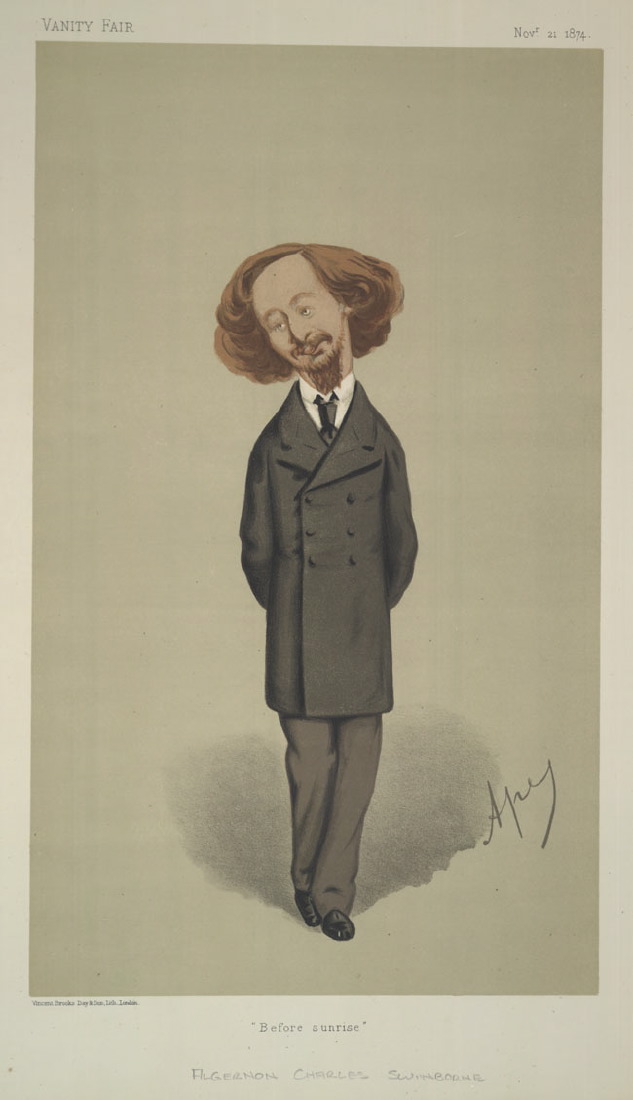
Another undercurrent of the show is the rise of sensual approaches to art that scandalized the establishment. Cited in many of the art descriptions is poet Algernon Charles Swinburne. The name brought back a flood of memories for me: I’d written one of my college research papers on some of his poems, comparing his work with that of Gerard Manley Hopkins. These two three-barreled men at first glance had very little in common, one being a “decadent”  and sensualist (Swinburne) and the other a devout Jesuit (Hopkins)–but I tried to show how much they did share in a counter-intuitive way. I don’t normally quote myself, but here’s a little taste: “Both poets wrote about the divine and the body, and both believed that there were intimate links between the spiritual and the physical…” And in conclusion: “Both men took uniquely physical approaches to the spiritual, and both attempted to mingle the body and the soul in unique, redemptive philosophies.” Of course the core ideas of those philosophies were at either ends of the spectrum of their age–a Dorian Gray-like release through sensual materialism, vs. a martyr-imbued Catholicism.


Swinburne, in a contemporary caricature
from Vanity Fair (from Wikipedia Commons)

Perhaps one of the most striking set of images towards the end of this exhibit were a handful drawings by Aubrey Beardsley. The man was pure genius–his caricature-like pen and ink pieces delicately captured a wicked sensibility (which Swinburne strove towards also). He was buddies with Oscar Wilde and illustrated his writings. I learned a little more after the show: It turns out that he died of tuberculosis at age 25–not long after converting to Catholicism and trying to get his publisher to destroy all his earlier “obscene drawings” (which he did NOT do). It was a journey that highlights those same competing sensibilities of Victorian England that I wrote about over 15 years ago. What a very rich period, and source of much worthy art by any standard of beauty.

Aubrey Beardsley’s The Peacock Skirt
(from Wikipedia Commons)


Hemingway the Romantic

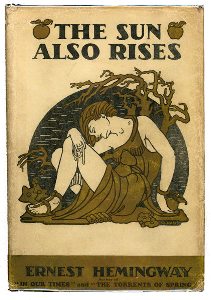
I just finished reading The Paris Wife, a novel by Paula McLain that traces the relationship of Ernest Hemingway and his first wife, Hadley Richardson, from their meeting in Chicago through their wedding and married life in 1920s Paris. A large section of the book covers their time visiting Pamplona, where they watched the running of the bulls and numerous bullfights. In the book, Hadley accuses Ernest of lifting large parts of the dialogue among their friends from their Pamplona trips and inserting the material into his novel, The Sun Also Rises. I decided to go back and read that book, to dig deeper into the period and the source.

There are stretches of dialogue where nothing really happens; then there are very tense scenes where all the book’s male characters try desperately to get the attention of the lead female character, Brett. She’s a serial romantic, who, at age 34, can’t seem to settle down with one man. The narrator, Jake Barnes, is a thinly veiled version of Hemingway himself; he, too, wants Brett but a war wound has left him impotent, and, apparently, she’s not really interested in someone who is lacking in that department.

Although it’s clearly a roman a clef about Hemingway’s friends and his romantic interest in a female friend, Duff, there is one person he left out entirely: Hadley never figures in the book in any form. The novel still feels quite fresh in spots (some of the flirty dialogue reads well, and there is a rather delightful pastoral section where a couple of the men go fishing in the Pyrenees) though it is also horribly dated in many ways.

Especially bad is the treatment of Robert Cohn, an American Jewish Princeton grad who competes for Brett’s affections. Admittedly, Robert is a cad who is pitted up against Brett’s fiance–who naturally hates him–but even so, the Jewish references come off as anti-Semitic for their nasty focus on his “Jewish superiority” complex.

The way Hemingway wrote this novel (described well in The Paris Wife) reminds me of my youthful attempt at a novel, which I wrote right after graduating from college when I spent the academic year in Paris. Maybe it’s time for me to return to that text. Like Hemingway, I tried to capture the sounds of how smart, privileged young people talk to each other–what is said and what’s left out, the wit and the humor, but really just the banter of those faced with immense possibility and already feeling a sense of loss–or of incapacity–in their efforts to fulfill their wild dreams of love, genius, and fame.

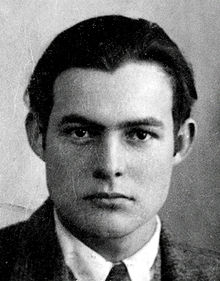
Hemingway in the early 1920s (Wikipedia)

Not exactly restored, but returned

I am just now emerging from a terrible flu, a vicious bug that knocked me out for nearly two weeks. I’ve been thinking about it a lot and can say this: It is only when we are forced to stop doing everything that we normally do that we find out how unimportant most of it is (just like when we’re forced to live without 95% of our stuff when we travel, we realize how unnecessary that stuff is).

For me, those noticeably unimportant things (that I normally place far too much emphasis on) were:
1) Email: sorry, friends, I just couldn’t manage to sort through my messages; not that very many of you were actually trying to get ahold of me. Mostly it was the online equivalent of telemarketers.
2) Keeping up with news: yes, I was aware that people were shot in Afghanistan, and that it was horrible; but I did not follow the details or analysis, and the world did not end. Likewise I think there were more Republican primaries… My guess is, some were surprised by the outcomes but no one dropped out, but I can’t be sure; seems as if there are new primaries twice a week these days…
3) Shopping: both in its real and virtual forms; I’m one of those weak, semi-recreational shoppers who keep lists in my mind and am always refreshing them, and with the ease of online shopping, it has become far too habitual. I was able to get by with no shopping at all thanks to a grocery run made for us by my mom.

And of course work had to be put aside and delayed, both of the office and home varieties. When you’re lying in bed sweating profusely through a fevered delirium is one of the very few times when you just can’t feel guilty about pushing back a deadline or ignoring a stack of very dirty laundry.

(Pause while coughing lays me low for three minutes; now back.)

Illness can be important when we do recover, because we are “recalled to life” with a new sense of priorities and perspective. Again, just like when you come back from that vacation where you left your regular “stuff” behind. Only instead of a tan (or even a sunburn), I’m back with big circles under my eyes and the kind of pallor that normally indicates months spent in grad student library carrels…. That is to say, not exactly restored, but returned. And most thankful for it.

Fake It Until You Make It

What is “fake”–and does it matter? When it comes to the spaces in which we live, work, and play, it’s not a simple question. I pondered this idea as I strolled up the Ramblas-style avenue bisecting Santana Row, San Jose’s self-created shopping mecca.

The Row doubles as a “downtown” in a section of the city that’s a bit of a no-man’s land, in between Santa Clara and San Jose. In an area where before, there had only been a huge indoor mall with (obviously) no sense of street life, now there’s an island of capitalist and epicurean pleasure. Gucci, Burberry and Tesla Motors (typical car starting at $109,000) storefronts rub shoulders with sushi, steak, and other high-end fare. At one end, a movie theatre shows art films; on the other, just off the main drag, Crate and Barrel sells stuff you want because it’s pretty and the Container Store (next door) sells you big plastic bins to stash it in.

By all accounts, I should hate this place. It’s so fake. But I don’t react that way. In fact, it’s a ton of fun to walk around here, and I’m not the only fan—hundreds of local residents flock here on the weekends, especially at night, to experience our best shot at “street life” on this side of suburbia. People strut around in heels and designer jeans, looking ultra-cool even if a fair few are pushing baby strollers. It’s a scene, and you hear every language under the sun from passers-by.

I think Santana Row proves a theory that’s gotten a little higher in my book lately: the idea that “faking it” can change attitudes enough to create a new reality. This street was wholly conjured out of nothing, built to look like a Barcelona boulevard replete with fountains and lounge chairs. Just looking around, you start to imagine what life might be like if you actually could have a mid-day siesta away from work and other obligations just to hang out here. A lot of people object to how “fake” it is to fabricate street life this way. But they did build it, and people did come, and now it’s a real pleasure to walk in your brand-new shoes from bubble tea right to tapas to grab a Japanese birthday card while you wrap up a little gift of costume jewelry.

That is, if your wallet can stand it—this is a very expensive date.

But there are a few semi-bargains. Did I mention the Pinkberry? Yes, in the center aisle of the street, surrounded by comfy outdoor chairs, is my favorite frozen yogurt place, with huge chunks of mango and pineapple just waiting to be scooped into your cup…

Yes, I enjoy the fantasy. And maybe that’s because it’s all fantasy on some level. I’ll give you an example. Americans think of the Eiffel Tower as an unchanging symbol of the outrageous stylishness of the French, and a trip to Paris wouldn’t be complete without going up this steel shaft. But in fact, many of the French originally hated this “monstrosity” and couldn’t understand why it was built. It was new and ugly and, I’m sure, pretty silly looking. But now it’s an icon.

That’s just one small case in point. Even more importantly, I’ve learned over the years that you can actually change your feelings about things by faking it. Hang on—I’m not referring to what Elaine (of Seinfeld fame) called out as “fake, fake, fake, fake!” I’m talking about recent studies that show that just by smiling—no matter how you feel inside—you eventually start to feel happier.

So join me in our fake world and take a stroll on the Ramblas of San Jose. Now, if only they’d finish that pedestrian mall in Sunnyvale, surrounded by the huge Target and Macy’s….. then I could actually walk to a “downtown shopping experience” of my very own.

Double-Dip

There was a time when the words “double-dip” made me think of my all-time favorite TV show, Seinfeld. The show popularized this description of using a single chip to dip twice into a communal bowl of salsa. Double-dipping a chip was a no-no because it could spread germs from the half-eaten chip into the salsa bowl, potentially infecting all other comers. “That’s like putting your whole mouth right in the dip!” someone yells at George during a party.


(More recently, the Discovery Channel show MythBusters tested this idea. The “myth” that double-dipping spreads germs was “busted” by episode’s end: apparently, the chip and dip were already coated in microbes to begin with, and double-dipping only added “negligible” amount. But I still teach my kids not to double-dip, because some microbes might be nastier than others!)

In an earlier, even more innocent era, double-dip made people think of candy or ice cream – in the UK, there’s a popular sweet by this name, and some may recall double-dip ice cream cones from the 1950s or earlier.


Well, times have changed, my friends, and there’s no clearer indication than the fact that now, the phrase “double-dip” has taken on a far more sinister meaning.

I put on MSNBC to catch up on a few headlines and the screen screamed at me: “DOUBLE DIP FEARED” – in this case, a so-called “double-dip recession.” That is, a recession that began after the investment banks imploded and bad mortgage debt went sky high could now begin all over again, creating a second “dip” in our economic well-being.

According to Investopedia, here’s the definition of a double-dip recession:

“When gross domestic product (GDP) growth slides back to negative after a quarter or two of positive growth. A double-dip recession refers to a recession followed by a short-lived recovery, followed by another recession.”

Dip is a terrific word in this sense. You can picture the “dip” in gross domestic product as graphed on a simple chart. This is clearly the origin of the term: the image of two dips in a line charting the economy’s growth and health. And as a short, well-defined, peppy little phrase it adds an emotional feel that a “negative quarter of growth” just can’t convey.

Fingers crossed that a “double-dip” won’t nip us this time around. How about we come up with an equally lively term for a slow but steady recovery that brings back investment and jobs?