I always dreamed of becoming a writer and artist. And I did—just not exactly in the way I dreamed it. I am a writer professionally, focused in my job on science and technology. In my personal time, I write about modern life as a woman and mother, about what holds us back and what helps us thrive, and about philosophies of life going back to ancient times. My art projects are a combination of creative crafts and, when time permits, a range of other classic forms.
I’ve realized some of my dreams, and I have also worked hard to change my focus as my interests have evolved. I’ve tried to keep learning and growing, to build new strengths and keep the old.
Now, in some ways, it feels as if I’m returning home.
I find myself surrounded by science and technology researchers at my new job. Almost all have PhDs in engineering or computer science fields. They share many of the traits of focused intellectuals everywhere: a sense of purpose, a belief that theirs is the most important work, and a brainy concentration able to tune out all else.
This all feels very familiar to me. My dad was a mathematician. He was also a self-trained computer scientist, the first one who taught courses in that field at his university. He was a pioneer.
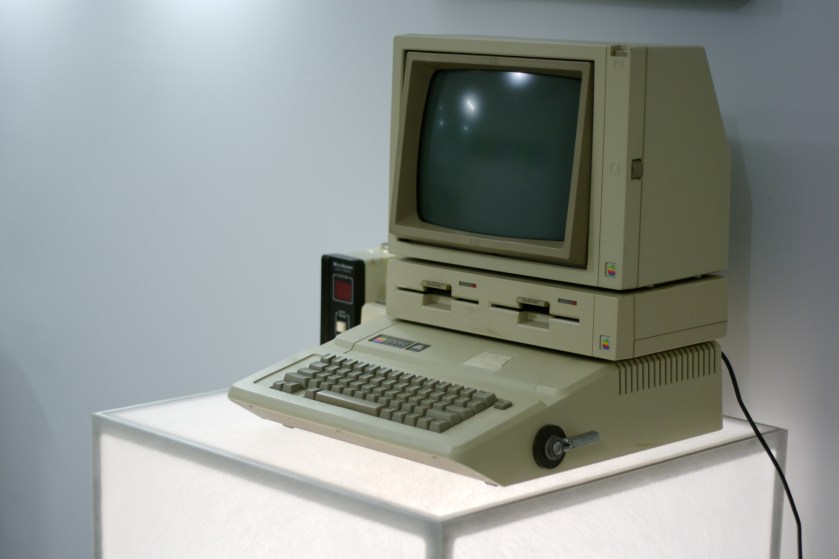
His interest in computers permeated some of my early memories. Like when he brought home our first computer, an Apple IIe, in 1983.
On a tiny desk in the corner of our dining room, the boxy black screen lit up with green characters when you typed on the keyboard. Magic! At the time, none of my friends had computers. It was cutting-edge.
At first, it seemed more like a science experiment than a useful tool. That was 1983, remember! What did you do with a computer back in those days if you weren’t a computer science researcher?
There were no GUI interfaces or desktop-computer video games or digital photos or social media or instant messaging. No icons, just typed-in text. My teachers did not require we word-process homework and there was no Internet (at least that I could access) to help us research assignments. None of my friends had email (although I believe Dad did, very early on).
In a search to make the computer fun, Dad soon found a “cool” piece of software (on a floppy disk that made horrible crunching sounds when you inserted it) for me and my sister.
It was an early text-based role-playing game that asked a series of yes or no questions. The player would type in answers in an effort to find hidden treasure deep within a castle. I never won. I got stuck at the well. And later I found myself standing in front of an armed knight. Was I armed too? I can’t remember. And I cannot ask my dad, because he died much too young in 1999.
At my new office, a woman I encountered at a social event said to me: “You’re living the dream! You’ll get to write about a lot of very cool things in that job.” She works for a different team and seemed quite taken with the innovative efforts of the researchers I’m surrounded with.
When I heard that, I felt that Fortuna was smiling down on me. Fate willing, as the ancient Stoic philosophers say, I will enjoy this work. Fate willing, I will teach my daughters that you can change and grow what you do professionally and land in a good place.
And no matter what may come, I will continue to feel a connection to my father and his groundbreaking work whenever I turn on a computer.
 MeredithInk