
Paris is a very old place, and yet it has remained dynamic over the centuries. Every time I return to the City of Light, I see something new—some detail or quirk that I’d never noticed in numerous visits, or something that’s actually changed as generations of Parisians shift and evolve.
In this post, I’ll share the first part of my Paris observations from June 2018, when I visited with my husband and two daughters.
……….
As soon as I arrived in the heart of the city, I spotted a trend. Just about everyone—both men and women—sported fancy sneakers.
These are specific kinds of sneakers: Adidas, Nike, and New Balance, primarily. Only certain colors and styles that qualified as somewhat upscale. Gentrified sneakers, not so much running shoes as urban fashion sneakers. And compared with two years ago, it was a vast uptick.
My older daughter, wearing slightly beat-up Adidas Superstars (the kind popular at her school), fit right in, whereas in ages past, any sneakers-wearing tourist would have been immediately branded an American and pointed/laughed at. (When I was a student in Paris, I selected my footwear just as carefully as my clothing, to try to fit in. Leather oxfords, flats, or sandals seemed acceptable then.)

Our first night in the city, my husband and daughter spent a couple hours watching feet go by the Place St. Michel as we sat at the Café St-Severin. Nearby, Saint Michael himself watched us from his mighty statue, wings spread and sword in hand, judging us all.

Sneakers with wide culottes. Sneakers with dresses. Dodging puffs of smoke from neighboring diners, my family members spied dozens of Adidas and Nikes coming in and out of the Metro stop.
Interesting that the French seem to have now embraced healthier approaches in some areas—wearing supportive footwear, drinking detox teas, enjoying spa treatments, and taking up running—while still continuing to smoke like chimneys.
……….
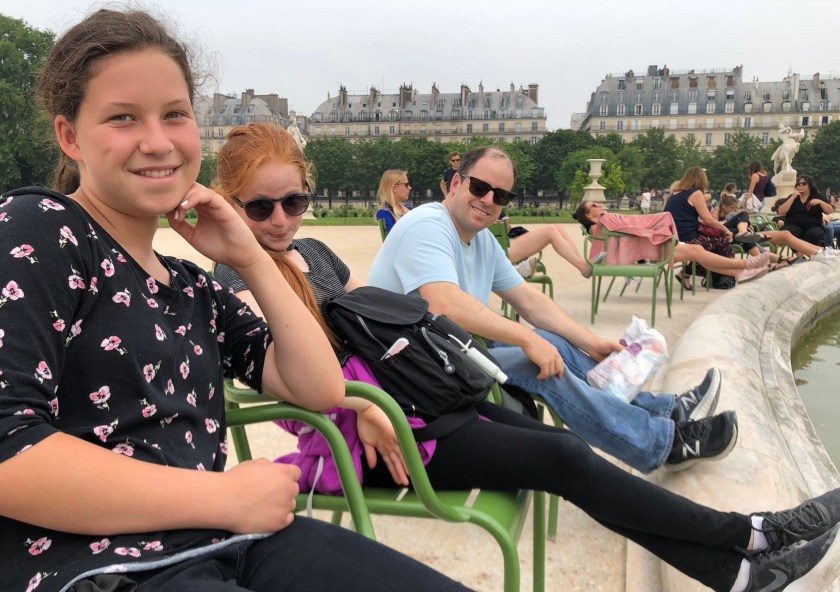
In Paris, we walked. And walked. And walked (in our well-designed footwear). And then we did what the French do, alongside tourists, in public parks—we propped our weary feet up on the edges of large fountains.
We did this at the Palais-Royal, the famous royal courtyard now populated with black-and-white columns, leafy trees, and a traditional round fountain basin encircled by metal chairs (this site was featured in Mission Impossible: Fallout, along with many other Paris locales).

Later, in the Tuileries garden, by an even larger round pool, where many tourists sat to take in the view of the Louvre, statuary, and patches of (off-limit to feet) very green grass.
The weather was humid and damp, not exactly hot, but sticky. (It got cooler and much wetter as our Paris stay went on.) Given our jetlag and the longer-than-usual walks often fighting against the traffic waves of cars or of other tourists, it felt good to relax à la française.
……….
Have you ever been shamed into silence by a museum guard? My family has.
“Un peu de silence, s’il vous plaît,” alternated with “quiet, please” (same thing, in English, and less poetic-sounding). This happened in two places: the Orangerie museum was the first. It’s a gem located in the Tuileries garden, not far from the Place de la Concorde. The museum houses remarkable wrap-around waterlily paintings by Monet, who wanted the space to be a sanctuary for “working men” (and women, one hopes) far from the hustle and bustle, a place of rest and peace. I sort of got the point of honoring his wishes in the Monet rooms.

But in other rooms, featuring riotous post-Impressionists, the same rule seems to hold—guards asked us to keep our voices down. And they did that too, with other patrons who had not yet learned to communicate with each other silently, in a special exhibit featuring the influence of Monet on contemporary New York artists.
Really? “New York modern art scene” and “silence” are a very unlikely combo, in my opinion.
The second spot of voice-shaming was the mausoleum in the basement of the Pantheon, where Voltaire, Rousseau, Victor Hugo, Alexandre Dumas, and many others are entombed and memorialized. I understand that it’s a solemn place.
But the female guard yelled “silence” and “quiet” through the labyrinth of echoing halls so vociferously that it was unsettling. Her voice created its own disturbance. (My younger daughter continued to invoke the hypocrisy of this approach long after.)
……….
Also in Paris, we learned that if you design a treasure hunt, it’s best not to offer as clues “water” and “a ledge.”
The otherwise-clever City in My Bag Paris treasure hunt overlooked this notion.
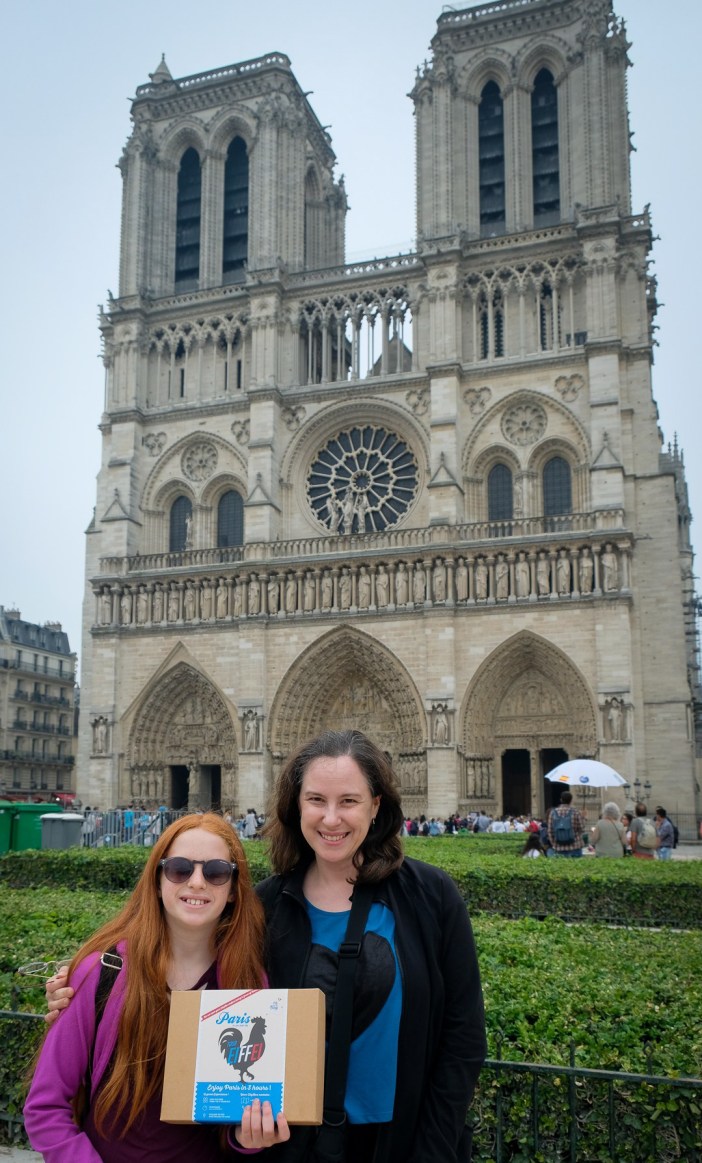
The experience as a whole was quite fun and we enjoyed the little gifts and treasures we could “unlock” along the way by solving location puzzles. However, one visual clue was a photo of water from above. In a city that 1) has a large river running right through it 2) has numerous (aforementioned) fountains everywhere and 3) is constantly being rained on and fairly frequently flooded, a picture of water does not really distinguish things much.
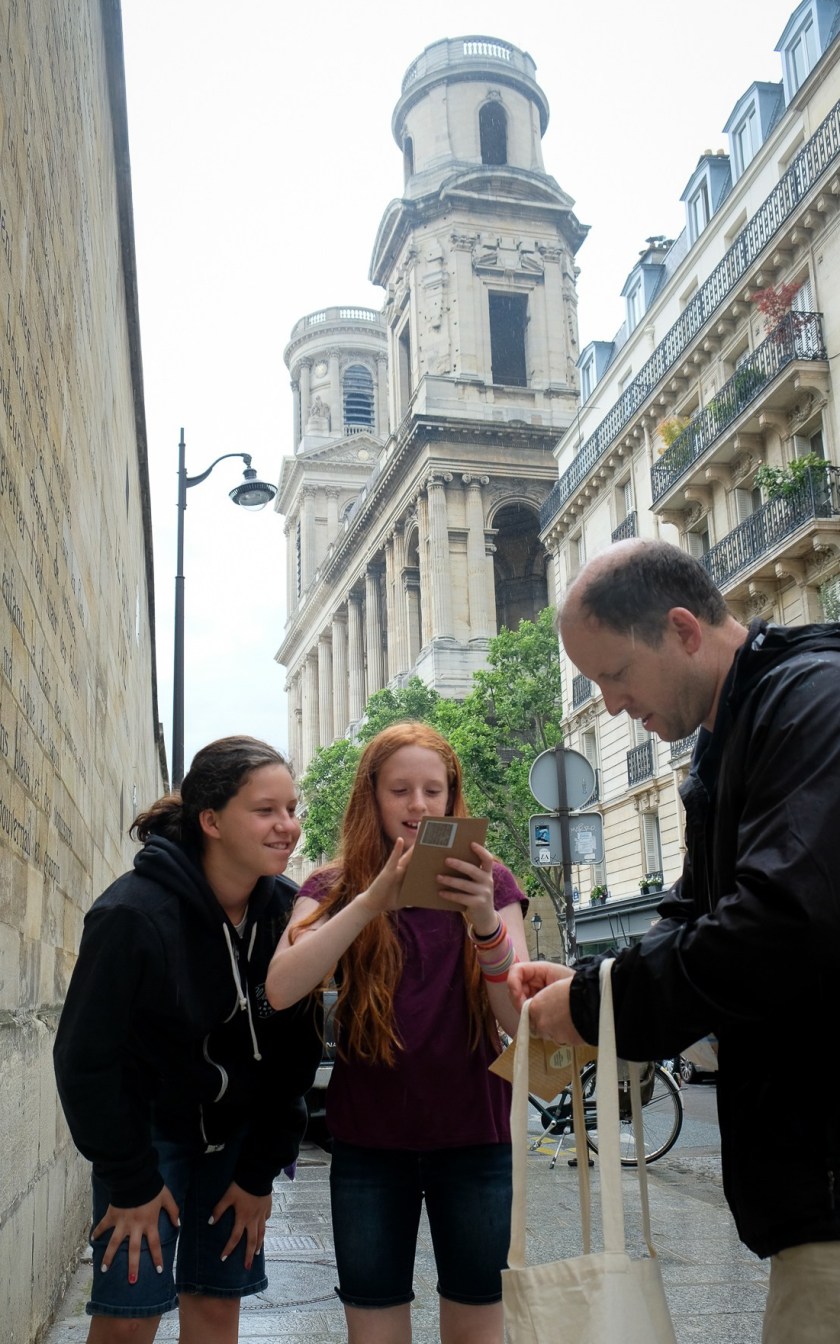
The ledge image, a different clue, was also kind of funny. It turns out that specific sizes of these items were used by the French as they converted to the metric system more than 200 years ago. Physical ledges, built into walls, told the citizens how long a meter was.
(Are we meant to picture people walking up to these ledges, taking their measurement, and then being forever informed of its size? Or did they have to go back over and over again to check their work?)
There’s one such ledge still in existence, and we think it’s somewhere near the Luxembourg gardens. The only problem was, what was happening near the gardens when we visited that day was an aggressive protest. A passerby told us it was striking railway workers, but with all the smoke bombs and torches and loud megaphones booming, as well as the armored swat teams ready to pounce, it was a bit hard to tell.

The rest of the week, my younger daughter kept pointing to random ledges and asking, “Is this the ledge? Is it this one?”
……….
We may have made it onto the B roll of a French film.
I can’t be sure. I really have no idea what they were recording with a professional-grade video camera when my kids and I visited Sainte Chapelle. We were admiring the gem-like windows, coated in brilliant red and blue stained glass. They surround you on all sides in the former royal chapel, an outstanding example of medieval artistry and modern cleaning/repair work.
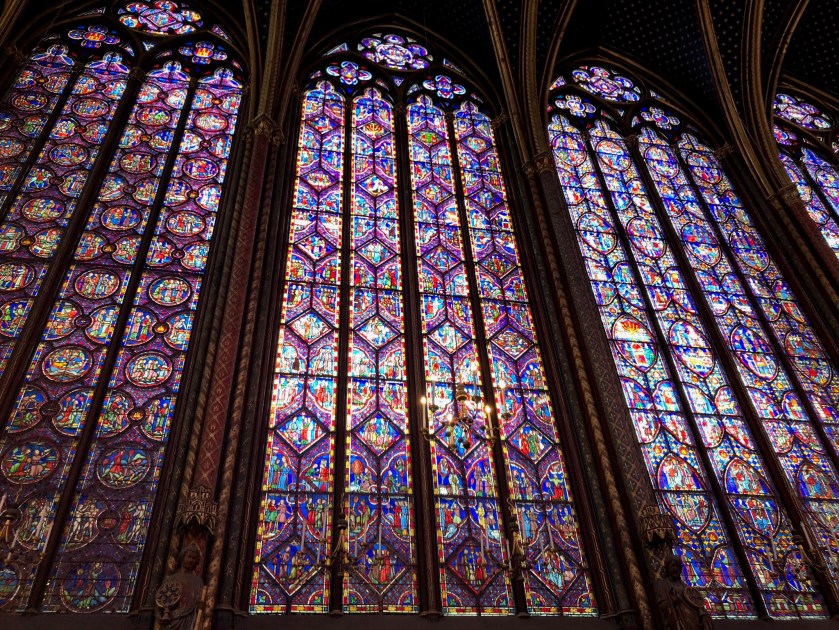
And then the woman in red appeared, and with her, an encourage. A large camera, a mic on a small boom, and some people hovering about trying to ensure a good shot.
At one point she ascended to the top of the pulpit area. And her camera person seemed to be seeking something else to shoot. Another person–the assistant director perhaps–pointed in our direction as we were carefully observing windows from the sidelines. The camera pointed our way for sometime. I could swear it moved with us.
I wanted to ask what they were filming, but they were intensely focused, and I didn’t find a good opportunity to interrupt their work.
So who knows? “Coming soon, on a screen far from you: Meredith and daughters touring Paris, hot on the heels of a mysterious woman in red…”
……….
Next time: Paris musings, part two. Please return for the sequel!
 MeredithInk